



Introduction
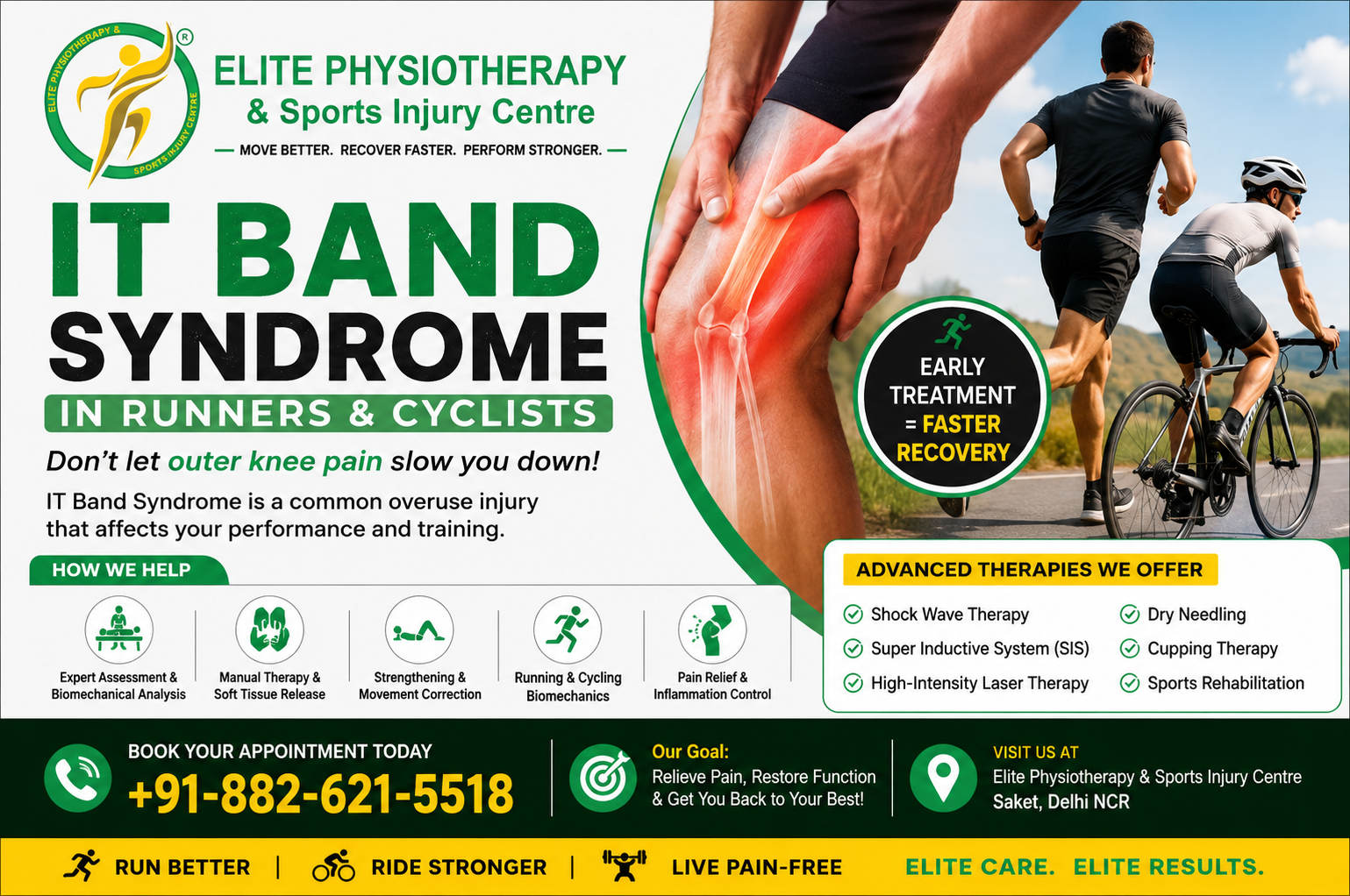
- Among the most well-liked endurance sports are cycling and running. However, the lower limbs may be severely stressed by repetitive training. Iliotibial Band Syndrome (ITBS) is a common overuse injury that affects both cyclists and runners. This disease is a prevalent cause of lateral knee pain and can drastically decrease athletic performance.
- IT Band Syndrome Physiotherapy plays a significant role in relieving discomfort, correcting biomechanical flaws, restoring movement, and enabling athletes return to sport safely. Early intervention is critical since untreated symptoms can become chronic and compromise training consistency.
- We frequently evaluate and treat runners, cyclists, triathletes, and recreational athletes with IT Band Syndrome at Elite Physiotherapy and Sports Injury Centre in Delhi NCR. To achieve the best possible recovery, our all-inclusive rehabilitation programs incorporate cutting-edge technologies, strength training, movement correction, and modern physiotherapy techniques.
- Whether you’re looking for physiotherapy Saket, physiotherapy Delhi, or physiotherapy near me, knowing what IT Band Syndrome is can help you get well.
What Is IT Band Syndrome?
- A thick, fibrous band of connective tissue that runs from the outside of the pelvis to the outside of the tibia is known as the iliotibial band (IT Band). The tensor fascia lata and gluteus maximus muscles join to it.
- The IT band assists:
- Maintain knee stability during running and walking.
- Help with hip movement
- Regulate the position of your lower limbs
- Boost the transmission of force when participating in sports
- The tissues surrounding the lateral femoral epicondyle are impacted by excessive friction, compression, or repetitive stress, which results in Iliotibial Band Syndrome (ITBS). The outside of the knee becomes painful as a result.
- The condition commonly develops in:
- Long-distance runners
- Cyclists
- Triathletes
- Hikers
- Military personnel
- Athletes participating in repetitive knee flexion activities
Understanding the Mechanism of Injury
- Previously, ITBS was considered a friction syndrome caused by the IT band repeatedly rubbing over the lateral femoral epicondyle.
- According to available data, compression of highly innervated tissues beneath the IT band may be a significant factor. Running and cycling cause repetitive knee bending, which puts more strain on these structures.
- Consequently:
- There is localized inflammation.
- Increased tissue irritation
- Pain happens while engaging in an activity.
- Performance gradually deteriorates
Epidemiology of IT Band Syndrome
- One of the most prevalent overuse injuries among endurance athletes is IT Band Syndrome.
- Studies reveal that:
- ITBS accounts for a significant percentage of running injuries.
- It is among the leading causes of lateral knee pain.
- Distance runners show higher incidence rates.
- Cyclists frequently develop symptoms due to repetitive pedaling mechanics.
- Athletes of all ages and skill levels may be impacted by the condition .
Causes of IT Band Syndrome
- Training Errors (Sudden mileage increase, Rapid increase in cycling volume, Excessive hill running, Inadequate recovery, High training frequency)
- Biomechanical Factors (Excessive hip adduction, Dynamic knee valgus, Excessive foot pronation, Internal femoral rotation, Poor pelvic control)
- Muscle Weakness (Gluteus medius weakness, Gluteus maximus weakness, Core instability, Hip external rotator weakness)
- Mobility Deficits (Tight tensor fascia lata, Tight hip flexors, Limited ankle mobility, Reduced hip extension)
- Cycling-Related Factors (Incorrect saddle height, Improper cleat alignment, Excessive training volume, Poor bike fit)
- Running-Related Factors (Downhill running, Cambered roads, Poor footwear, Abrupt training changes)
Risk Factors for IT Band Syndrome
- Intrinsic Risk Factors
- Weak hip abductors
- Poor neuromuscular control
- Reduced flexibility
- Previous injury history
- Leg length discrepancy
- Extrinsic Risk Factors
- Inappropriate footwear
- Training surface changes
- Excessive mileage
- Improper cycling setup
- Poor recovery habits
Clinical Features of IT Band Syndrome
- Sharp lateral knee pain
- Burning sensation during running
- Pain during cycling
- Symptoms worsening with distance
- Pain during downhill running
- Pain during long rides
- Pain while climbing stairs
- Pain during repeated knee bending
Why Early Physiotherapy Is Important
- Many athletes continue training despite symptoms. Unfortunately, this often worsens tissue irritation.
- Early IT Band Syndrome Physiotherapy can:
- Reduce pain quickly
- Correct biomechanical faults
- Prevent chronic symptoms
- Improve athletic performance
- Reduce recurrence risk
- Enable a safe return to sport
- At Elite Physiotherapy and Sports Injury Centre, Delhi NCR, we use evidence-based assessment methods and advanced rehabilitation protocols to identify the root cause of IT Band Syndrome rather than simply treating symptoms.
IT Band Syndrome Physiotherapy & Rehabilitation Guide
- Successful treatment requires more than pain relief. The primary goal is to identify and correct the underlying cause of the condition. At Elite Physiotherapy and Sports Injury Centre, Delhi NCR, we focus on restoring normal biomechanics, improving strength, optimizing movement patterns, and enabling a safe return to running and cycling.
Goals of IT Band Syndrome Physiotherapy
- Reduce pain and inflammation
- Improve tissue healing
- Restore normal movement
- Improve flexibility
- Correct biomechanical faults
- Enhance hip and core strength
- Improve running mechanics
- Improve cycling biomechanics
- Prevent recurrence
- Return athletes safely to sport
Pain Reduction and Tissue Recovery
- Initial Activity Modification
- Temporary reduction in running volume
- Shorter cycling sessions
- Avoidance of downhill running
- Avoidance of excessive hill training
- Reduced training intensity
- Pain Management Strategies
- Ice application
- Relative rest
- Manual therapy
- Therapeutic modalities
- Soft tissue techniques
- Manual Therapy Techniques
- Soft Tissue Mobilization
- Myofascial Release
- Joint Mobilization
- Stretching
- Tensor Fascia Lata Stretch
- Hip Flexor Stretch
- Gluteal Stretch
- Hamstring Stretch
- Calf Stretch
- Strengthening
- Hip Abductor Strengthening
- Hip Extensor Strengthening
- Core Stability Training
- Quadriceps Strengthening
- Neuromuscular Re-Education
- Single-leg balance
- Dynamic balance drills
- Step-down retraining
- Landing mechanics
- Agility exercises
- Running Retraining
- Cycling Biomechanics Correction
Advanced Physiotherapy Modalities for IT Band Syndrome
- Shock Wave Therapy
- Super Inductive System (SIS) Therapy
- High-Intensity Laser Therapy
- Dry Needling for IT Band Syndrome
- Cupping Therapy
Return-to-Sport Criteria
- Full knee range of motion
- Minimal or no pain
- Normal hip strength
- Good single-leg control
- Pain-free squatting
- Pain-free running or cycling drills
- Improved movement mechanics
Prevention of IT Band Syndrome
- Training Load Management
- Strength Training
- Mobility Maintenance
- Proper Footwear
- Bike Fit Optimization
Why Choose Elite Physiotherapy and Sports Injury Centre for IT Band Syndrome Physiotherapy?
- At Elite Physiotherapy and Sports Injury Centre, Delhi NCR, we specialize in the assessment and treatment of sports injuries affecting runners, cyclists, and endurance athletes.
- Our approach combines:
- Comprehensive biomechanical assessment
- Sports-specific physiotherapy
- Running gait analysis
- Advanced rehabilitation protocols
- Shock Wave Therapy
- Super Inductive System (SIS)
- High-Intensity Laser Therapy
- Dry Needling
- Cupping Therapy
- Return-to-sport testing
- Whether you are searching for physiotherapy near me, physiotherapy Delhi, or physiotherapy Saket, our team provides individualized care designed to restore performance and prevent future injuries.
Conclusion
- One of the most frequent overuse ailments among cyclists and runners is IT Band Syndrome. But pain management alone is not enough for a full recovery. Strength deficiencies, movement dysfunctions, training mistakes, and biomechanical flaws must all be addressed by athletes.
- An organized program of physical therapy for IT Band Syndrome can greatly speed up recovery, lower the chance of recurrence, and improve sports performance. Long-term success is still largely dependent on early diagnosis and evidence-based rehabilitation.
- With cutting-edge physiotherapy and sports rehabilitation techniques, we at Elite Physiotherapy and Sports Injury Centre, Delhi NCR, help athletes recover stronger, move more effectively, and perform at their peak.