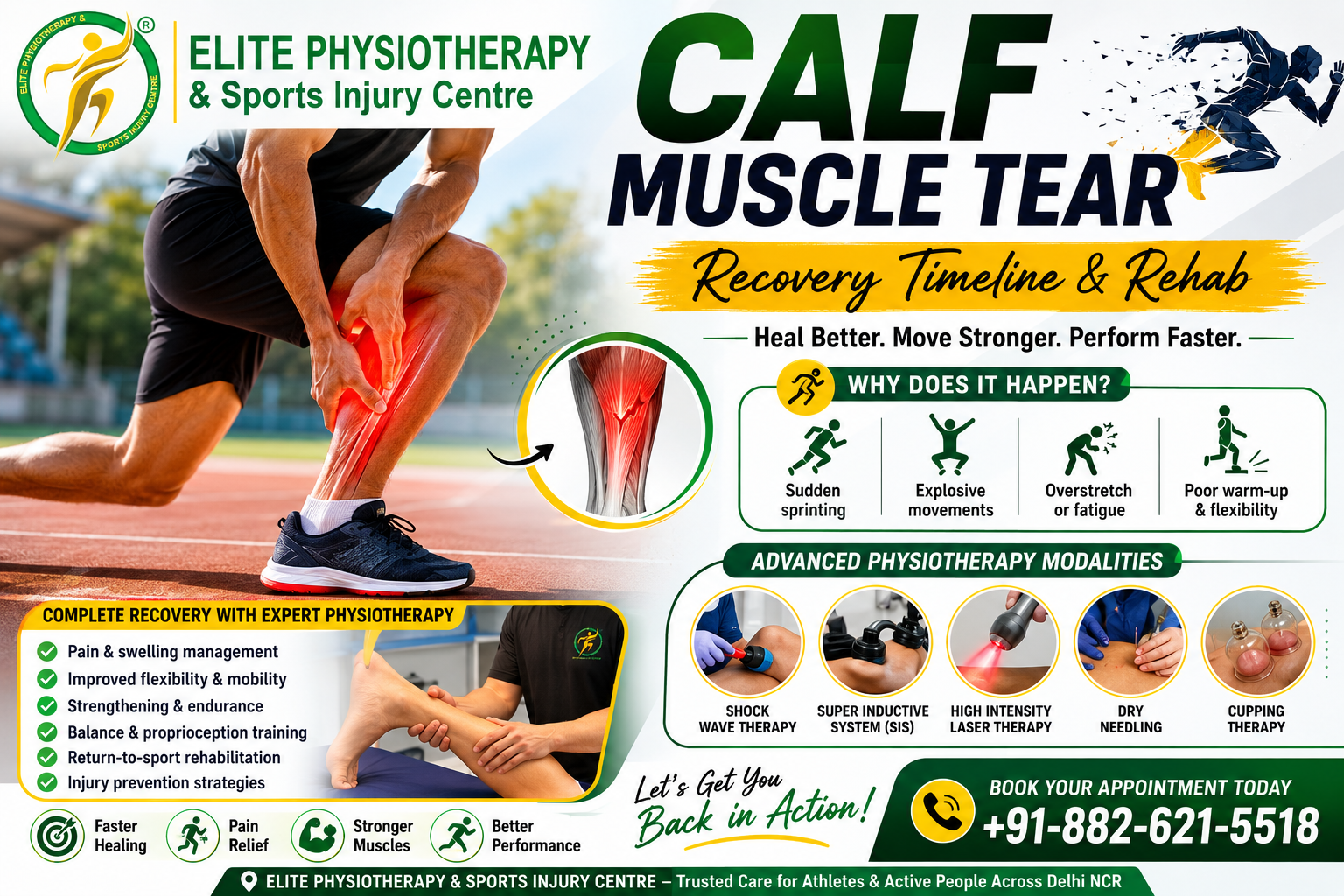
Calf Muscle Tear Recovery: Your Complete Guide to Healing and Returning to Sport
One of the most frequent injuries among runners, football players, badminton players, tennis players, cricket players, basketball players, and leisure exercise lovers is a calf muscle tear. It frequently happens when you suddenly accelerate, jump, run, or change direction quickly. Inadequate care can result in persistent discomfort, weakness, recurrent injuries, and a delayed return to sports, despite the fact that many individuals view it as a minor injury.
Recovery from a calf muscle tear depends on a number of variables. These include the extent of the injury, the damaged muscle, your general health, and the standard of your recovery. Restoring strength, flexibility, endurance, and athletic performance is largely dependent on early diagnosis and evidence-based physical treatment.
At Elite Physiotherapy and Sports Injury Centre, we think that each patient should receive a customized rehabilitation program instead of a standard training regimen. Our skilled sports physiotherapists integrate cutting-edge technology like Shock Wave Therapy, Super Inductive System (SIS), High-Intensity Laser Therapy, Dry Needling, and sports-specific rehabilitation with thorough clinical evaluation. This all-encompassing strategy lowers the chance of recurrence, speeds up recovery, restores muscular function, and lessens pain.
Our clinic is pleased to provide patients in Delhi NCR with cutting-edge sports injury care and evidence-based rehabilitation regimens, regardless of whether you looked for physiotherapy near me, physiotherapy Delhi, or physiotherapy Saket.
This book will teach you everything there is to know about recovering from a calf muscle tear, including its causes, symptoms, diagnosis, recovery period, and the significance of physiotherapy for safely resuming employment, exercise, and competitive sports.
Understanding the Calf Muscles
The rear of the lower leg contains the calf. It produces the energy required for pushing off during sports, walking, sprinting, jumping, and climbing stairs.
There are three key muscles in the calf:
Gastrocnemius
Soleus
Plantaris
What Is a Calf Muscle Tear?
When muscle fibers are overextended beyond their limit, a calf muscle tear results. Muscle fibers can rip completely or microscopically when the force is greater than what the muscle can withstand.
The injury may involve:
Gastrocnemius
Soleus
Plantaris
Junction between muscle and tendon
Tendon attachment
A few injured fibers or a whole rupture of the muscle can be the extent of the tear.
The majority of injuries happen during:
Sprinting
Jumping
Sudden acceleration
Sudden stopping
Lunging
Explosive direction changes
Before enduring excruciating agony, patients frequently report hearing or feeling a quick “pop.”
Why Does a Calf Muscle Tear Occur?
Sudden Explosive Movements
Forceful Push-Off
Sudden Change in Direction
Overstretching
Fatigue
Poor Warm-Up
Previous Injury
Risk Factors for Calf Muscle Tear Recovery
Increasing age
Poor flexibility
Muscle imbalance
Weak calf muscles
Previous calf injuries
Sudden increase in training
Inadequate recovery
Poor footwear
Limited ankle mobility
Poor running mechanics
Diabetes
Smoking
Obesity
Dehydration
Electrolyte imbalance
Who Is Most at Risk?
A calf muscle tear affects individuals of all activity levels.
However, the following groups are particularly vulnerable:
Sprinters
Marathon runners
Football players
Badminton players
Tennis players
Basketball players
Volleyball players
Kabaddi players
Cricket players
Hockey players
Dancers
CrossFit athletes
Gym enthusiasts
Military personnel
Middle-aged recreational athletes
Signs and Symptoms of a Calf Muscle Tear
Sudden sharp pain
Audible popping sensation
Feeling of being struck from behind
Difficulty walking
Limping
Swelling
Bruising
Muscle tightness
Tenderness
Pain while climbing stairs
Difficulty standing on toes
Reduced push-off strength
Muscle weakness
Night discomfort
Calf stiffness
Limited ankle movement
Pain during running
Difficulty jumping
Can You Prevent a Calf Muscle Tear?
Although not every injury is preventable, the risk decreases significantly with proper preparation.
Helpful strategies include:
Perform a dynamic warm-up before exercise.
Strengthen the calf muscles regularly.
Improve ankle mobility.
Increase training gradually.
Avoid sudden workload spikes.
Stay hydrated.
Wear appropriate footwear.
Include balance and proprioception exercises.
Recover adequately between training sessions.
Address minor calf tightness early through physiotherapy.
Physiotherapy Management for Calf Muscle Tear Recovery
Gentle Range of Motion Exercises
Isometric Strengthening of the calf muscle
Manual Therapy
Progressive Strengthening of the calf muscle
Neuromuscular Rehabilitation
Proprioception Training
Functional Rehabilitation
Plyometric Training
Running Rehabilitation
Agility Training
Sports-Specific Rehabilitation
Shock Wave Therapy
Super Inductive System (SIS)
High-Intensity Laser Therapy
Return-to-Sport Criteria
Full pain-free ankle range of motion.
No tenderness on palpation.
Normal walking pattern.
Equal calf strength compared with the opposite side.
Symmetrical heel raise performance.
Pain-free hopping.
Pain-free sprinting.
Successful sport-specific drills.
Good balance and proprioception.
Confidence during high-speed movements.
Common Mistakes That Delay Calf Muscle Tear Recovery
Returning to sports too early.
Ignoring mild pain.
Skipping strengthening exercises.
Stretching aggressively during the acute stage.
Relying only on painkillers.
Not completing rehabilitation.
Poor warm-up routines.
Sudden increases in training load.
Wearing inappropriate footwear.
Neglecting flexibility and balance training.
Why Choose Elite Physiotherapy and Sports Injury Centre?
At Elite Physiotherapy and Sports Injury Centre, we combine clinical expertise with advanced rehabilitation technologies to provide world-class care for sports injuries and musculoskeletal conditions across Delhi NCR.
Our comprehensive approach includes:
Detailed biomechanical assessment.
Personalized physiotherapy programs.
Sports-specific rehabilitation.
Shock Wave Therapy.
Super Inductive System (SIS).
High-Intensity Laser Therapy.
Dry Needling.
Cupping Therapy.
Functional movement retraining.
Return-to-play testing.
Injury prevention strategies.
Conclusion
A calf muscle tear should never be underestimated. While pain may improve quickly, complete Calf Muscle Tear Recovery requires progressive strengthening, neuromuscular retraining, and carefully planned return-to-sport rehabilitation. Early assessment and evidence-based physiotherapy reduce pain, promote tissue healing, and lower the risk of reinjury.
At Elite Physiotherapy and Sports Injury Centre, we are committed to providing personalized, research-informed rehabilitation for every patient. By combining expert clinical assessment, advanced physiotherapy technologies, and sport-specific exercise programs, we help patients throughout Delhi NCR recover stronger, move better, and return safely to their daily activities and athletic goals.
If you are experiencing calf pain or have recently sustained a calf muscle injury, do not delay treatment. Early intervention can make a significant difference in your recovery and long-term performance.