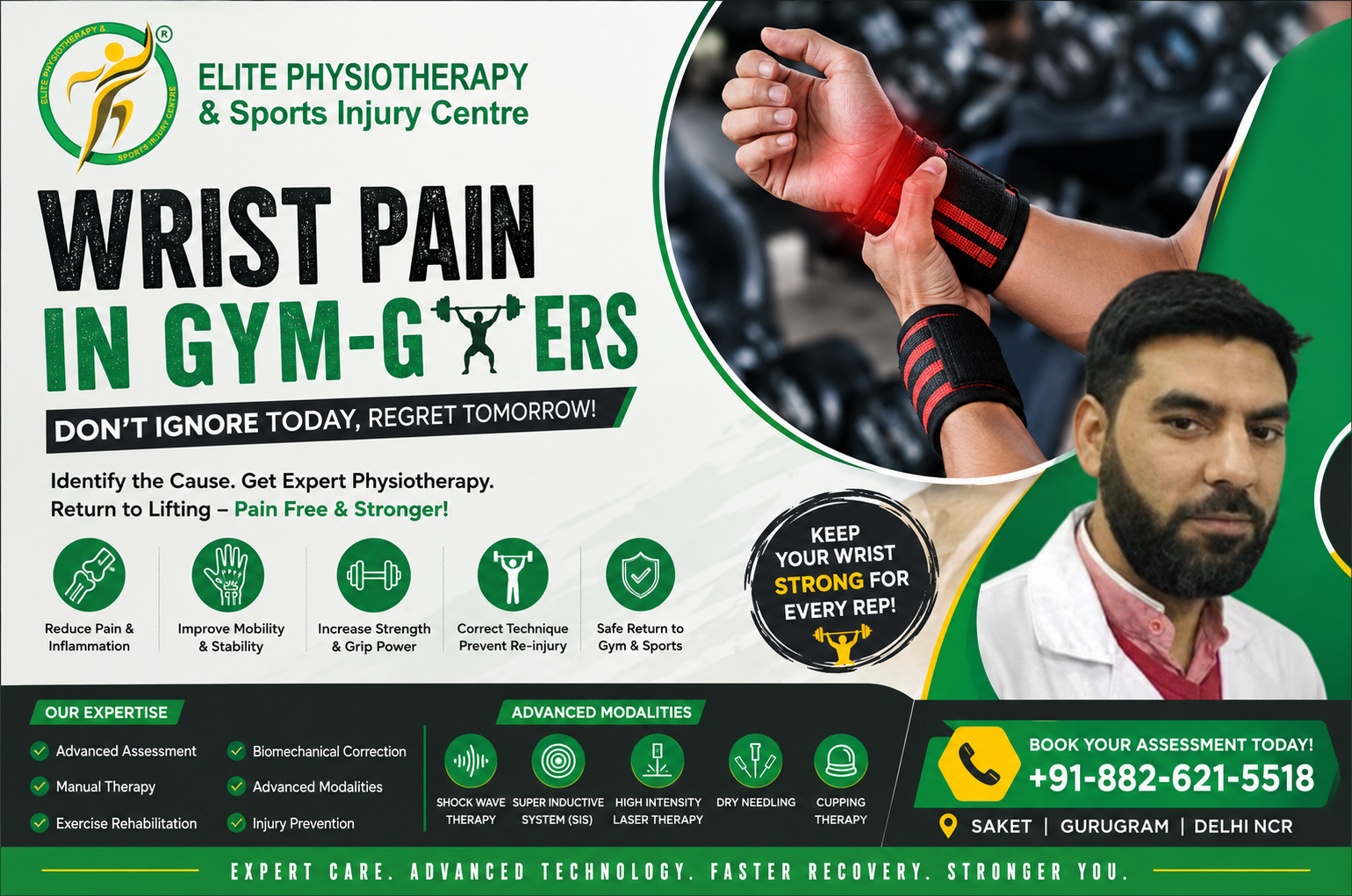
Fitness enthusiasts, recreational lifters, CrossFit athletes, bodybuilders, calisthenics athletes, and powerlifters are increasingly experiencing wrist pain. Ignoring wrist pain can eventually result in chronic pain, decreased grip strength, limited lifting capacity, and extended absences from training, despite the fact that many people view it as a minor problem.
In practically all upper limb workouts, the wrist is an essential component. It maintains stability and mobility while transferring force from the forearm to the hand. Exercises that put a lot of strain on the wrist joint include the bench press, push-ups, overhead press, front squats, deadlifts, cleans, snatches, dips, handstands, and burpees. As a result, tissue irritation and damage are frequently caused by repeated loading without sufficient mobility, strength, or recuperation.
For this reason, early diagnosis is crucial. In addition to relieving pain, appropriate physiotherapy finds the root cause and fixes improper movement patterns. This method enables people to safely resume training and helps prevent recurrent injuries.
Our team at Elite Physiotherapy and Sports Injury Centre offers thorough evaluation and evidence-based rehabilitation to athletes, fitness enthusiasts, and active people in Delhi NCR. Whether you’re looking for physiotherapy in Saket, Delhi, or nearby, our team’s goal is to assist you safely resume your chosen level of activity while recovering pain-free movement.
What is Wrist Pain in Gym-Goers?
For gym-goers, wrist pain is any discomfort, inflammation, or damage to the wrist’s bones, ligaments, tendons, cartilage, muscles, nerves, or joint capsule that occurs during or after resistance exercise.
Gym-related wrist discomfort frequently develops gradually, in contrast to abrupt acute injuries. Over weeks or months, small quantities of recurrent stress build up. Pain and decreased performance eventually come from the tissues’ inability to heal in between exercises.
The wrist is made up of several tiny joints that cooperate to give it stability and range of motion. These joints can withstand significant compressive, tensile, and rotational forces when lifting weights. Injury is more possible when these forces are greater than the tissue’s capacity.
Depending on the injured structure, pain may arise from:
Tendons
Ligaments
Joint capsule
Cartilage
Carpal bones
Nerves
Muscles
Synovial tissue
Why is the Wrist Vulnerable During Gym Training?
Instead of bearing a lot of weight, the wrist is made for precise movement. However, the wrist must be able to withstand repeated high loads in order to perform modern gym routines.
Several exercises significantly increase wrist stress, including:
Bench Press
Push-ups
Handstands
Clean and Jerk
Snatch
Front Squats
Overhead Press
Dips
Burpees
Heavy Deadlifts
Kettlebell Exercises
Olympic Weightlifting
Barbell Rows
Many individuals also train despite stiffness, fatigue, or previous injuries. As a result, tissues receive insufficient recovery, increasing the likelihood of overuse injuries.
Common Causes of Wrist Pain in Gym-Goers
Many conditions may cause wrist pain. Identifying the exact cause is the first step toward effective treatment.
Tendinopathy
Wrist Sprain
Triangular Fibrocartilage Complex (TFCC) Injury
De Quervain’s Tenosynovitis
Carpal Instability
Ganglion Cyst
Carpal Tunnel Syndrome
Stress Fractures
Osteoarthritis
Technique Errors
Clinical Features and Symptoms of Wrist Pain in Gym-Goers
Pain Characteristics
Patients may experience:
Sharp pain during lifting
Dull aching after workouts
Localized tenderness
Deep joint pain
Pain during push-ups
Pain while gripping weights
Pain during wrist extension
Pain during wrist flexion
Pain during twisting movements
Functional Limitations
Many gym-goers notice:
Reduced grip strength
Difficulty lifting heavy weights
Reduced push-up capacity
Poor hand endurance
Difficulty opening jars
Pain while typing
Pain while carrying objects
Fear of loading the wrist
Physiotherapy Management of Wrist Pain in Gym-Goers
Pain Management
Ice application during the acute stage.
Heat before mobility exercises when stiffness predominates.
Why Choose Elite Physiotherapy and Sports Injury Centre?
The evaluation and treatment of sports injuries, overuse disorders, and musculoskeletal issues associated to the gym are our areas of expertise at Elite Physiotherapy and Sports Injury Centre.
Instead of managing symptoms, our team offers individualized treatment plans based on thorough clinical evaluation.
Our approach includes:
Comprehensive physiotherapy assessment
Individualised rehabilitation programmes
Manual therapy
Progressive exercise therapy
Sports-specific rehabilitation
Biomechanical analysis
Movement correction
Return-to-gym planning
Injury prevention education
Advanced physiotherapy technology
Conclusion
Gym-goers’ wrist pain should never be disregarded. If treatment is not received, what starts out as minor discomfort might eventually develop into tendon injuries, ligament sprains, joint instability, or nerve compression. Fortunately, the majority of wrist disorders can be effectively managed without surgery with early diagnosis and skilled treatment.
Reducing pain, increasing strength, regaining mobility, fixing poor movement patterns, and gradually reintroducing the patient to gym activities should all be the main goals of a thorough rehabilitation program. Instead of just covering up symptoms, long-term success requires addressing the root cause.
To help patients heal quickly and reduce the chance of further injuries, our team at Elite Physiotherapy and Sports Injury Centre combines thorough clinical evaluation, evidence-based physiotherapy, cutting-edge rehabilitation equipment, and customized exercise regimens. In addition to reducing pain, our objectives include boosting performance, boosting self-esteem, and promoting long-term musculoskeletal health.