Skip to content
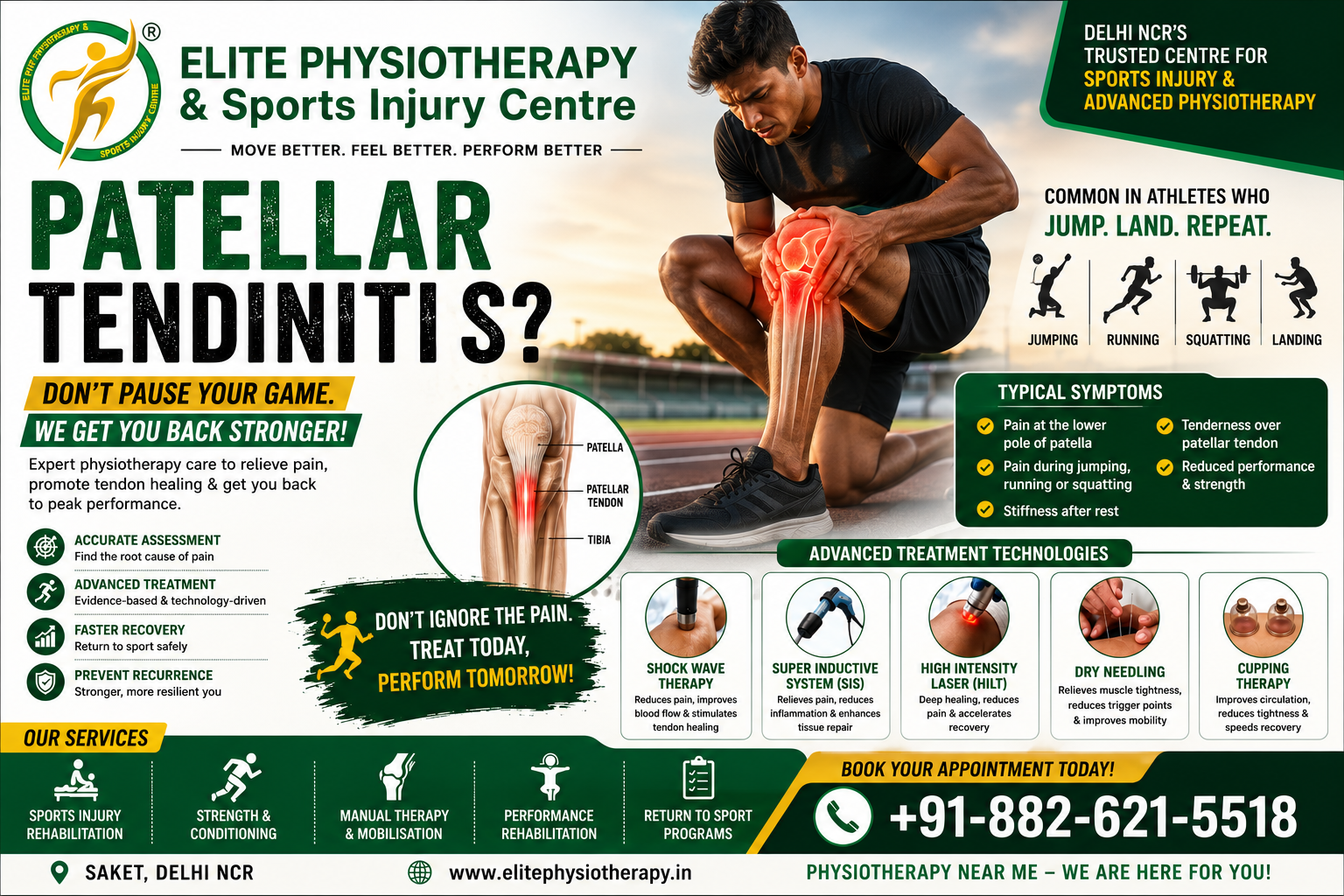
Patellar Tendinitis Physiotherapy: The Key to a Stronger Comeback
- Athletes continuously challenge their bodies to reach their maximum potential. However, the knee joint is severely stressed by frequent jumping, sprinting, landing, and abrupt direction changes. Because of this, a lot of athletes get patellar tendinitis, also referred to as Jumper’s Knee.
- We regularly treat athletes with this problem at Elite Physiotherapy and Sports Injury Centre, Delhi NCR. Athletes can safely recuperate and resume their best performance with the aid of our evidence-based rehabilitation programs.
- Patellar tendinitis physiotherapy is the best healing method. Early management enhances tendon repair, restores strength, lessens pain, and stops recurrence.
- Knowing this problem will help you seek prompt treatment, whether you are a fitness enthusiast, professional athlete, or leisure athlete looking for physiotherapy near me.
What is Patellar Tendinitis?
- An overuse injury that affects the patellar tendon is called patellar tendinitis. The patella, or kneecap, and tibia, or shinbone, are joined by this tendon.
- The patellar tendon plays a critical role during:
- Running
- Sprinting
- Jumping
- Landing
- Squatting
- Kicking
- The tendon sustains microscopic injury as a result of repeated stress. Degeneration occurs when the tendon is unable to recover sufficiently in between training sessions. Pain and decreased athletic performance follow.
- While the word “tendinitis” implies inflammation, tendon degradation is more common in chronic instances than active inflammation. As a result, tendon loading and tissue remodeling are the main goals of contemporary rehabilitation.
Understanding Patellar Tendinitis Physiotherapy
- Restoring tendon health while addressing the underlying causes of overload is the goal of patellar tendinitis physical therapy.
- The main goals of treatment are:
- Pain reduction
- Tendon healing
- Strength restoration
- Biomechanical correction
- Return-to-sport preparation
- Injury prevention
- We create customized rehabilitation plans at Elite Physiotherapy and Sports Injury Centre depending on the athlete’s sport, training requirements, mobility patterns, and recuperation objectives.
Who Commonly Develops Patellar Tendinitis?
- This condition is frequently seen in:
- Volleyball players
- Basketball players
- Football players
- Wrestlers
- Weightlifters
- Track and field athletes
- Badminton players
- Tennis players
- CrossFit athletes
- Athletes involved in explosive jumping and landing activities are particularly vulnerable.
Causes of Patellar Tendinitis
- Repetitive Jumping Activities
- Sudden Increase in Training Load
- Muscle Weakness
- Poor Landing Mechanics
- Reduced Flexibility
- Training Surface Issues
- Biomechanical Abnormalities
Clinical Features and Symptoms
- Anterior Knee Pain
- Pain During Jumping
- Pain During Squats
- Morning Stiffness
- Tenderness
- Reduced Performance
- Swelling
Patellar Tendinitis Physiotherapy Management
- For the majority of athletes, patellar tendinitis physiotherapy is still the best course of action.
- A methodical and systematic strategy is necessary for successful rehabilitation.
- Our programs at Elite Physiotherapy and Sports Injury Centre are customized based on:
- Sport demands
- Stage of injury
- Pain severity
- Performance goals
Pain Reduction and Load Management
- The initial goal is symptom control. However, complete rest is rarely recommended. Instead, we modify activities while maintaining fitness.
- Strategies include:
- Training load modification
- Activity adjustment
- Temporary reduction in jumping volume
- Pain monitoring
Isometric Strengthening
- Isometric Wall Sit
- Isometric Leg Press Hold
Progressive Tendon Loading
- Progressive loading stimulates tendon remodeling.
- Decline Squats
- Spanish Squats
- Leg Press Training
- Split Squats
Eccentric Strength Training
- Decline eccentric squats
- Eccentric leg press
- Slow step-down exercises
Heavy Slow Resistance Training
- Squats
- Leg press
- Hack squats
- Bulgarian split squats
Functional Rehabilitation
- Running drills
- Agility drills
- Cutting maneuvers
- Direction changes
- Deceleration drills
Plyometric Rehabilitation
- Jump squats
- Box jumps
- Bounding drills
- Single-leg hopping
Advanced Modalities
Return-to-Sport Criteria
- Full range of motion
- Adequate strength
- Pain-free hopping
- Symmetrical jump performance
- Good landing mechanics
- Sport-specific readiness
Prevention of Patellar Tendinitis
- Progress training gradually
- Improve landing mechanics
- Strengthen lower limbs
- Maintain flexibility
- Monitor workload
- Use proper footwear
- Address pain early
Why Choose Elite Physiotherapy and Sports Injury Centre?
- Athletes across Delhi NCR trust Elite Physiotherapy and Sports Injury Centre because of our sports-focused approach.
- We provide:
- Advanced physiotherapy assessment
- Individualized rehabilitation plans
- Shock Wave Therapy
- Super Inductive System (SIS)
- High Intensity Laser Therapy
- Dry Needling
- Sports performance rehabilitation
- Return-to-sport testing
Conclusion
- One of the most frequent overuse injuries among athletes is patellar tendinitis. However, with the right care, full recovery is achievable.
- Successful results depend on early diagnosis, gradual tendon loading, biomechanical rectification, and sophisticated physiotherapy techniques.
- To provide the best possible recovery and performance improvement, we at Elite Physiotherapy and Sports Injury Centre, Delhi NCR, integrate cutting-edge technologies with evidence-based rehabilitation.
- Athletes can regain their strength, speed, and resilience with customized Patellar Tendinitis Physiotherapy.