IT Band Pain Slowing You Down?

Introduction

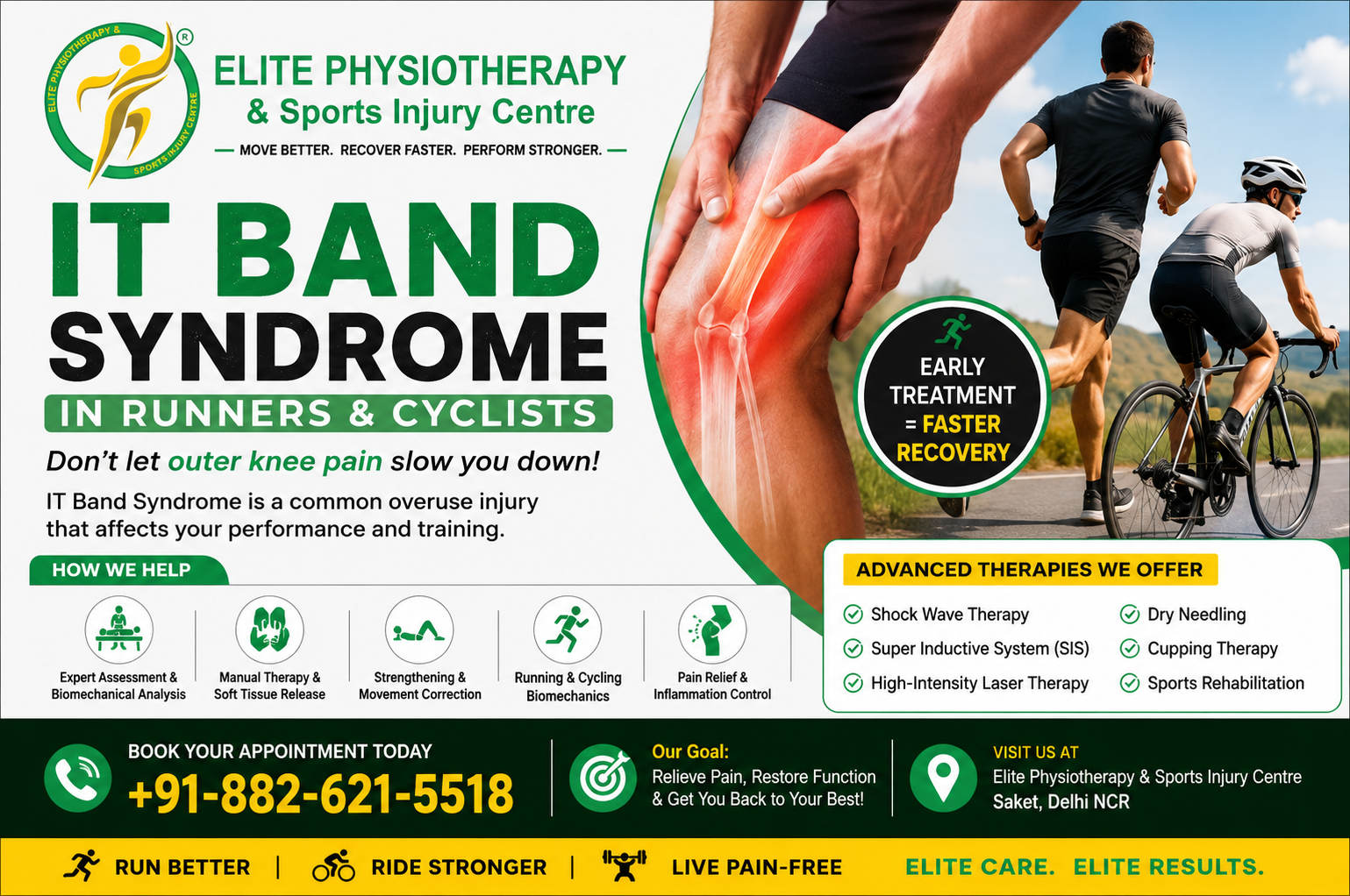
  • Among the most well-liked endurance sports are cycling and running. However, the lower limbs may be severely stressed by repetitive training. Iliotibial Band Syndrome (ITBS) is a common overuse injury that affects both cyclists and runners. This disease is a prevalent cause of lateral knee pain and can drastically decrease athletic performance.
  • IT Band Syndrome Physiotherapy plays a significant role in relieving discomfort, correcting biomechanical flaws, restoring movement, and enabling athletes return to sport safely. Early intervention is critical since untreated symptoms can become chronic and compromise training consistency.
  • We frequently evaluate and treat runners, cyclists, triathletes, and recreational athletes with IT Band Syndrome at Elite Physiotherapy and Sports Injury Centre in Delhi NCR. To achieve the best possible recovery, our all-inclusive rehabilitation programs incorporate cutting-edge technologies, strength training, movement correction, and modern physiotherapy techniques.
  • Whether you’re looking for physiotherapy Saket, physiotherapy Delhi, or physiotherapy near me, knowing what IT Band Syndrome is can help you get well.

What Is IT Band Syndrome?

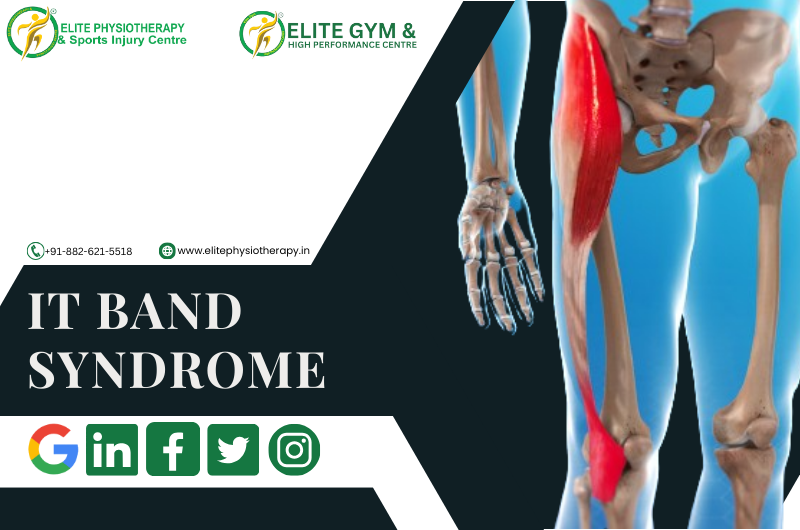
  • A thick, fibrous band of connective tissue that runs from the outside of the pelvis to the outside of the tibia is known as the iliotibial band (IT Band). The tensor fascia lata and gluteus maximus muscles join to it.
  • The IT band assists:
    • Maintain knee stability during running and walking.
    • Help with hip movement
    • Regulate the position of your lower limbs
    • Boost the transmission of force when participating in sports
  • The tissues surrounding the lateral femoral epicondyle are impacted by excessive friction, compression, or repetitive stress, which results in Iliotibial Band Syndrome (ITBS). The outside of the knee becomes painful as a result.
  • The condition commonly develops in:
    • Long-distance runners
    • Cyclists
    • Triathletes
    • Hikers
    • Military personnel
    • Athletes participating in repetitive knee flexion activities

Understanding the Mechanism of Injury

  • Previously, ITBS was considered a friction syndrome caused by the IT band repeatedly rubbing over the lateral femoral epicondyle.
  • According to available data, compression of highly innervated tissues beneath the IT band may be a significant factor. Running and cycling cause repetitive knee bending, which puts more strain on these structures.
  • Consequently:
    • There is localized inflammation.
    • Increased tissue irritation
    • Pain happens while engaging in an activity.
    • Performance gradually deteriorates

Epidemiology of IT Band Syndrome

  • One of the most prevalent overuse injuries among endurance athletes is IT Band Syndrome.
  • Studies reveal that:
    • ITBS accounts for a significant percentage of running injuries.
    • It is among the leading causes of lateral knee pain.
    • Distance runners show higher incidence rates.
    • Cyclists frequently develop symptoms due to repetitive pedaling mechanics.
  • Athletes of all ages and skill levels may be impacted by the condition .

Causes of IT Band Syndrome

  1. Training Errors (Sudden mileage increase, Rapid increase in cycling volume, Excessive hill running, Inadequate recovery, High training frequency)
  2. Biomechanical Factors (Excessive hip adduction, Dynamic knee valgus, Excessive foot pronation, Internal femoral rotation, Poor pelvic control)
  3. Muscle Weakness (Gluteus medius weakness, Gluteus maximus weakness, Core instability, Hip external rotator weakness)
  4. Mobility Deficits (Tight tensor fascia lata, Tight hip flexors, Limited ankle mobility, Reduced hip extension)
  5. Cycling-Related Factors (Incorrect saddle height, Improper cleat alignment, Excessive training volume, Poor bike fit)
  6. Running-Related Factors (Downhill running, Cambered roads, Poor footwear, Abrupt training changes)

Risk Factors for IT Band Syndrome

  • Intrinsic Risk Factors
    • Weak hip abductors
    • Poor neuromuscular control
    • Reduced flexibility
    • Previous injury history
    • Leg length discrepancy
  • Extrinsic Risk Factors
    • Inappropriate footwear
    • Training surface changes
    • Excessive mileage
    • Improper cycling setup
    • Poor recovery habits

Clinical Features of IT Band Syndrome

  • Sharp lateral knee pain
  • Burning sensation during running
  • Pain during cycling
  • Symptoms worsening with distance
  • Pain during downhill running
  • Pain during long rides
  • Pain while climbing stairs
  • Pain during repeated knee bending

Why Early Physiotherapy Is Important

  • Many athletes continue training despite symptoms. Unfortunately, this often worsens tissue irritation.
  • Early IT Band Syndrome Physiotherapy can:
    • Reduce pain quickly
    • Correct biomechanical faults
    • Prevent chronic symptoms
    • Improve athletic performance
    • Reduce recurrence risk
    • Enable a safe return to sport
  • At Elite Physiotherapy and Sports Injury Centre, Delhi NCR, we use evidence-based assessment methods and advanced rehabilitation protocols to identify the root cause of IT Band Syndrome rather than simply treating symptoms.

IT Band Syndrome Physiotherapy & Rehabilitation Guide

  • Successful treatment requires more than pain relief. The primary goal is to identify and correct the underlying cause of the condition. At Elite Physiotherapy and Sports Injury Centre, Delhi NCR, we focus on restoring normal biomechanics, improving strength, optimizing movement patterns, and enabling a safe return to running and cycling.

Goals of IT Band Syndrome Physiotherapy

  • Reduce pain and inflammation
  • Improve tissue healing
  • Restore normal movement
  • Improve flexibility
  • Correct biomechanical faults
  • Enhance hip and core strength
  • Improve running mechanics
  • Improve cycling biomechanics
  • Prevent recurrence
  • Return athletes safely to sport

Pain Reduction and Tissue Recovery

  • Initial Activity Modification
  • Temporary reduction in running volume
  • Shorter cycling sessions
  • Avoidance of downhill running
  • Avoidance of excessive hill training
  • Reduced training intensity
  • Pain Management Strategies
    • Ice application
    • Relative rest
    • Manual therapy
    • Therapeutic modalities
    • Soft tissue techniques
  • Manual Therapy Techniques
    • Soft Tissue Mobilization
    • Myofascial Release
    • Joint Mobilization
  • Stretching
    • Tensor Fascia Lata Stretch
    • Hip Flexor Stretch
    • Gluteal Stretch
    • Hamstring Stretch
    • Calf Stretch
  • Strengthening
    • Hip Abductor Strengthening
    • Hip Extensor Strengthening
    • Core Stability Training
    • Quadriceps Strengthening
  • Neuromuscular Re-Education
    • Single-leg balance
    • Dynamic balance drills
    • Step-down retraining
    • Landing mechanics
    • Agility exercises
  • Running Retraining
  • Cycling Biomechanics Correction

Advanced Physiotherapy Modalities for IT Band Syndrome

  • Shock Wave Therapy
  • Super Inductive System (SIS) Therapy
  • High-Intensity Laser Therapy
  • Dry Needling for IT Band Syndrome
  • Cupping Therapy

Return-to-Sport Criteria

  1. Full knee range of motion
  2. Minimal or no pain
  3. Normal hip strength
  4. Good single-leg control
  5. Pain-free squatting
  6. Pain-free running or cycling drills
  7. Improved movement mechanics

Prevention of IT Band Syndrome

  • Training Load Management
  • Strength Training
  • Mobility Maintenance
  • Proper Footwear
  • Bike Fit Optimization

Why Choose Elite Physiotherapy and Sports Injury Centre for IT Band Syndrome Physiotherapy?

  • At Elite Physiotherapy and Sports Injury Centre, Delhi NCR, we specialize in the assessment and treatment of sports injuries affecting runners, cyclists, and endurance athletes.
  • Our approach combines:
    • Comprehensive biomechanical assessment
    • Sports-specific physiotherapy
    • Running gait analysis
    • Advanced rehabilitation protocols
    • Shock Wave Therapy
    • Super Inductive System (SIS)
    • High-Intensity Laser Therapy
    • Dry Needling
    • Cupping Therapy
    • Return-to-sport testing
  • Whether you are searching for physiotherapy near me, physiotherapy Delhi, or physiotherapy Saket, our team provides individualized care designed to restore performance and prevent future injuries.

Conclusion

  • One of the most frequent overuse ailments among cyclists and runners is IT Band Syndrome. But pain management alone is not enough for a full recovery. Strength deficiencies, movement dysfunctions, training mistakes, and biomechanical flaws must all be addressed by athletes.
  • An organized program of physical therapy for IT Band Syndrome can greatly speed up recovery, lower the chance of recurrence, and improve sports performance. Long-term success is still largely dependent on early diagnosis and evidence-based rehabilitation.
  • With cutting-edge physiotherapy and sports rehabilitation techniques, we at Elite Physiotherapy and Sports Injury Centre, Delhi NCR, help athletes recover stronger, move more effectively, and perform at their peak.

IT Band Syndrome : Lateral Knee Pain

Introduction

Iliotibial Band Syndrome (ITBS) is a prevalent overuse injury among athletes, particularly runners and cyclists. It commonly impairs performance and day-to-day activities by presenting as pain on the outside of the knee. Our expertise in identifying and treating ITBS at Elite Physiotherapy and Sports Injury Centre guarantees a quick and efficient return to activities. ​

Understanding the Iliotibial Band

The iliotibial (IT) band is a thick band of fascia extending from the hip’s lateral aspect down to the outer part of the knee. It plays a crucial role in stabilizing the knee during movement. When this band becomes tight or inflamed, it can lead to ITBS.​

Causes of IT Band Syndrome

Iliotibial Band Syndrome develops as a result of several factors: ​

  • Training Errors: The IT band may be strained by abrupt increases in training time or intensity, insufficient rest, and inadequate warm-up exercises. ​
  • Biomechanical Problems: Poor running mechanics, excessive foot pronation, and variations in leg length can all put more strain on the IT band. ​
  • Muscle Imbalances: Improper leg alignment can exacerbate IT band friction if there is weakness in the hip abductors, gluteal muscles, and core. ​

Repetitive knee flexion and extension usually result in ITBS because the IT band rubs against the lateral femoral epicondyle. Particularly when running or cycling, this friction causes irritation and inflammation. ​

Signs and Symptoms

Individuals with Iliotibial Band Syndrome may experience:​

  • Lateral Knee Pain: A searing or sharp pain on the outside of the knee that usually gets worse when you move.​
  • Tenderness: Sensitivity, especially close to the knee, along the IT band.​
  • Swelling: Localized swelling on the outside of the knee.​
  • Pain with Movement: Uncomfortable when doing things like climbing stairs or sitting for extended periods of time.​
  • Audible Sounds: During movement, the outside of the knee may snap or pop.​

Diagnostic Approach at Elite Physiotherapy

At Elite Physiotherapy and Sports Injury Centre, we employ a comprehensive assessment to diagnose ITBS:​

Physical Examination

  • Posture and Gait Analysis: Analyzing alignment and movement patterns to spot irregularities.​
  • Palpation: Evaluating the IT band’s softness.​
  • Range of Motion Tests: Assessing ankle, knee, and hip joint mobility and flexibility.​

Functional Assessment

  • Activity Simulation: Keeping an eye on mechanics when cycling or jogging in order to spot problematic trends.​
  • Strength testing: Involves determining how strong the quadriceps, gluteal muscles, and hip abductors are.​

Special Physiotherapy Tests

Physiotherapy Management at Elite Physiotherapy

Our tailored approach focuses on alleviating symptoms, addressing underlying causes, and preventing recurrence:​

Pain Management

  • Cryotherapy: Using ice packs to decrease inflammation and numb pain.​
  • Electrotherapy: Pain management through the use of techniques such as transcutaneous electrical nerve stimulation (TENS).​

Manual Therapy

  • Soft Tissue Mobilization: To relieve tension, deep tissue massage is used to target the gluteal muscles, tensor fasciae latae (TFL), and IT band.​
  • Myofascial Release: Resolving trigger points in the IT band and surrounding muscles.​
  • Joint Mobilization: Improving hip, knee, and ankle joint alignment and mobility.​

Stretching Activities

Improving flexibility in the IT band and surrounding muscles:​

  • Standing IT Band Stretch: Lean sideways and cross one leg behind the other to perform a standing IT band stretch that stretches the outer thigh.​
  • Seated Glute Stretch: Stretching the glutes while seated involves placing one ankle over the other knee and applying light pressure to the elevated knee.​

Strengthening Exercises

Building strength to correct muscle imbalances:​

  • Clamshells: Bend your knees while lying on your side, then open and close your top knee in a clamshell motion.​
  • Lateral Band Walks: Using a resistance band over your ankles, perform lateral band walks while keeping the band taut.​
  • Single-Leg Deadlifts: Lower your torso while extending the other leg behind you while maintaining balance on one leg and hunching at the hips.​
  • Step-Ups: Focus on controlled motions as you step onto a platform with one leg and raise the other leg.​

Biomechanical Correction

  • Gait Retraining: Using techniques to improve walking or running patterns is known as gait retraining.​
  • Footwear Assessment: Making recommendations for suitable footwear or orthotics to correct foot mechanics.​

Advanced Modalities

Incorporating state-of-the-art technologies to enhance recovery:​

  • Shock Wave Therapy: Encourages the IT band to recover by using acoustic waves.​
  • The Super Inductive System: uses electromagnetic fields to provide pain alleviation and deep tissue repair.​
  • High-Intensity Class 4 Laser Therapy: Uses concentrated light energy to speed up tissue repair and lessen inflammation.​
  • Hydrotherapy: Lessens joint impact while enabling movement-based recovery
  • Taping: Using kinesiology taping to relieve tension and promote biomechanics

Why Choose Elite Physiotherapy for IT Band Syndrome?

We offer a holistic and science-backed approach to musculoskeletal injuries at Elite Physiotherapy and Sports Injury Center. Our combination of clinical expertise, world-class facilities, and individualized attention ensures unmatched outcomes for every patient.

We are proud to provide:

  • One-on-one physiotherapy sessions
  • Customized exercise prescriptions
  • High-end electro-modalities and manual therapy techniques
  • Sports-specific rehabilitation programs
  • Guided return-to-sport protocols

Book Your Appointment Today

Don’t let lateral knee pain limit your lifestyle or sports performance. Early intervention ensures faster recovery and prevents long-term issues.

Visit our website at elitephysiotherapy or call us to book a consultation with our expert physiotherapists.

Let us help you move pain-free, perform better, and prevent injury -the Elite way.

IT Band Syndrome and Its Management

IT Band Syndrome, also known as Iliotibial Band Syndrome, is a common overuse injury that affects athletes, especially runners, bikers, and those who engage in repetitive lower-limb exercises. We at Elite Physiotherapy and Sports Injury Centre are experts at identifying and successfully treating this illness, enabling athletes to resume their best performance.

Causes of IT Band Syndrome

The iliotibial (IT) band is a thick band of connective tissue extending from the hip to the shinbone along the outside of the thigh is called the iliotibial (IT) band. When this band irritates or inflames as a result of excessive contact against the lateral femoral condyle, it can lead to IT Band Syndrome. Typical reasons include:

  • Overuse: Running, cycling, and rowing are examples of repetitive knee flexion and extension exercises.
  • Biomechanical imbalances: Include differences in leg length, weak hip abductors, or poor foot arch mechanics.
  • Inappropriate training methods: Include abrupt increases in mileage, effort, or footwear.
  • Tight IT Band or Surrounding Muscles: The glutes, quadriceps, or hamstrings are less flexible when the IT band or surrounding muscles are tight.

Mechanism of Injury

IT Band Syndrome can result from both on-field and off-field activity. For example, because of insufficient hip stability, a sprinter pushing off quickly during a race may overload their IT band, resulting in microtrauma and ultimately inflammation. Similarly, the IT band may rub too much against the femur if you cycle repeatedly while sitting at an incorrect height.

Signs, Symptoms, and Clinical Features

People with IT Band Syndrome frequently exhibit the following symptoms and indicators:

  • Running or cycling exacerbates lateral knee pain, which is usually acute or burning.
  • Sensitivity along the IT band, especially in the area next to the knee.
  • Localized inflammation or swelling on the knee’s lateral side.
  • Discomfort when sitting for extended periods of time or when going downstairs.
  • When moving, there is an audible snapping or popping sound on the outside of the knee.

Diagnostic Methods at Elite Physiotherapy

To identify the underlying cause of IT Band Syndrome, our diagnostic method combines specific physiotherapy tests with thorough physical and functional evaluations:

1. Physical Assessment:

  • Examination of posture and gait.
  • Palpation along the IT band to detect discomfort.
  • Assessing the hip, knee, and ankle joints’ range of motion and flexibility.

2. Functional Assessment:

  • Evaluation of the mechanics of cycling or running.
  • Hip abductors, glutes, and quadriceps strength tests.

3. Special Physiotherapy Tests:

  • Ober’s Test: Assesses the tightness of the IT band.
  • Noble Compression Test: When knee flexion and extension are performed, the Noble Compression Test detects discomfort or crepitus at the lateral femoral condyle.
  • Modified Thomas Test: The modified Thomas test evaluates hip flexor and IT band flexibility.

Physiotherapy Management at Elite Physiotherapy

We at Elite Physiotherapy and Sports Injury Centre provide a thorough physiotherapy technique that is customized to meet the needs of every patient. In addition to treating underlying biomechanical abnormalities and symptom relief, we also aim to avoid recurrence. This is how we go about it:

1. Pain Management:

  • Cryotherapy: Applying ice to alleviate pain and inflammation is known as cryotherapy.
  • Electrotherapy: Techniques such as TENS or ultrasound that aid in pain management and recovery.

2. Manual Therapy:

  • Soft Tissue Mobilization: Deep tissue massage to relieve tensor fasciae latae (TFL), glutes, and IT band tension.
  • Myofascial Release: Targeting trigger points along the IT band and surrounding muscles is known as myofascial release.
  • Joint Mobilization: Enhancing the ankle, knee, and hip joints’ alignment and range of motion is known as joint mobilization.

3. Stretching Exercises:

  • Stretches that increase the flexibility of the quadriceps, hamstrings, glutes, and IT band can be both dynamic and static.
  • Examples include: The standing hip flexor stretch, pigeon position, and the cross-body IT band stretch.

4. Strengthening Exercises:

Targeted workouts to improve stability and address muscular imbalances:

  • Clamshells: To strengthen the gluteus medius, use clamshells.
  • Lateral Band Walks: Strengthens the hip abductors with lateral band walks.
  • Single-Leg Deadlifts: Improves synergy between the glutes and hamstrings.
  • Step-ups: Increase the general strength and stability of the lower limbs.

5. Biomechanical Correction:

  • Postural corrections and gait retraining are used to maximize movement patterns.
  • Suggestions for appropriate footwear or, if required, orthotics.

6. Return-to-Sport Training:

  • Utilizing sport-specific drills to gradually resume running, cycling, or other sports.
  • Exercises involving plyometry and agility can improve performance while lowering the risk of injury.

Example: IT Band Syndrome in a Cyclist

Think of a professional cyclist who gets lateral knee pain when training hard. We would evaluate their pedaling mechanics and bike fit at Elite Physiotherapy. In addition to physiotherapy treatments, we would address concerns such as incorrect saddle height or cleat position. The cyclist can resume training pain-free and more effectively with the use of focused manual treatment, stretching, and strengthening exercises.

Why Choose Elite Physiotherapy?

At Elite Physiotherapy and Sports Injury Centre, we combine clinical expertise with state-of-the-art facilities to deliver personalized care. Whether you’re a professional athlete or a recreational enthusiast, our evidence-based approach ensures effective recovery and optimal performance. Visit us to experience the best in sports injury management!