



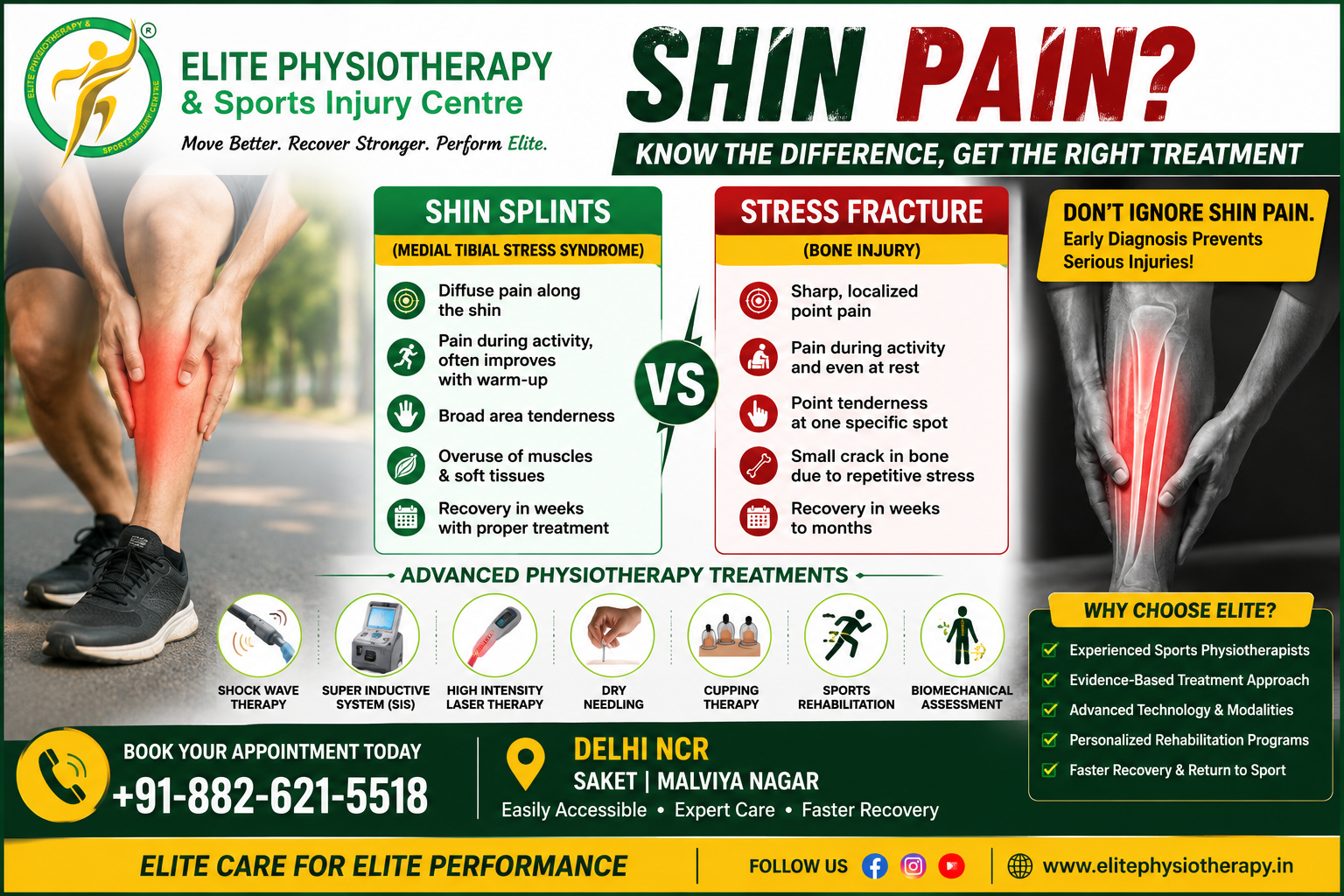
Pain in Your Shin? Know the Difference Before It Gets Worse
- Shin bone discomfort is common among athletes, runners, and fitness lovers. But not every shin pain is caused by the same thing. Shin splints and stress fractures are two prevalent conditions that cause shin pain. Despite having similar symptoms, the two disorders differ greatly in terms of severity, diagnosis, and course of treatment.
- Comprehending the distinction between Shin Splints and Stress Fractures is crucial for appropriate recuperation and harm avoidance. Prolonged pain, diminished performance, and even consequences can be avoided with an early diagnosis.
- We regularly evaluate and treat athletes with lower limb injuries at Elite Physiotherapy and Sports Injury Centre in Delhi NCR. To assist patients in safely returning to their activities, our evidence-based approach integrates advanced physiotherapy, sports rehabilitation, comprehensive assessment, and cutting-edge modalities.
- This guide will help you comprehend the main distinctions between stress fractures and shin splints, as well as the importance of physiotherapy in healing, whether you’re looking for physiotherapy in Saket, Delhi, or your area.
Understanding Shin Splints vs Stress Fracture
- Both disorders are common in athletes who participate in running and jumping sports and impact the lower leg. The underlying tissue damage is distinct, though.
What Are Shin Splints?
- Medial Tibial Stress Syndrome (MTSS) is the medical term for shin splints. The inner border of the tibia, also referred to as the shin bone, is where they produce pain.
- Repetitive stress irritates the muscles, tendons, and periosteum around the tibia, leading to the development of the disease.
- Instead of structural bone damage, shin splints typically indicate an overuse issue.
What Is a Stress Fracture?
- A stress fracture is a tiny crack in the bone brought on by repeated loads that are greater than the bone’s capacity to heal itself.
- Stress fractures entail actual bone injury, in contrast to shin splints.
- Stress fractures commonly affect:
- Tibia
- Fibula
- Metatarsals
- Femur
- Pelvis
- Shin splints can develop into stress fractures in athletes who continue training in spite of ongoing pain.
| FEATURE | SHIN SPLINTS | STRESS FRACTURE |
| Tissue Involved | Muscle and periosteal irritation | Bone crack |
| Pain Area | Diffuse and broad | Localized and pinpoint |
| Pain During Activity | Often improves after warming up | Worsens with activity |
| Pain at Rest | Rare | Common |
| Tenderness | Spread over a larger area | Very specific spot |
| Swelling | Minimal | May be present |
| Recovery Time | Weeks | Several weeks to months |
| Risk of Progression | Moderate | High if untreated |
Causes of Shin Splints
- Several factors contribute to the development of shin splints.
- Rapid increases in:
- Running distance
- Training frequency
- Running intensity
- Biomechanical Problems
- Abnormal lower limb mechanics may increase stress on the tibia.
- Examples include:
- Excessive pronation
- Flat feet
- Leg length discrepancy
- Poor running mechanics
- Muscle Tightness
- Tight calf muscles increase traction forces on the tibia.
- Inadequate Footwear
- Worn-out shoes reduce shock absorption.
- Hard Training Surfaces
- Running on concrete or uneven surfaces increases impact loading.
Causes of Stress Fractures
- Stress fractures develop when repetitive loading exceeds bone remodeling capacity.
- Overtraining
- Excessive training without adequate recovery increases risk.
- Sudden Training Changes
- A rapid increase in workload can overwhelm bone adaptation.
- Poor Nutrition
- Deficiencies in:
- Calcium
- Vitamin D
- Protein
- Relative Energy Deficiency in Sport (RED-S)
- Low energy availability negatively affects bone density and healing.
- Biomechanical Abnormalities
- Poor movement patterns may increase local bone stress.
- Previous Injury History
- Athletes with previous stress injuries have a higher recurrence risk.
| Clinical Features of Shin Splints | Clinical Features of Stress Fracture |
| Diffuse pain along the inner shin | Localized sharp pain |
| Pain during running | Point tenderness |
| Tenderness over a broad area | Pain during weight-bearing |
| Mild swelling | Pain at rest |
| Tight calf muscles | Pain during hopping |
| Pain that reduces after warming up | Swelling around the affected area |
| Progressive worsening of symptoms |
Risk Factors for Shin Splints and Stress Fracture
- Intrinsic Factors
- Flat feet
- Excessive pronation
- Muscle weakness
- Reduced flexibility
- Poor balance
- Leg length discrepancy
- Previous injury
- Extrinsic Factors
- Training errors
- Poor footwear
- Hard surfaces
- Inadequate recovery
- Sudden workload increases
Physiotherapy Management of Shin Splints and Stress Fracture
Pain Reduction and Tissue Protection
- Relative Rest
- Ice Therapy
- Activity Modification
- Load Protection
Advanced Physiotherapy Modalities for Shin Splints and Stress Fracture
- High Intensity Laser Therapy
- Super Inductive System (SIS)
- Shock Wave Therapy
- Dry Needling
- Cupping Therapy
- Manual Therapy Techniques
- Flexibility Restoration Program
Strengthening Program for Shin Splints and Stress Fracture
- Tibialis Posterior Strengthening
- Tibialis Anterior Strengthening
- Calf Strengthening
- Gluteal Strengthening
- Core Stability Training
Balance and Proprioception Training
- Single-leg stance
- Weight shifts
- Balance pads
- Dynamic reaching tasks
Why Choose Elite Physiotherapy and Sports Injury Centre?
- At Elite Physiotherapy and Sports Injury Centre, we provide comprehensive care for athletes and active individuals throughout Delhi NCR.
- Our approach combines:
- Detailed biomechanical assessment
- Sports injury expertise
- Personalized physiotherapy programs
- High Intensity Laser Therapy
- Super Inductive System (SIS)
- Shock Wave Therapy
- Dry Needling
- Cupping Therapy
- Return-to-sport rehabilitation
- Whether you are searching for physiotherapy Delhi, physiotherapy Saket, or physiotherapy near me, our team focuses on identifying the root cause of injury rather than simply treating symptoms.
- By combining advanced technology with evidence-based rehabilitation, we help patients recover faster and perform better.