Meniscus Tear Without Surgery – Is It Possible?

Can Physiotherapy Help You Avoid an Operation?

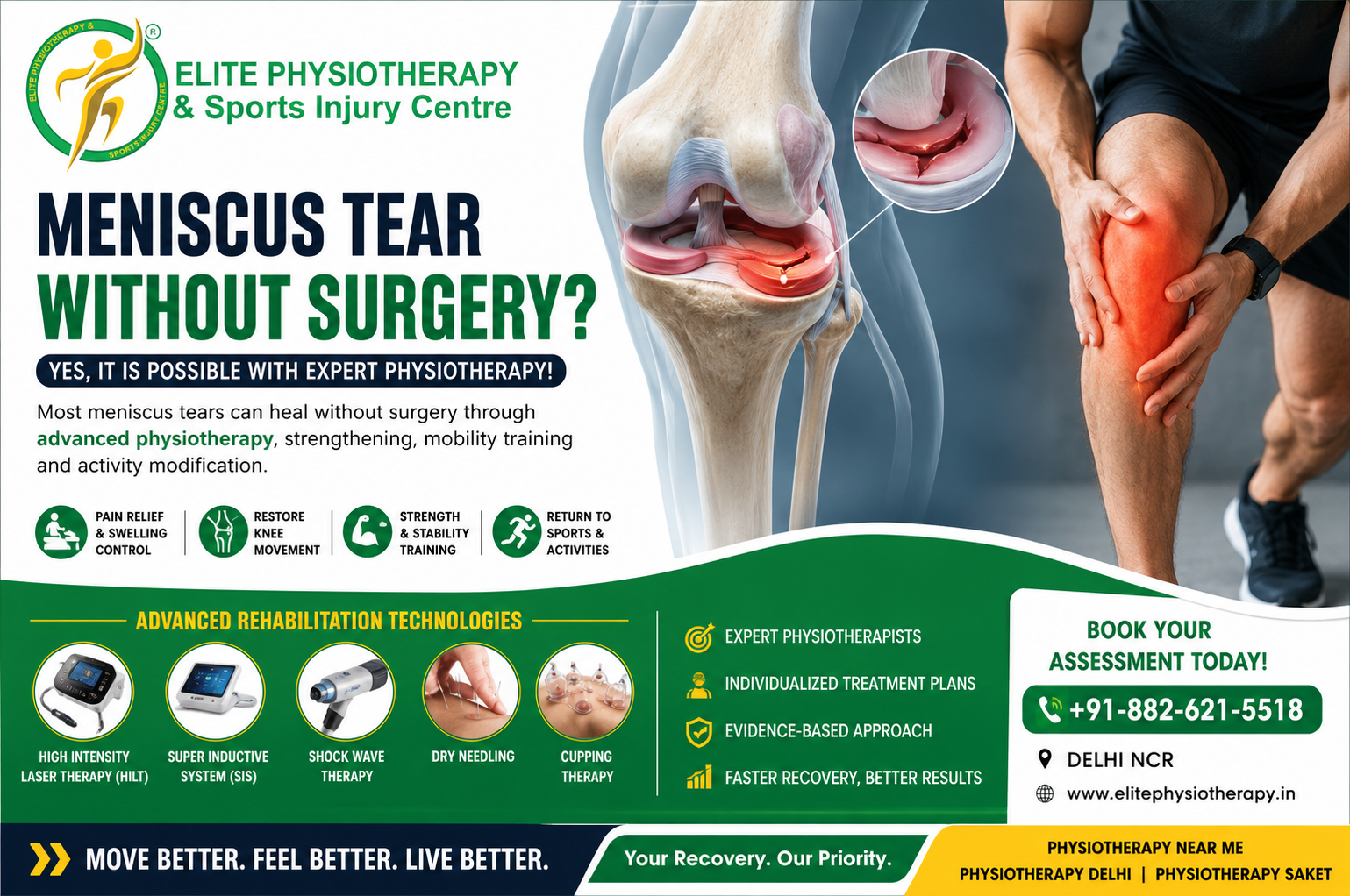
  • Every facet of daily living can be impacted by knee discomfort. Running, crouching, walking, climbing stairs, and participating in sports may become challenging. Meniscus injuries are among the most frequent causes of knee discomfort. Thankfully, surgery is not always required. Under the direction of skilled physiotherapists, Meniscus Tear Without Surgery is frequently a practical and effective therapy strategy.
  • Using evidence-based rehabilitation methods, we at Elite Physiotherapy & Sports Injury Centre frequently assist patients and athletes in recovering from meniscus injuries. Our objectives are to lessen discomfort, enhance strength, restore knee function, and enable people to safely resume their intended activities.
  • Knowing the function of physiotherapy in meniscus recovery will help you make wise choices whether you’re looking for physiotherapy, physiotherapy Delhi, physiotherapy Saket, physiotherapy near me, or specialized sports rehabilitation services.

What Is a Meniscus Tear?

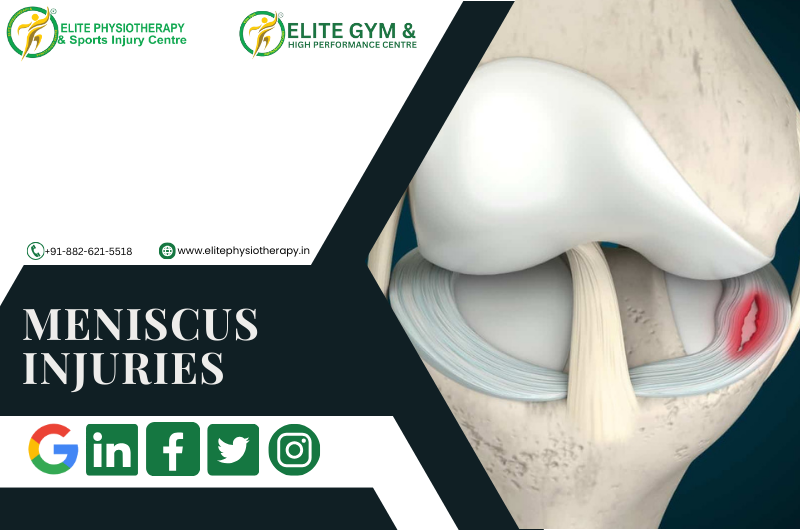
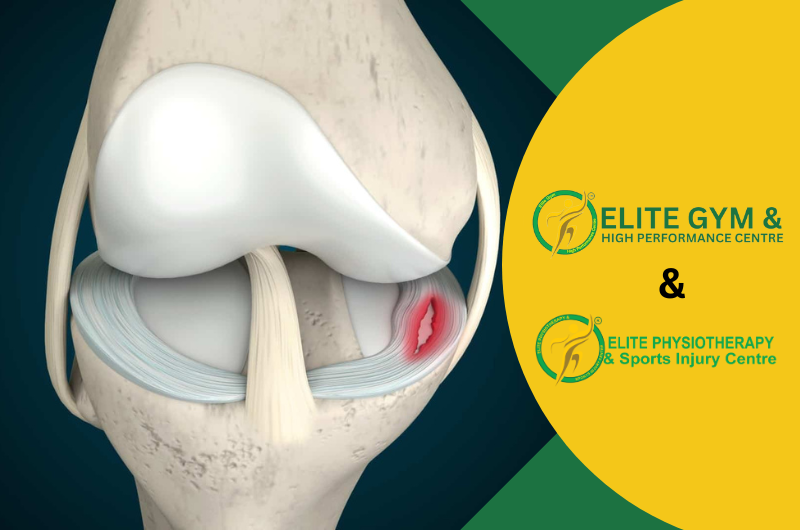
  • Between the shin bone (tibia) and the thigh bone (femur) is a C-shaped cartilage structure called the meniscus. There are two menisci in each knee:
  1. Medial meniscus (inside)
  2. Lateral meniscus (outside)
  • Menisci serve as shock absorbers. They increase joint stability and disperse load across the knee joint. Additionally, they aid in preventing excessive stress on the articular cartilage.
  • When this cartilage is harmed by abrupt twisting, high loading, degeneration, or trauma, a meniscus tear results.
  • A lot of folks think that surgery is the only option. However, current research indicates that for certain patients, meniscus tears without surgery can be quite beneficial.

Can a Meniscus Tear Heal Without Surgery?

  • The response is contingent upon multiple factors:
    • Tear location
    • Tear size
    • Patient age
    • Activity level
    • Knee stability
    • Presence of locking symptoms
  • The blood supply is better in the meniscus’s outer region. As a result, tears in this area frequently heal more quickly.
  • Structured physiotherapy works incredibly well for many small-to-moderate rips. Without surgery, degenerative meniscus rips often heal.
  • Before suggesting a course of treatment, we at Elite Physiotherapy & Sports Injury Centre evaluate each case on an individual basis.

Types of Meniscus Tears

  • Understanding the tear pattern helps determine the most appropriate treatment plan.
  1. Longitudinal Tear
  • The tear runs along the length of the meniscus.
  1. Bucket Handle Tear
  • A large portion of the meniscus becomes displaced. This type may cause knee locking.
  1. Radial Tear
  • The tear extends from the inner edge outward.
  1. Horizontal Tear
  • The meniscus splits into upper and lower sections.
  1. Flap Tear
  • A loose fragment develops and may cause mechanical symptoms.
  1. Complex Tear
  • Multiple tear patterns occur simultaneously.
  1. Degenerative Tear
  • Usually develops gradually due to age-related wear and tear.

Causes of Meniscus Tear

  • Several factors contribute to meniscus injuries.
  1. Sports Injuries – Sudden twisting while the foot remains planted can tear the meniscus.
  2. Deep Squatting – Repeated deep squatting places significant stress on the meniscus.
  3. Sudden Direction Changes – Rapid pivoting movements can overload knee structures.
  4. Age-Related Degeneration – The meniscus becomes less flexible with age.
  5. Repetitive Knee Loading – Occupations involving kneeling and squatting increase risk.
  6. Previous Knee Injuries – Ligament injuries may increase meniscus stress.

Clinical Features and Symptoms

  • Knee pain
  • Joint line tenderness
  • Swelling
  • Stiffness
  • Clicking sensations
  • Locking episodes
  • Catching sensation
  • Reduced knee motion
  • Difficulty squatting
  • Pain during twisting
  • Instability feeling
  • Reduced athletic performance

Physiotherapy Management for Meniscus Tear Without Surgery

  • Physiotherapy is the cornerstone of conservative treatment.
  • The primary goals are:
    • Reduce pain
    • Control swelling
    • Restore movement
    • Improve strength
    • Improve stability
    • Restore confidence
    • Return to sport safely
  • At Elite Physiotherapy & Sports Injury Centre, rehabilitation programs are individualized according to the patient’s goals and clinical presentation.

Pain and Inflammation Management

  • Activity modification
  • Cryotherapy
  • Compression
  • Manual therapy
  • Protected loading

Restoring Knee Mobility

  • Joint mobilization
  • Soft tissue mobilization
  • Active range exercises
  • Stretching techniques

Quadriceps Strengthening

  • Static quadriceps contractions
  • Straight leg raises
  • Terminal knee extensions
  • Wall sits
  • Leg press variations

Hamstring Rehabilitation

  • Isometric exercises
  • Resistance band exercises
  • Eccentric strengthening
  • Functional strengthening drills

Hip and Core Strengthening

  • Glute strengthening
  • Core stabilization
  • Pelvic control exercises
  • Single-leg stability work

Balance and Proprioception Training

  • Single-leg stance exercises
  • Balance boards
  • Dynamic stability drills
  • Sport-specific control exercises

Functional Rehabilitation

  • Squatting progression
  • Lunges
  • Step-ups
  • Running drills
  • Agility exercises
  • Direction-change drills

Advanced Physiotherapy Modalities

  • High Intensity Laser Therapy (HILT)
  • Super Inductive System (SIS)
  • Shock Wave Therapy
  • Dry Needling
  • Cupping Therapy

When Is Surgery Necessary?

  • Although many patients succeed with Meniscus Tear Without Surgery, surgery may be considered when:
    • The knee repeatedly locks
    • Large displaced tears exist
    • Conservative treatment fails
    • Severe instability persists
    • Significant mechanical symptoms remain
  • A physiotherapy assessment can help determine the most appropriate pathway.

Why Choose Elite Physiotherapy & Sports Injury Centre?

  • Our approach includes:
    • Detailed assessment
    • Personalized treatment plans
    • Sports rehabilitation expertise
    • Advanced physiotherapy modalities
    • Return-to-sport testing
    • Patient education
  • Whether you are searching for physiotherapy Delhi, physiotherapy Saket, elite rehabilitation services, or physiotherapy near me, our team is committed to helping you move pain-free and return to the activities you enjoy.

Conclusion

  • Surgery is not always necessary when a meniscus tear occurs. A well-designed physiotherapy program can often prevent meniscus tears without the need for surgery. Knee function and quality of life can be greatly enhanced by appropriate evaluation, gradual strengthening, mobility restoration, and functional therapy.
  • Seek a professional checkup if you are having knee pain, locking, or trouble playing sports. Better results and quicker recovery are frequently the results of early intervention.

Meniscus Injuries and Physiotherapy Management

Introduction

We often see athletes and others with meniscus injuries at Elite Physiotherapy and Sports Injury Centre. Meniscus injuries are a prevalent condition that affects the knee joint. In the knee, the meniscus is essential for load distribution, joint stability, and shock absorption. Mobility and function can be severely hampered by damage to this structure, especially in active people. In-depth information about meniscus injury causes, symptoms, and physiotherapy treatment will be covered in this article, along with a comprehensive rehabilitation and knee health plan.

Anatomy and Function of the Meniscus

There are two menisci in the knee joint:

  1. Medial Meniscus (inner side): The inner side, or medial meniscus, is larger and more C-shaped.
  2. Lateral Meniscus (outer side): The outside side, or lateral meniscus, is smaller and rounder.

Between the tibia (shin bone) and femur (thigh bone), these fibrocartilaginous structures provide the following functions:

  • Weight should be distributed over the knee joint.
  • Ensure stability when moving.
  • Reduce friction to preserve articular cartilage.

Causes of Meniscus Injuries

Meniscus injuries may result from:

  • Trauma: Frequently experienced by sportsmen during abrupt direction changes or twisting actions (e.g., in football, basketball, or weightlifting).
  • Degeneration: Wear and tear brought on by aging, which frequently causes tears in elderly people.

Symptoms of a Meniscus Injuries

  1. Pain localized to the knee joint.
  2. Swelling or effusion.
  3. Locking sensation or inability to fully extend the knee.
  4. Instability or giving way of the knee.
  5. Decreased range of motion and stiffness.

Diagnosis

At Elite Physiotherapy, we prioritize accurate diagnosis using:

  • Clinical tests: include the Thessaly, Apley, and Murray tests.
  • Imaging: MRI to verify tear type and extent.

Physiotherapy Management of Meniscus Injuries

Physiotherapy is essential for post-operative and conservative care. At Elite Physiotherapy, we prioritize function restoration, pain management, and recurrence prevention in our individualized approach.

1. Acute Phase (0–2 weeks)

Goal: The objectives are to preserve mobility, prevent joint damage, and manage pain and edema.

  • Rest and Protection: Offloading weight using crutches or a knee brace.
  • Pain relief: Apply ice for 15 to 20 minutes every two to three hours.
  • Gentle Range of Motion (ROM) Exercises:
  • Heel slips.
  • Knee flexion and extension when seated.
  • Isometric Strengthening:
  • Quadriceps setting.
  • Glutes squeezes.

2. Sub-Acute Phase (2–6 weeks)

Goals: Increase proprioception, start strength training, and improve mobility.

  • Weight-Bearing Exercises: Focus on appropriate gait patterns and advance as tolerated.
  • Strengthening Exercises:
  • Quadriceps: terminal knee extension, straight leg lifts.
  • Hamstrings: Resistance to hamstring curls and bridging.
  • Glutes: Lateral band walks and clamshells.
  • Proprioceptive Training:
  • flat-ground single-leg stance, followed by foam pads or a Bosu ball.

3. Strengthening and Functional Training Phase (6–12 weeks)

Goal: Strengthening, stabilizing, and getting back to low-impact activities are the objectives.

  • Advanced Strengthening:
  • Step-ups and step-downs.
  • Bulgarian split Squats.
  • Leg presses (light resistance).
  • Dynamic Stability:
  • Side lunges from to side.
  • Resistance band squats with a bosu ball.
  • Balance and Proprioception:
  • Single leg balance with perturbations.
  • Training on a wobble board.

4. Return-to-Sport Phase (12 weeks and beyond)

Goals: Restoring complete function, agility, and sport-specific motions are the objectives.

  • Plyometric Training:
  • Plyometric exercises include lateral hops, box jumps, and skipping.
  • Agility Drills:
  • exercises for agility include cutting techniques, ladder exercises, and shuttle runs.
  • Sport-Specific Conditioning:
  • Under controlled circumstances, mimic motions that are pertinent to the athlete’s discipline.

Post-Surgical Physiotherapy Management

The strategy is customized for the surgical process when surgery is required (such as meniscectomy or meniscus repair):

  • Meniscus Repair: To preserve the sutured tissue, a slower pace of healing is necessary. In contrast to a partial meniscectomy, weight-bearing, and range-of-motion activities are postponed.
  • Partial Meniscectomy: The goal of a partial meniscectomy is to quickly restore function and movement.

Similar steps are followed in rehabilitation, although it frequently takes longer to guarantee tissue recovery.

Additional Modalities at Elite Physiotherapy

We use cutting-edge methods to improve recovery:

  • Manual therapy: patellar and soft tissue mobilizations.
  • Electrotherapy: ultrasound or TENS to reduce edema and discomfort.
  • Dry Needling: To increase blood flow and relieve tense muscles.
  • Kinesiology Taping: For proprioceptive feedback and joint support.

Conclusion

Our goal at Elite Physiotherapy and Sports Injury Centre is to provide the best possible care for meniscus issues. We assist people and athletes in regaining the strength, mobility, and self-assurance necessary to perform at their peak through an organized, research-based physiotherapy program.

If you’re experiencing knee discomfort or suspect a meniscus tear, reach out to us now. Together, we will create a customized rehabilitation program based on your objectives and needs.

Meniscus Injury: Understanding, Treatment, and Recovery

Meniscus injuries are frequent among sportsmen and regular people equally. Injuries can have a substantial impact on mobility and quality of life, whether they are caused by sports or regular activities. Elite Physiotherapy and Sports Injury Centre specializes in the diagnosis, treatment, and rehabilitation of meniscus injuries, ensuring that each patient receives a personalized recovery plan.

What is the Meniscus?

In the knee joint, the meniscus is a crescent-shaped piece of cartilage placed between the femur (thigh bone) and the tibia (shin bone). Each knee contains two menisci: medial (inside) and lateral (outside). These structures operate as shock absorbers, cushioning and stabilizing the knee joint.

Causes of Meniscus Injuries

Meniscus injuries can arise for a variety of causes, which vary between athletes and the general population:

In Athletes:

Athletes that participate in contact sports such as football, rugby, basketball, or tennis are more likely to sustain meniscus injuries. The injury frequently happens when the knee is violently twisted or turned, or when an athlete lands awkwardly after a jump.

In General Population:

Non-athletes frequently sustain meniscus injuries from ordinary tasks like squatting, climbing stairs, or carrying heavy things. As we age, the meniscus becomes more prone to degeneration, increasing the risk of tears even with slight motions.

Symptoms of Meniscus Injury

A meniscus injury can result in a variety of symptoms, including:

  1. Pain in the knee joint, particularly while twisting or turning it.
  2. Swelling around the knee can arise suddenly or gradually.
  3. A sensation of the knee “locking” or being unable to completely extend.
  4. A feeling of instability or giving way in the knee joint.
  5. Squatting and knee bending are difficult actions.
  6. If you or someone you know suffers these symptoms, get professional help right once.

Diagnosis and Treatment at Elite Physiotherapy and Sports Injury Centre

Elite Physiotherapy and Sports Injury Centre takes a thorough approach to diagnosing and treating meniscus injuries:

Clinical Assessment:

Our trained physiotherapists undertake a complete assessment, including range-of-motion tests, palpation, and specific testing to precisely diagnose meniscus problems.

Imaging Techniques:

Imaging studies, such as MRI scans, may be recommended to confirm the diagnosis and determine the injury’s severity. This assists in devising the best effective treatment strategy.

Non-Surgical Treatment Options:

Non-surgical treatments can be successful for small meniscus tears or degenerative tears in older persons. Our therapy regimens often include the following:

Physiotherapy:

Physiotherapy involves tailored exercises to strengthen muscles surrounding the knee, improve flexibility, and restore normal movement patterns. Specific treatments, such as isometric exercises and progressive resistance training, are utilized to progressively restore knee function.

Manual Therapy:

Manual therapy involves mobilization techniques to improve knee joint mobility and relieve discomfort.

Electrotherapy:

Electrotherapy, including ultrasound, TENS, and laser therapy, can help decrease inflammation and facilitate healing.

Surgical Intervention and Post-Surgical Rehabilitation:

If the tear is severe or the knee joint remains unstable, surgery such as arthroscopic meniscectomy or meniscus repair may be required. Elite Physiotherapy and Sports Injury Centre collaborates closely with orthopedic doctors to offer a comprehensive approach to care.

Following surgery, our post-operative rehabilitation program seeks to restore strength, mobility, and functional movement patterns. This includes:

Progressive Loading Programs:

Progressive Loading Programs aim to gradually increase knee load-bearing capacity and strength.

Balance and Proprioception Exercises:

Balance and proprioception exercises involve using balance boards and stability training to improve knee control and avoid future injuries.

Sport-Specific Rehabilitation:

We use sport-specific drills and routines to help players safely and effectively return to their sport.

Prevention Tips

To avoid meniscus problems, strengthen the muscles around the knee while also increasing flexibility and balance. Here are some practical suggestions:

Warm-Up Properly:

Warm-Up Always warm up before starting in physical activities. Dynamic stretching and mobility exercises can help to prepare muscles and joints for movement.

Strength Training:

Incorporate strength workouts for the quadriceps, hamstrings, and calf muscles. These muscles support the knee and preserve the meniscus.

Balance Training:

Balance training enhances knee stability, lowering the risk of damage during unexpected movements.

Avoid Sudden Movements:

Be wary of unexpected twisting or pivoting motions, especially on uneven ground.

Elite Physiotherapy and Sports Injury Centre: Your Partner in Recovery

Whether you are a person seeking to resume your regular routine without experiencing any pain or an athlete hoping to return to peak performance, we at Elite Physiotherapy and Sports Injury Centre understand the impact a meniscus injury can have on your life. Every patient is guaranteed to receive the finest care possible thanks to our individualized, evidence-based treatment regimens.

Do not hesitate to contact us if you have knee pain or suspect a meniscus tear. Our staff is committed to assisting you with regaining your strength, mobility, and self-assurance when moving.

This is where your path to recovery begins. Every step forward matters when you visit Elite Physiotherapy and Sports Injury Centre.