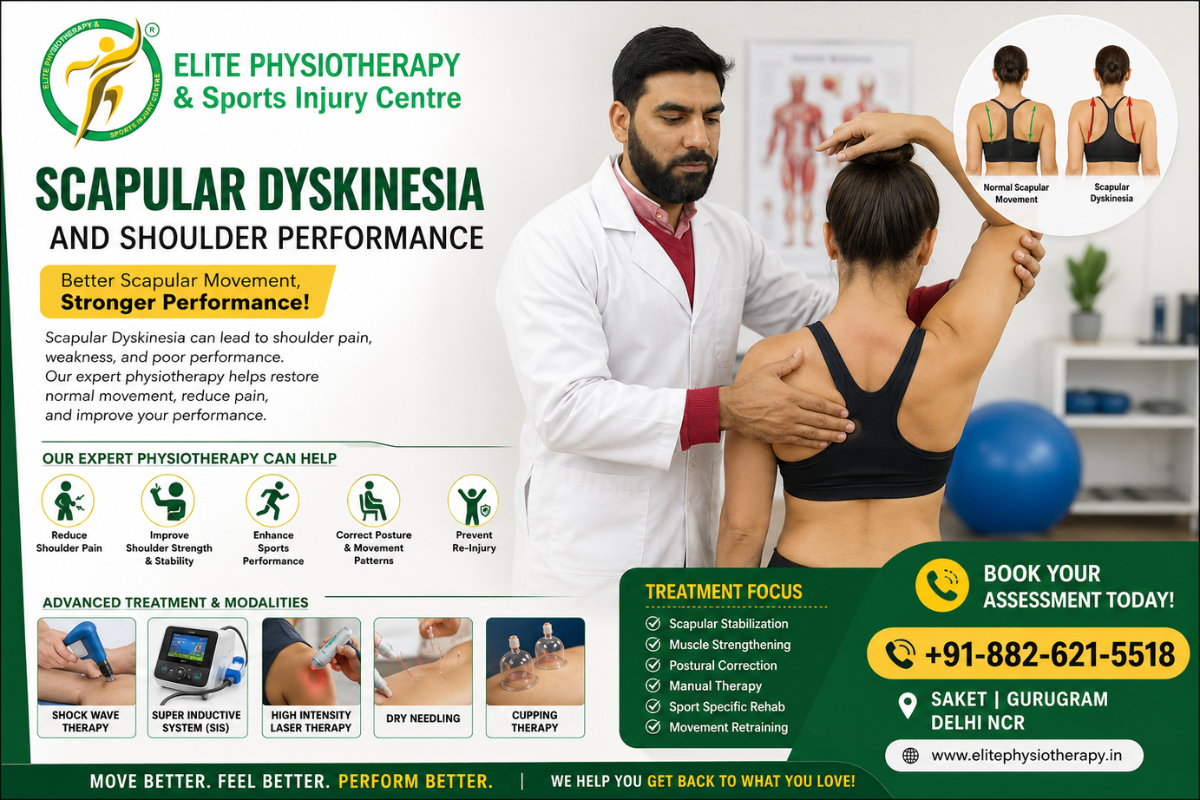
Scapular Dyskinesia and Shoulder Performance: A Complete Physiotherapy Guide

  • A lot of the time, shoulder pain starts quietly. A lot of athletes and energetic people concentrate on the shoulder joint. But often, the shoulder blade is where the real issue begins. Scapular Dyskinesia Physiotherapy plays a significant role in restoring normal shoulder mechanics, reducing discomfort, and enhancing sports performance. Thus, early detection of aberrant scapular mobility can maximize movement efficiency and prevent chronic injuries.
  • Our team at Elite Physiotherapy and Sports Injury Centre frequently treats athletes, fitness enthusiasts, office workers, and overhead athletes who have shoulder problems brought on by inadequate scapular control. To promote long-lasting healing, our evidence-based rehabilitation programs incorporate manual treatment, strength training, movement correction, thorough assessment, and cutting-edge physiotherapy technologies.
  • Proper scapular function is crucial for pain-free mobility, regardless of your sport—cricket, badminton, tennis, volleyball, swimming, CrossFit, or lengthy desk job. The first step to long-term shoulder health is recognizing scapular dyskinesia, whether you’re looking for physiotherapy in Delhi, Saket, premier physiotherapy, or physiotherapy near me.

Understanding the Scapula

  • Shoulder movement is based on the scapula, also referred to as the shoulder blade. The shoulder is actually a complicated system made up of several joints and muscles that work together, despite the fact that many people consider it to be a single joint.
  • Rather than being a real bony joint, the scapula is a muscle that joins the upper limb to the trunk. This special configuration offers exceptional mobility but necessitates strong muscle control for stability.
  • Several important joints contribute to shoulder function:
    • Glenohumeral Joint
    • Acromioclavicular Joint
    • Sternoclavicular Joint
    • Scapulothoracic Articulation

What is Scapular Dyskinesia?

  • A change in the scapula’s typical position or movement during shoulder motion is referred to as scapular dyskinesia. It is a movement disability that arises from muscular imbalance, weakness, pain, exhaustion, nerve injury, joint stiffness, or repetitive overhead activity rather than being a disease in and of itself.
  • When the arm is raised, the scapula and humerus often move in unison. The term “scapulohumeral rhythm” refers to this coordinated interaction. The shoulder muscles may produce force effectively while preserving joint stability when they operate in a healthy way.
  • This rhythm is disturbed with scapular dyskinesia. Consequently, the shoulder muscles work harder, mechanical stress increases, and the risk of injury rises dramatically.
  • The abnormal movement may involve:
    • Excessive winging
    • Early elevation
    • Reduced upward rotation
    • Excessive downward rotation
    • Internal rotation
    • Anterior tilting
    • Delayed movement
    • Asymmetrical motion
  • As a result, athletes often notice decreased power, reduced endurance, and recurring shoulder pain.

Why is the Scapula So Important for Shoulder Performance?

  • The scapula is often referred to by medical professionals as the “foundation of shoulder function.” This description is true since appropriate scapular posture is necessary for all shoulder movements.
  • During overhead movements, the scapula must:
    • Rotate upward
    • Tilt posteriorly
    • Externally rotate
    • Retract appropriately
    • Coordinate with clavicular motion
  • This coordinated movement keeps the humeral head centered within the glenoid cavity.
  • When these movements fail to occur properly, several problems develop.
  • These include:
    • Reduced force production
    • Shoulder impingement
    • Rotator cuff overload
    • Labral stress
    • Glenohumeral instability
    • Early fatigue
    • Poor throwing mechanics
    • Decreased sporting performance
  • Therefore, improving scapular control often produces dramatic improvements in shoulder function even before strengthening the rotator cuff.

How Common is Scapular Dyskinesia?

  • According to research, those who engage in repetitive overhead activities frequently develop scapular dyskinesia.
  • Higher prevalence has been reported in:
    • Cricket bowlers
    • Fast bowlers
    • Swimmers
    • Tennis players
    • Volleyball players
    • Baseball pitchers
    • Badminton players
    • Weightlifters
    • CrossFit athletes
    • Gymnasts
    • Throwing athletes
  • Interestingly, scapular dyskinesia also occurs frequently among office workers because prolonged sitting alters posture and weakens important stabilizing muscles.

Causes of Scapular Dyskinesia

  1. Muscle Weakness (Serratus anterior, Lower trapezius, Middle trapezius, Rotator cuff, Deep cervical flexors)
  2. Muscle Tightness (Pectoralis minor, Pectoralis major, Levator scapulae, Upper trapezius, Latissimus dorsi)
  3. Poor Posture
  4. Repetitive Overhead Activity (In sports such as Cricket, Tennis, Swimming, Volleyball, Basketball, Javelin throw, Handball, Badminton)
  5. Shoulder Injuries (Rotator cuff tears, Shoulder impingement syndrome, Labral injuries, AC joint injuries, Shoulder instability, Frozen shoulder, Proximal humerus fractures)
  6. Cervical Spine Dysfunction (Cervical radiculopathy, Facet joint dysfunction, Poor cervical posture, Disc pathology)
  7. Nerve Injuries
  8. Joint Restrictions (Thoracic spine stiffness, Rib dysfunction, Clavicular restrictions, Acromioclavicular joint stiffness, Sternoclavicular joint dysfunction)

Common Symptoms of Scapular Dyskinesia

  1. Shoulder pain
  2. Shoulder weakness
  3. Clicking sensations
  4. Reduced overhead ability
  5. Early muscle fatigue
  6. Loss of throwing power
  7. Poor sports performance
  8. Difficulty lifting weights
  9. Neck tightness
  10. Upper back discomfort

Evidence-Based Physiotherapy Management for Scapular Dyskinesia

  • At Elite Physiotherapy and Sports Injury Centre, our Team follows a comprehensive rehabilitation approach rather than treating only the painful area. We identify the root cause of abnormal scapular movement through detailed assessment and then develop an individualized Scapular Dyskinesia Physiotherapy program. This approach helps reduce pain, improve shoulder stability, restore athletic performance, and minimize the risk of recurrent injury.
  1. Activity Modification:
    Limiting repetitive overhead movements
    Taking regular breaks during desk work
  2. Pain Management:
    Ice therapy during acute irritation,
    Heat therapy for muscle tightness,
    Soft tissue mobilization,
    Gentle therapeutic exercises,
    Taping techniques.
  3. Manual Therapy:
    Thoracic Spine Mobilization,
    Scapulothoracic Mobilization,
    Glenohumeral Joint Mobilization,
    Soft Tissue Mobilization
  4. Postural Correction:
    Rehabilitation focuses on restoring
    Neutral cervical alignment
    Thoracic extension
    Proper rib cage position
    Scapular resting position
    Core stability
  5. Mobility Restoration:
    Pectoralis Minor Stretching
    Posterior Capsule Stretching
    Thoracic Mobility Exercises
  6. Neuromuscular Re-Education
  7. Scapular Stabilization Exercises
    Scapular setting
    Scapular clocks
    Scapular retraction
    Serratus punches
    Wall slides
  8. Strengthening the Serratus Anterior
    Push-up plus
    Dynamic hug
    Serratus punches
    Wall slide with resistance band
    Bear crawl progression
    Plank plus
    Landmine press
    Cable punches
  9. Strengthening the Lower Trapezius
    Prone Y raise
    Prone lower trapezius lift
    Wall Y exercise
    Resistance band Y
    Incline Y raise
    Overhead carry
  10. Strengthening the Middle Trapezius and Rhomboids
    Resistance band rows
    Face pulls
    Reverse fly
    Prone T raise
    Seated row
    Chest-supported row
  11. Rotator Cuff Rehabilitation
    External rotation with resistance band
    Internal rotation exercises
    Side-lying external rotation
    Full-can exercise
    Scaption
    Rhythmic stabilization drills
  12. Core Stability and Kinetic Chain Training
    Front plank
    Side plank
    Bird dog
    Dead bug
    Pallof press
    Farmer’s carry
    Single-leg balance drills
  13. Proprioception and Dynamic Stability
    Bodyblade exercises
    Ball stabilization against the wall
    Perturbation drills
    Closed-chain weight shifts
    Medicine ball control drills
    Reactive reaching exercises
  14. Sport-Specific Rehabilitation
    Specific to individual sports
  15. Advanced Physiotherapy Modalities for Scapular Dyskinesia
    High-Intensity Laser Therapy (HILT)
    Super Inductive System (SIS)
    Extracorporeal Shock Wave Therapy (ESWT)
    Dry Needling
    Cupping Therapy
    Kinesiology Taping
    Return-to-Sport Criteria

Why Choose Elite Physiotherapy and Sports Injury Centre?

  • At Elite Physiotherapy and Sports Injury Centre, we provide tailored, evidence-based care for shoulder discomfort and sports injuries across Delhi NCR.
  • Instead than only treating the symptoms of scapular dysfunction, our team concentrates on finding the underlying reason. Every rehabilitation program is tailored to the patient’s goals, whether returning to competitive athletics, enhancing workplace function, or resuming regular activities.

Scapular Dyskinesia: And Advanced Physiotherapy Management

Introduction

Often disregarded, scapular dyskinesia is a major contributor to shoulder pain, dysfunction, and problems with athletic performance. Using thorough evaluations and evidence-based physiotherapy treatments, we at Elite Physiotherapy and Sports Injury Centre are experts at diagnosing and treating this issue. For the best recovery, our clinic uses a combination of manual therapy, functional training, and premium modalities like Class 4 High-Intensity Laser, CRET Therapy, and Super Inductive System (SIS).

What is Scapular Dyskinesia?

When the shoulder blade (scapula) moves abnormally during shoulder motion, it is referred to as scapular dyskinesia. If left unchecked, this abnormal movement can cause pain, decreased mobility, and even rotator cuff damage by upsetting the entire shoulder complex.

Causes of Scapular Dyskinesia

  • Muscle imbalances (tightness or weakness in the rhomboids, trapezius, or serratus anterior)
  • Round shoulders and bad posture
  • Overuse injuries, particularly in sports involving overhead
  • Disorders that impact the spinal accessory nerves or the long thoracic nerve
  • Prior shoulder surgeries or injuries
  • Lack of scapular stability exercises and improper training methods

Signs and Symptoms

  • Visible asymmetry in scapular motion
  • Medial or inferior border prominence during arm movement
  • Shoulder pain, particularly during overhead activity
  • Muscle fatigue and tightness around the neck or upper back
  • Audible clicking or snapping in the scapula
  • Reduced shoulder strength or performance
  • Postural imbalance or winging of the scapula

Clinical Assessment at Elite Physiotherapy

At Elite Physiotherapy and Sports Injury Centre, we prioritize thorough assessment using functional and physical evaluation techniques:

  • We begin with postural inspection to assess static scapular positioning.
  • Dynamic Scapular Movement Tests
    • Scapular Assistance Test (SAT)
    • Scapular Retraction Test (SRT)
    • Wall Push-Up Test
    • Lateral Scapular Slide Test
  • These special tests help us pinpoint scapular dysfunction patterns.
  • We assess the strength and activation of the serratus anterior, trapezius, and rotator cuff muscles.
  • Athlete-specific or daily movement tasks are analyzed using video-assisted feedback for real-time correction.

Personalized Physiotherapy Management

At Elite Physiotherapy, we offer individualized care based on the goals, activity level, and condition of each patient. We don’t employ a phase-based or general strategy. Rather, we use a combination of manual therapy, corrective exercise, and technology-assisted rehabilitation to directly treat the underlying reasons.

1. Manual Therapy

  • Overactive muscles such as the levator scapulae or pectoralis minor might leak soft tissue.
  • Joint mobilizations for the scapulothoracic or thoracic spine
  • Trigger point and myofascial release therapy

2. Neuromuscular Re-Education

  • Training in proprioception to enhance neuromuscular control
  • Using closed-chain scapular control exercises to integrate kinetic chains

3. Corrective Exercise Program

  • Using body weight and elastic resistance to stabilize the scapula
  • Rhomboids, serratus anterior, and lower and middle trapezius strengthening
  • Exercises for correcting posture
  • Using eccentric loading in conjunction with tendon retraining

Why Choose Elite Physiotherapy for Scapular Dyskinesia?

In addition to having cutting-edge modalities, our center is fueled by extensive clinical knowledge. What sets us apart is this:

  • Thorough functional evaluation tailored to sportsmen and busy people
  • Protocols for evidence-based physical therapy that address the underlying problem
  • Sports physiotherapists with experience who have worked in elite rehabilitation
  • Integration of contemporary technology for a quicker and more durable recovery
  • Individualized sessions that guarantee complete focus and customized development

Final Thoughts

If left untreated, scapular dyskinesia can impair shoulder health and sports performance. Our goal at Elite Physiotherapy and Sports Injury Centre is to restore mobility, function, and balance through accurate diagnosis and skilled physiotherapy care. We use cutting-edge technology and individualized treatment to help you heal more quickly, safely, and robustly.

Schedule an evaluation at www.elitephysiotherapy.in right now if you or someone you know suffers from scapular instability or shoulder trouble.