
Clinical Assessment vs Imaging – What Matters More?

Scan or Skill? What Truly Guides Recovery

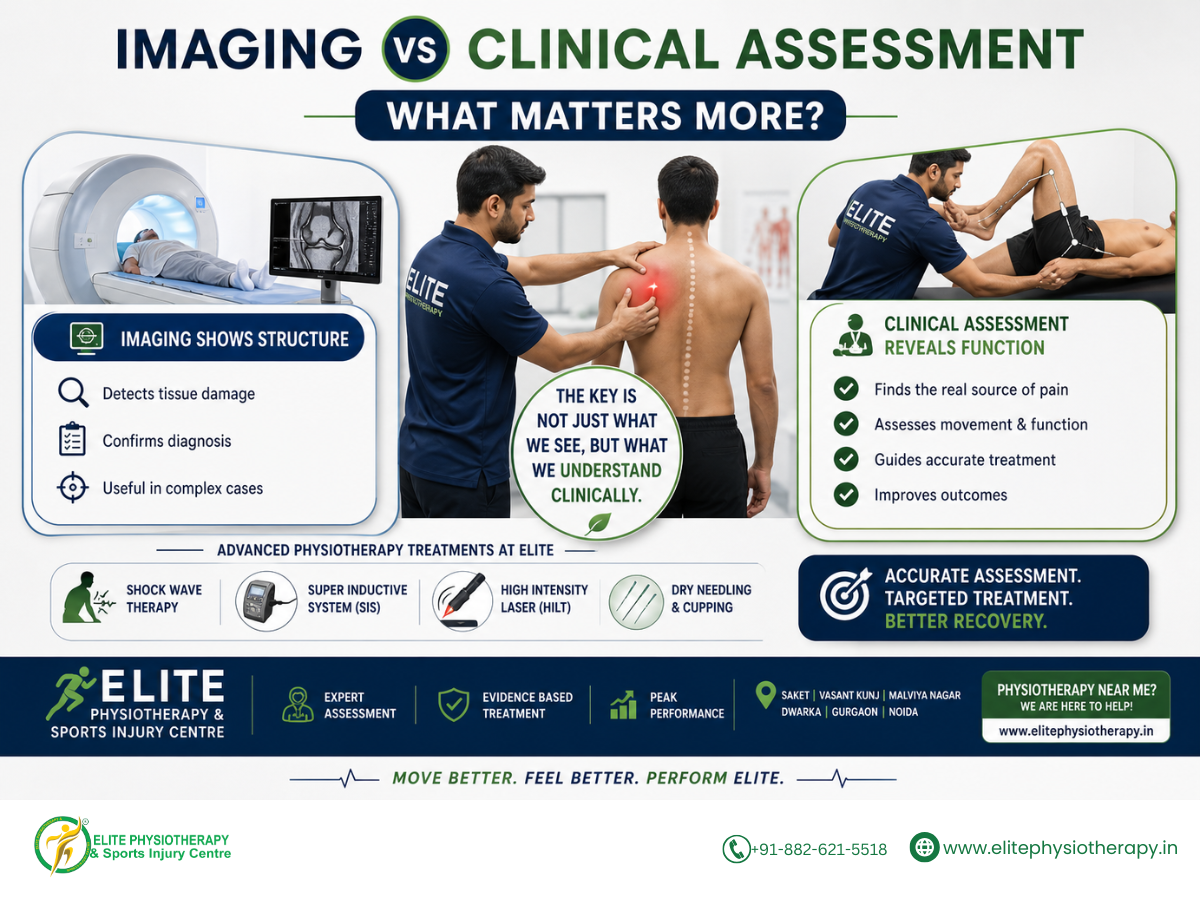
  • A frequent argument in contemporary healthcare is between imaging and clinical assessment. A lot of patients think scans show everything. This isn’t always the case, though. At Elite Physiotherapy & Sports Injury Centre, we stress that both science and expert evaluation are necessary for a correct diagnosis.
  • This balance is emphasized by the important phrase “clinical assessment vs imaging.” Clinical evaluation exposes function, whereas imaging reveals structure. Better results are thus guaranteed when both are combined.
  • Knowing this idea might alter your recuperation process if you’re looking for physiotherapy nearby, particularly in Saket or Delhi.

What is Clinical Assessment vs Imaging?

  • Imaging versus clinical assessment refers to two methods of diagnosis:
    • Clinical Assessment: A physiotherapist’s practical assessment. It consists of unique testing, movement analysis, and history.
      Imaging: Technology-based instruments such as CT, MRI, ultrasound, and X-ray. These display structural alterations.
    • Imaging helps with visual clarity, but it is not always able to explain discomfort or malfunction. As a result, clinical reasoning is crucial to physiotherapy.

Why Does This Debate Exist?

  • Confusion between imaging and clinical assessment arises for several reasons:
    • Over-reliance on MRI and scans
    • Misinterpretation of imaging findings
    • Incidental findings without symptoms
    • Lack of functional assessment
    • Patient expectations for “visible proof.”
  • For instance, a lot of patients have MRI disc bulges but no pain. Others, however, experience excruciating agony during routine scans.

Types / Classification

The concept of clinical assessment vs imaging can be divided into:

  1. Structural Diagnosis (Imaging-Based)
    Focuses on tissues like bones, discs, ligaments
    Examples: MRI for ligament tears, X-ray for fractures
  2. Functional Diagnosis (Clinical Assessment-Based)
    Focuses on movement, strength, and biomechanics
    Identifies root cause of dysfunction
  3. Integrated Diagnosis
    Combines both methods
    Considered the gold standard in elite physiotherapy practice

Physiotherapy Management

At Elite Physiotherapy & Sports Injury Centre, we prioritize clinical assessment vs imaging for precise treatment planning.

  1. Pain Management
  • First, we use modern methods to alleviate discomfort. Tissue repair is enhanced by high-intensity laser therapy. It successfully lowers inflammation. The Super Inductive System aids in pain management and neuromuscular activation.
  • Shockwave therapy also works well for long-term ailments like tendinopathy. It promotes the regeneration of tissue. Cupping and dry needling relax tense muscles and enhance blood flow.
  1. Movement Correction
  • We concentrate on fixing poor movement patterns after reducing pain. Poor biomechanics is a major cause of injuries.
  • To restore normal movement, we employ focused physiotherapy activities. Soft tissue release and joint mobilization fall under this category. These methods lessen stiffness and increase flexibility.
  1. Strength and Stability Training
  • Recurrent discomfort is frequently caused by muscle weakness. Strengthening is therefore crucial.
  • We create individualized rehabilitation plans. These emphasize muscular balance, joint control, and core stability. To improve performance, athletes receive conditioning tailored to their particular sport.
  1. Functional Rehabilitation
  • We then go on to functional training. This phase gets the patient ready for everyday tasks or athletic endeavors.
  • Exercises imitate how people move in real life. This guarantees a safe resumption of activities. Our focus at Elite is on performance-based rehabilitation.
  1. Injury Prevention
  • Lastly, we instruct patients. The secret to long-term health is prevention.
  • We offer at-home workout regimens, ergonomic guidance, and posture correction techniques. This lowers the chance of future injuries.

Why Clinical Assessment Matters More

  • Imaging has limitations despite its usefulness. It is unable to evaluate the quality of movement. It is also unable to quantify pain behavior.
  • A comprehensive picture is provided by clinical examination. It pinpoints the underlying reason. Thus, functional evaluation should always take precedence over imaging in clinical assessment.
  • Both methods are combined at Elite Physiotherapy & Sports Injury Center. This guarantees a precise diagnosis and a quicker recovery.

Conclusion

  • The argument between imaging and clinical assessment is not about picking one over the other. Rather, it’s about making sensible use of both.
  • Treatment is guided by clinical knowledge. Confirmation is supported by imaging. When combined, they produce the finest outcomes.
  • Visit Elite Physiotherapy & Sports Injury Centre if you’re searching for professional physiotherapy in Saket or Delhi. Get cutting-edge care with a customized approach.
Stay Game-Ready: Injury Prevention Tips for Wrestlers, Volleyball & Table Tennis Players

Introduction

  • To perform better, athletes continually challenge their bodies. On the other hand, rigorous training frequently raises the risk of injury. Therefore, long-term athletic success depends on effective preventative techniques.
  • For wrestlers, volleyball players, and table tennis players, injury prevention is crucial to sustaining performance, preventing downtime, and safeguarding joint health. Explosive power, quick direction changes, overhead motions, and repetitive actions are all required in these sports. Because of this, shoulder, knee, ankle, and wrist injuries are common among athletes.
  • We at Elite Physiotherapy and Sports Injury Centre concentrate on evidence-based physical therapy techniques that improve sports performance and lower the chance of injury. Our Delhi NCR facility provides cutting-edge care with individualized rehabilitation plans and contemporary physiotherapy techniques.

Understanding Sports Injuries in These Athletes

  • Excessive stress surpasses the body’s ability to adjust, leading to sports injuries. Muscles, tendons, ligaments, and joints are frequently strained by quick movements and repeated loading in sports like table tennis, volleyball, and wrestling.
  • Therefore, improving movement patterns and strengthening weak areas are the main goals of injury prevention for wrestlers, volleyball players, and table tennis players.
  • Common Injuries in Wrestlers, Volleyball & Table Tennis Players
  1. Wrestling Injuries
  • Shoulder dislocation
  • Knee ligament sprain
  • Neck strain
  • Lower back pain
  • Elbow injuries
  • Repeated grappling forces stress the spine, shoulders, and knees.
  1. Volleyball Injuries
  • Rotator cuff injuries
  • Shoulder impingement
  • Patellar tendinopathy
  • Ankle sprain
  • Lower back strain
  • Jumping and landing mechanics strongly influence injury risk.
  1. Table Tennis Injuries
  • Tennis elbow
  • Wrist tendinitis
  • Shoulder overuse injury
  • Lumbar strain
  • Overuse injuries dominate this sport due to repetitive strokes.

Causes of Sports Injuries

  1. Poor Strength and Conditioning
  2. Poor Movement Mechanics
  3. Inadequate Warm-Up
  4. Overtraining
  5. Muscle Imbalance

Signs and Symptoms of Sports Injuries

  • Joint pain during movement
  • Muscle tightness or stiffness
  • Reduced strength
  • Swelling around joints
  • Limited range of motion
  • Decreased sports performance

Physiotherapy Management for Sports Injury Prevention

  • In order to prevent injuries and enhance performance, physiotherapy is essential.
  • Rehabilitation plans at Elite Physiotherapy and Sports Injury Centre are customized for each athlete based on their sport, training load, and biomechanical requirements.

Strength Training for Injury Prevention

  • Squats and lunges for lower body strength
  • Rotator cuff strengthening for shoulder stability
  • Core strengthening exercises
  • Hip stabilization exercises

Mobility and Flexibility Training

  • Dynamic stretching
  • Joint mobilization techniques
  • Foam rolling
  • Sport-specific mobility drills

Neuromuscular Training

  • Balance training
  • Plyometric drills
  • Landing mechanics training
  • Agility drills

Advanced Physiotherapy Modalities at Elite Physiotherapy

  • Shockwave Therapy
  • Super Inductive System (SIS)
  • High Intensity Laser Therapy
  • Dry Needling
  • Cupping Therapy

Sport-Specific Injury Prevention Strategies

Injury Prevention for Wrestlers

  • Strengthen neck and shoulder muscles
  • Improve hip mobility
  • Train core stability

Injury Prevention for Volleyball Players

  • Strengthen rotator cuff muscles
  • Train landing mechanics
  • Improve ankle stability

Injury Prevention for Table Tennis Players

  • Strengthen forearm muscles
  • Improve shoulder stability
  • Train trunk rotation control

Importance of Warm-Up and Recovery

An effective warm-up includes:

  • Light aerobic activity
  • Dynamic stretching
  • Activation drills

Recovery strategies include:

  • Adequate sleep
  • Hydration
  • Physiotherapy recovery sessions

Why Choose Elite Physiotherapy and Sports Injury Centre

Our clinic in Delhi NCR offers:

  • Sports injury rehabilitation
  • Athlete performance training
  • Advanced physiotherapy modalities
  • Personalized treatment programs
  • If you are searching for physiotherapy near me, physiotherapy Delhi, or physiotherapy Saket, our clinic provides expert care for athletes.

Conclusion

  • Strong, sturdy, and well-conditioned muscles are essential for athletic performance. However, an athlete’s career may be limited if injury prevention is neglected.
  • As a result, training regimens should always include injury prevention for wrestlers, volleyball players, and table tennis players.
  • Athletes may maintain their strength, improve their performance, and avoid injuries with the right physiotherapy guidance.