



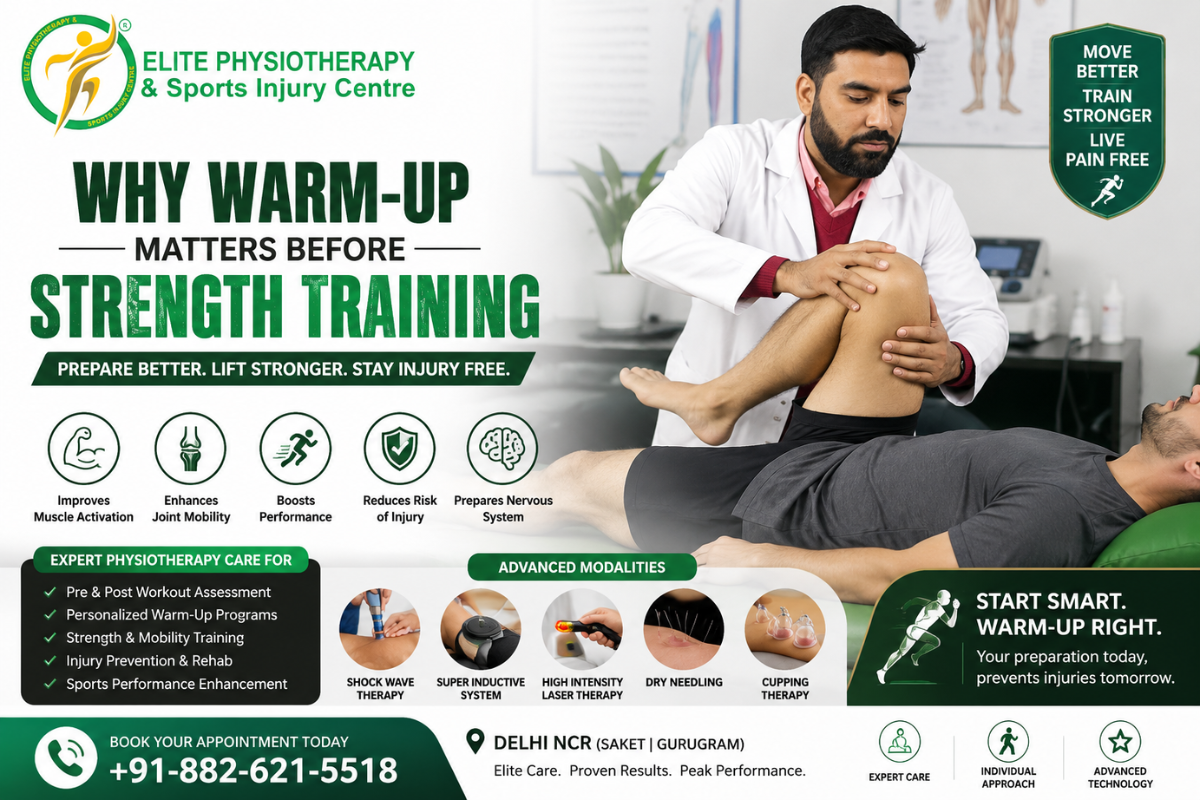
- Strength training can enhance bone health, sports performance, muscle strength, and power. However, unprepared muscles and joints may be challenged if heavy lifting is done right after. Your body is ready for increasing loading when you warm up properly before strength exercise. Additionally, it enhances muscular activation, workout preparedness, and movement quality. At Elite Physiotherapy and Sports Injury Center, we develop individualized training plans for athletes and fitness enthusiasts throughout Delhi NCR using movement evaluation.
- More than five minutes of recreational cycling constitutes a warm-up. It is a methodical process of preparation. It raises body temperature gradually, primes the neurological system, enhances joint mobility, and practices the motions needed for training.
- This preparation can increase the effectiveness of training for lifters, athletes, and casual gym patrons. Before engaging in strenuous exercise, it can also assist in identifying movement limitations.
What Is a Warm-Up Before Strength Training?
- A scheduled sequence of low-to-moderate-intensity exercises is called a warm-up. These exercises prime the musculoskeletal, neurological, cardiovascular, and muscular systems for physical activity.
- Before strength training, a warm-up often moves from general exercises to targeted exercises.
- For instance, someone getting ready for squats might start with some mild cycling. After that, they might make dynamic hip motions. The gluteal muscles can then be used. Lastly, they are able to execute increasingly difficult squat sets.
- The body is prepared by this phase without being overly exhausted.
- A good warm-up should therefore answer three questions:
- Is the body physically prepared?
Is the movement pattern controlled?
Is the athlete ready for the planned training load?
- Is the body physically prepared?
- At Elite Physiotherapy, we consider all three factors when designing exercise preparation programs.
Why Does Warm-Up Matter Before Strength Training?
- The mechanical and neurological demands of strength training are substantial. Joint control and coordinated muscle activation are necessary for heavy resistance.
- Movement restrictions may be shown if high loads are started right away. Additionally, it may make fixing bad technique more challenging.
- Before strength training, a well-planned warm-up helps the body become ready for these demands.
- It Gradually Increases Body Temperature
- It Improves Joint Mobility
- It Improves Muscle Activation
- It Prepares the Nervous System
- It Improves Exercise-Specific Readiness
- Types of Warm-Up Before Strength Training
- General Warm-Up
Brisk walking
Stationary cycling
Light jogging
Cross-trainer exercise
Low-intensity rowing - Dynamic Warm-Up
Leg swings
Walking lunges
Arm circles
Hip rotations
Thoracic rotations
Bodyweight squats
Inchworms - Muscle Activation Warm-Up
For lower-body training, examples include:
Glute bridges
Mini-band lateral walks
Bodyweight squats
Calf raises
Single-leg balance drills
For upper-body training, examples include:
Scapular push-ups
Band pull-aparts
External rotation drills
Serratus activation
Controlled shoulder movements - Specific Warm-Up
Bodyweight squats.
Empty-bar squats.
Light-loaded squats.
Moderate-loaded squats.
Working sets. - Rehearsal Sets
For strength athletes, rehearsal sets are very crucial.
Before the athlete reaches working intensity, they let them practice technique.
They also offer helpful criticism.
What Happens When You Skip Your Warm-Up?
- An injury is not a given when preparedness is neglected. It may, however, make you less prepared for strenuous exercise.
- A number of issues could become more likely.
- These include:
- Increased movement stiffness
- Poor exercise technique
- Reduced movement control
- Early muscle fatigue
- Reduced training quality
- Poor coordination
- Increased perceived effort
- Exacerbation of existing pain
- The risk can increase when heavy loads combine with fatigue and poor movement control.
- Therefore, warm-up should form part of responsible strength programming.
Common Causes of Poor Warm-Up Preparation
- Insufficient Preparation Time
- Incorrect Exercise Selection
- Excessive Static Stretching Before Heavy Lifting
- Excessive Warm-Up Volume
- Ignoring Previous Injuries
- Poor Exercise Technique
Clinical Features That Suggest You Need a Better Warm-Up
- Warming up is not a medical issue in and of itself. As a result, it lacks conventional clinical signs.
- On the other hand, some symptoms might point to poor planning or an underlying movement issue.
- Watch for:
- Persistent joint stiffness
- Pain during warm-up
- Repeated muscle tightness
- Difficulty reaching exercise positions
- One-sided movement restriction
- Poor balance
- Early muscle fatigue
- Recurrent muscle strains
- Pain during progressive loading
- Reduced exercise performance
- The body feels better after warming up, but this does not mean that pain should be disregarded.
- Movement can temporarily alleviate certain symptoms, but thorough evaluation is still necessary.
When Should You Seek Physiotherapy?
- When warm-up consistently causes or reveals pain, think about getting a professional evaluation.
- Physiotherapy evaluation is very helpful in the following situations:
- Recurrent muscle strains
- Persistent joint pain
- Repeated exercise-related injuries
- Significant mobility restrictions
- Strength imbalance
- Poor movement control
- Pain during squats or deadlifts
- Shoulder discomfort during pressing
- Knee pain during lunges
- Back pain during loaded exercises
Physiotherapy Management for Better Warm-Up Before Strength Training
- A general warm-up can be transformed into a customized preparation program with the aid of physiotherapy.
- Treatment at Elite Physiotherapy and Sports Injury Center is centered on the patient’s needs for movement.
- Mobility work, activation, manual therapy, corrective exercise, strength training, and sports-specific drills could all be part of the program.
- Individualized Warm-Up Planning
- Cardiovascular Preparation
- Dynamic Mobility
- Muscle Activation
- Corrective Exercise
- Warm-Up for Different Strength Exercises
- Before Squats
Focus on:
Ankle mobility
Hip mobility
Glute activation
Squat patterning
Progressive loading
- Before Deadlifts
Focus on:
Hip mobility
Hamstring preparation
Trunk control
Hip-hinge rehearsal
Progressive loading - Before Bench Press
Focus on:
Thoracic mobility
Shoulder movement
Scapular control
Rotator cuff activation
Progressive pressing sets - Before Overhead Press
Focus on:
Thoracic extension
Shoulder mobility
Scapular upward rotation
Core control
Progressive pressing - Before Olympic Lifting
The warm-up should include:
General temperature elevation
Dynamic mobility
Technical drills
Barbell rehearsal
Progressive loading
What Should a 10-Minute Warm-Up Before
•Minutes 0–3: General Preparation
•Minutes 3–5: Dynamic Mobility
•Minutes 5–7: Activation
•Minutes 7–10: Movement Rehearsal
Common Warm-Up Mistakes
- Mistake 1: Doing the Same Warm-Up Every Day
Different workouts require different preparation.
A leg session should not have the same preparation as an upper-body session.
- Mistake 2: Making the Warm-Up Too Long
A warm-up should prepare you.
It should not exhaust you. - Mistake 3: Ignoring Pain
Pain during warm-up requires attention.
Do not simply increase intensity until pain disappears. - Mistake 4: Using Only Cardio
Five minutes of cycling may increase temperature.
However, it may not prepare your shoulders or movement patterns. - Mistake 5: Skipping Warm-Up Sets
Progressive loading is especially important before heavy compound exercises. - Mistake 6: Copying Another Person’s Warm-Up
Your mobility and injury history may differ.
Your warm-up should therefore be individualized.
How Elite Physiotherapy Designs a Better Warm-Up
- We employ an assessment-led methodology at Elite Physiotherapy and Sports Injury Center.
- We first ascertain the individual’s training objectives.
- Next, we evaluate physical constraints and movement quality.
- We then determine which areas need to be prepared for mobility, activation, stability, or strength.
- Lastly, we incorporate these results into a useful warm-up.
- We can also link athletes’ warm-up preparation to the needs of their particular sport.
- Both performance and injury prevention are supported by this strategy.
- Both leisure and competitive athletes are the target audience for our sports performance services.
When Should You Modify Your Warm-Up?
- Modify your warm-up when:
- You feel unusually stiff.
- Your movement feels restricted.
- You have recently returned from injury.
- Training intensity increases.
- You change exercises.
- You experience repeated discomfort.
- Your technique deteriorates early.
- You return after a training break.
Why Choose Elite Physiotherapy and Sports Injury Centre?
- Physiotherapy, sports rehabilitation, and performance-focused training are all combined at Elite Physiotherapy and Sports Injury Center.
- Our methodology stresses individualized assessment.
- We don’t think all athletes require the same warm-up.
- Rather, the program ought to be tailored to the athlete’s body type and training requirements.
- Our physiotherapy approach can include:
- Movement assessment
- Mobility training
- Strength assessment
- Corrective exercise
- Neuromuscular training
- Manual therapy
- Sports rehabilitation
- Dry needling
- Cupping
- Shock Wave Therapy
- Super Inductive System
- High Intensity Laser Therapy
- Sport-specific preparation