Strength, fitness, mobility, and performance are all enhanced by gym training. But every fitness enthusiast should be concerned about typical gym injuries and how to avoid them. Tissues can be overloaded by poor technique, heavy loads, insufficient recuperation, and abrupt training increases. As a result, slight discomfort can turn into a serious injury.
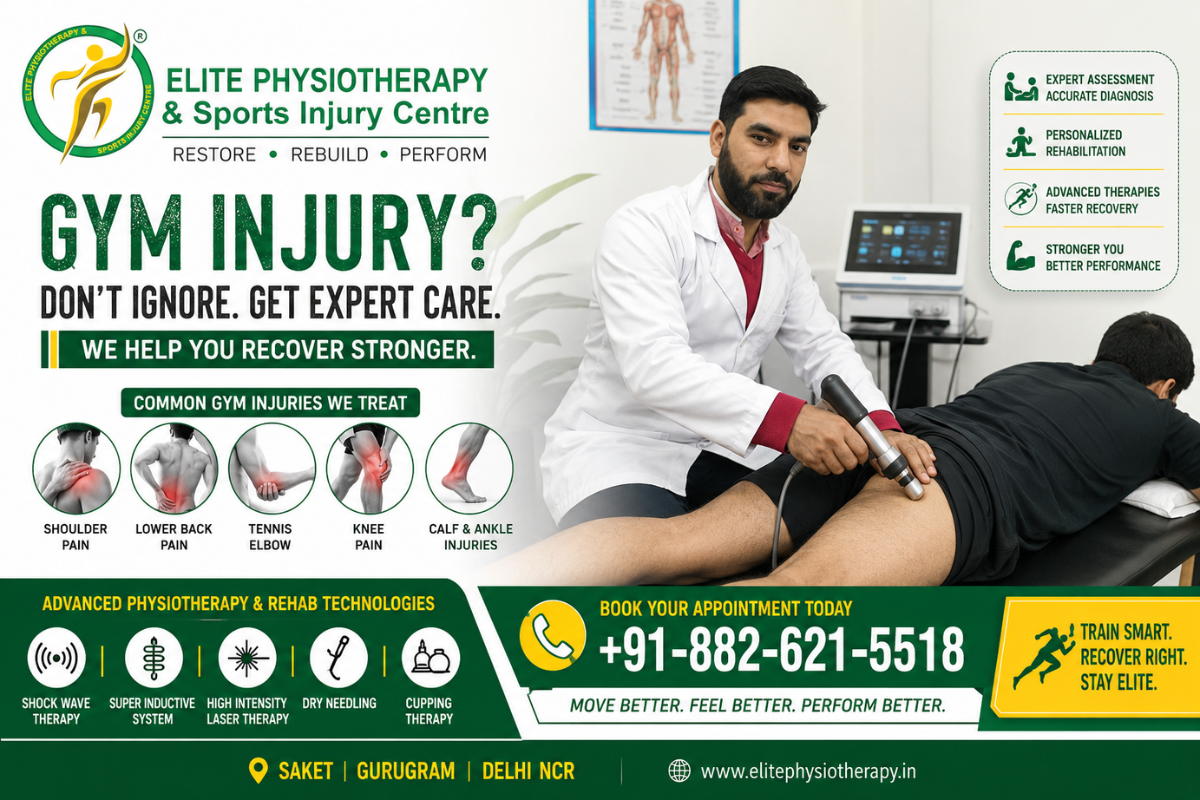
Our team at Elite Physiotherapy and Sports Injury Center is dedicated to figuring out what causes gym injuries. Movement, strength, flexibility, joint control, training method, and workload are all evaluated. For a safe recovery and long-term injury prevention, we then create customized physiotherapy regimens. Our strategy integrates cutting-edge rehabilitation technology with evidence-based physical treatment throughout Delhi NCR.
Injury avoidance is important regardless of your level of experience—beginner, recreational lifter, bodybuilder, athlete, or strength-training enthusiast. You may thus train regularly and confidently if you are aware of typical gym injuries and how to avoid them.
What Are Gym Injuries?
Musculoskeletal issues brought on by exercise, resistance training, repetitive motion, or insufficient recuperation are known as gym injuries.
They may involve:
Muscles
Tendons
Ligaments
Joints
Bones
Fascia
Nerves
The spine
Some injuries happen out of the blue. Others progressively worsen due to recurrent tissue overload.
An acute muscle strain, for instance, can result from lifting a large weight improperly. Heavy pressing that is done repeatedly might aggravate the elbow or shoulder. In a similar vein, excessive squatting can exacerbate the knee if there is insufficient strength and control over movement.
From little pain to severe tissue injury, the intensity ranges. As a result, accurate evaluation is still crucial.
Why Do Gym Injuries Happen?
Understanding the causes is the first step toward preventing common gym injuries and how to prevent them.
Poor Exercise Technique
Excessive Training Load
Insufficient Warm-Up
Muscle Weakness and Imbalance
Poor Mobility
Insufficient Recovery
Repetitive Training
Training Through Significant Pain
Types of Common Gym Injuries
Gym injuries can broadly be classified into acute injuries and overuse injuries.
Acute Gym Injuries
Muscle strains
Ligament sprains
Joint injuries
Dislocations
Acute tendon injuries
Fractures
Overuse Gym Injuries
Tendinopathy
Tennis elbow
Golfer’s elbow
Rotator cuff irritation
Patellar tendinopathy
Achilles tendinopathy
Shin pain
Persistent lower back pain
Physiotherapy Management for Common Gym Injuries
A key component of successful gym injury rehabilitation is physiotherapy.
Rather than offering short-term pain alleviation, the goal of treatment at Elite Physiotherapy and Sports Injury Center is to restore function. Clinical evaluation, manual therapy, exercise rehabilitation, movement correction, and progressive loading are all incorporated into our programs.
Pain Management
Relative rest
Activity modification
Cryotherapy
Manual therapy
Therapeutic exercise
Electrotherapy
Manual Therapy
Joint mobilization
Soft-tissue techniques
Myofascial release
Muscle energy techniques
Trigger-point techniques
Therapeutic Exercise
Mobility Training Ankle dorsiflexion drills Hip mobility exercises Thoracic rotation Shoulder mobility Wrist mobility
Isometric Training Progressive Strength Training Functional Training
Advanced Physiotherapy Modalities at Elite
Shock Wave Therapy
Super Inductive System
High Intensity Laser Therapy
Dry Needling
Cupping Therapy
How to Prevent Common Gym Injuries
Warm Up Properly
Master Exercise Technique
Progress Gradually
Strengthen Supporting Muscles
Improve Mobility
Respect Recovery
Do Not Ignore Persistent Pain
When Should You See a Physiotherapist?
Seek professional assessment when you experience:
Persistent pain
Recurrent injuries
Significant swelling
Sudden loss of strength
Joint instability
Persistent movement restriction
Pain that affects training
Numbness or tingling
Pain that worsens despite modifying activity
Why Choose Elite Physiotherapy and Sports Injury Centre?
At Elite Physiotherapy and Sports Injury Centre, rehabilitation is designed around the individual’s needs.
Our Team combines:
Detailed physiotherapy assessment
Orthopedic special tests
Sports injury rehabilitation
Manual therapy
Therapeutic exercise
Strength and conditioning
Movement analysis
Advanced physiotherapy modalities
Return-to-sport testing
Injury prevention strategies
Our rehabilitation approach focuses on restoring mobility, strength, control, confidence, and performance.