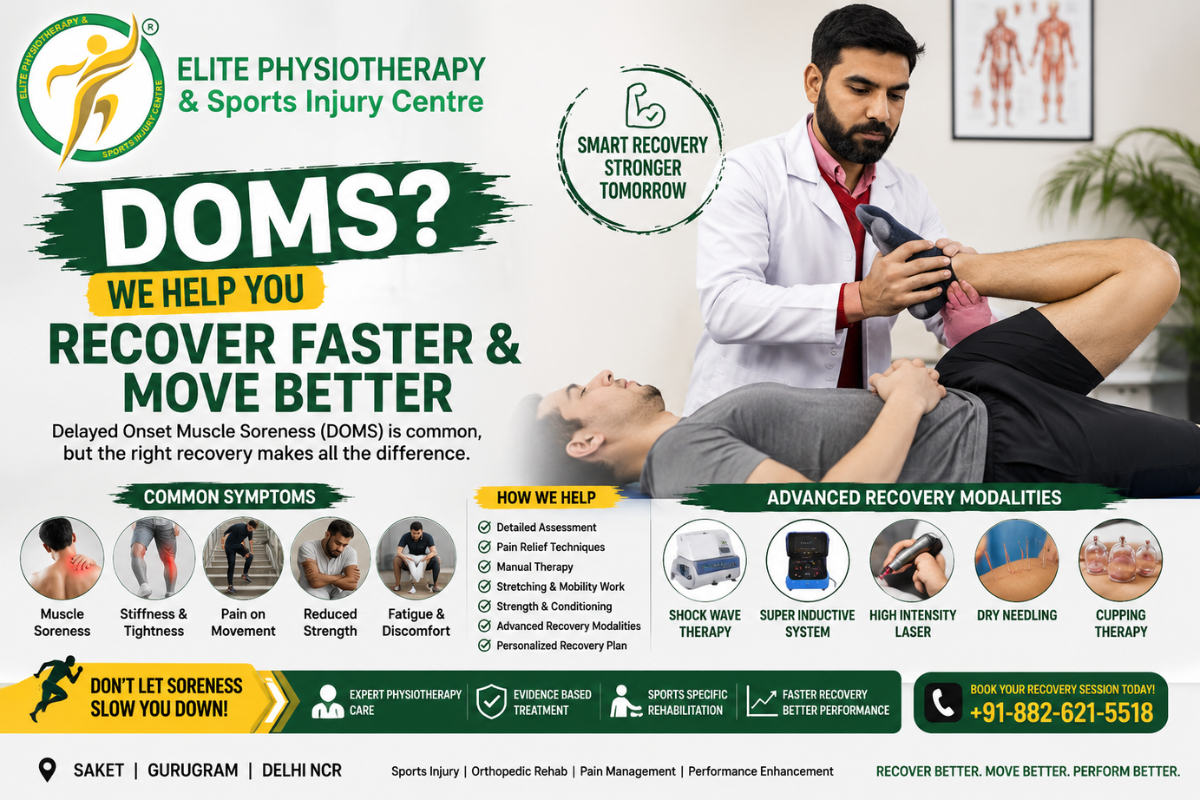
Recovery from delayed onset muscle soreness is crucial following novel or strenuous exercise. DOMS frequently occurs following difficult exercises, particularly when the activity involves novel motions. It typically manifests a few hours after activity and intensifies throughout the course of the following one to three days.
Athletes, gym-goers, runners, weightlifters, and recreational exercisers frequently experience DOMS. Severe pain, meanwhile, shouldn’t always be seen as typical. Severe pain can occasionally be a sign of a strained muscle or another injury.
Our strategy at Elite Physiotherapy and Sports Injury Center centers on determining the cause of soreness. Based on training load, symptoms, mobility quality, and performance objectives, we then choose the best recuperation techniques. The facility offers sports and orthopedic physical therapy services in Delhi NCR.
If you’re looking for physiotherapy in Delhi, Saket, or nearby, a professional evaluation can be helpful if your muscular ache becomes severe or chronic.
What Is Delayed Onset Muscle Soreness?
Muscle soreness following unusual or intense physical exercise is known as delayed onset muscle soreness, or DOMS.
It is not the same as pain experienced right away while exercising.
After exercise, DOMS typically appears 12 to 24 hours later. Usually, symptoms peak between 24 and 72 hours.
Then, when the muscles heal, the pain progressively subsides.
Exercises requiring large eccentric muscle contractions frequently result in DOMS.
The muscle lengthens and generates force during an eccentric contraction.
Examples include:
Lowering a barbell during a biceps curl
Descending during a squat
Walking downhill
Landing from a jump
Lowering weights during resistance training
Decelerating during sprinting
Performing Nordic hamstring exercises
Introducing new plyometric exercises
DOMS does not inherently indicate that an exercise was successful.
Similarly, the lack of DOMS does not imply that a workout was useless.
Progressive overload, proper exercise selection, recuperation, diet, and performance adaptability all affect training quality.
Why Does DOMS Happen?
The precise workings of DOMS are intricate.
Nonetheless, the illness is caused by a number of physiological processes.
Muscle tissue experiences mechanical stress as a result of unfamiliar activity. Muscle structures may experience microscopic alteration as a result of this stress.
An inflammatory response is then produced by the body.
This response contributes to:
Muscle tenderness
Temporary stiffness
Reduced force production
Reduced range of motion
Altered movement
Increased sensitivity
Temporary reduction in exercise performance
Compared to well-known concentric exercise, eccentric exercise can cause more muscle injury.
But muscular injury is not the only factor contributing to DOMS.
The experience of discomfort is influenced by multiple ways.
These include decreased muscular performance, connective tissue stress, sensory nerve sensitivity, and alterations in inflammatory mediators.
Consequently, DOMS need to be seen as a transient physiological reaction to novel stimulus.
What Causes Delayed Onset Muscle Soreness?
Sudden Training Increase
New Exercises
Eccentric Training
High Training Intensity
Sudden Return to Exercise
High-Volume Sports Training
Poor Recovery
Clinical Features of DOMS
Muscle tenderness
Stiffness
Aching pain
Reduced muscle flexibility
Temporary weakness
Reduced exercise performance
Pain during muscle contraction
Pain during muscle stretching
Local muscle sensitivity
Reduced range of motion
Difficulty performing familiar movements
How Is DOMS Different From an Acute Muscle Injury?
This distinction is crucial.
DOMS typically takes time to manifest.
Acute muscular injuries frequently cause pain while performing the activity.
When sprinting, a sudden, acute feeling could be a sign of a strained muscle.
On the other hand, DOMS is more constant with soreness that develops gradually the next day.
Other warning signs include:
Sudden severe pain
Significant swelling
Bruising
Major weakness
Loss of function
Severe pain during normal movement
A palpable defect in the muscle
Persistent symptoms
Dark or cola-colored urine
The final symptom may be a sign of rhabdomyolysis, a dangerous illness.
Such symptoms need to be evaluated by a doctor very once.
Delayed Onset Muscle Soreness Recovery: What Helps?
Restoring comfortable movement is the main goal of effective delayed onset muscle pain rehabilitation.
Eliminating all feeling at once is not the goal.
Rather, the objective is to maintain healthy physical activity while promoting recuperation.
Relative Rest
Active Recovery
Gentle Mobility Exercises
Progressive Exercise Therapy
Load Management
Manual Therapy
Dry Needling for DOMS
Cupping Therapy
High-Intensity Laser Therapy
Super Inductive System
Shock Wave Therapy for DOMS
Recovery-Focused Strength Training
Sleep and Recovery
Nutrition and Hydration
How Long Does DOMS Last?
DOMS commonly improves within several days.
The duration depends on:
Exercise intensity
Training novelty
Muscle group
Training volume
Individual recovery
Previous training exposure
Sleep
Nutrition
Soreness usually decreases with repeated exposure to the same exercise.
This reaction is commonly referred to as the “repeated-bout effect.”
As a result, progressive training can eventually lessen excessive discomfort.
Can You Exercise With DOMS?
Yes, however the choice of exercises is important.
When symptoms are minor, light activity is usually tolerated.
However, it might not be appropriate to train the very aching muscle intensely.
The athlete should modify:
Resistance
Volume
Speed
Range of motion
Exercise complexity
If movement quality deteriorates, training should be modified further.
DOMS Prevention Strategies
Gradually Increase Training Load
Introduce New Exercises Gradually
Warm Up Properly
Maintain Strength
Manage Weekly Training
Monitor Training Response
Prioritize Recovery
When Should You See a Physiotherapist?
Professional assessment is recommended when:
Pain is severe
Pain started suddenly during exercise
Significant swelling develops
Bruising appears
Strength decreases considerably
Normal walking becomes difficult
Symptoms continue longer than expected
Pain repeatedly returns
Training performance continues to decline
You suspect a muscle strain
You experience dark urine after intense exercise
Why Choose Elite Physiotherapy for DOMS and Sports Recovery?
Our method at Elite Physiotherapy and Sports Injury Center goes beyond providing short-term pain alleviation.
We assess the causes of increased discomfort in the muscles.
These include exercise technique, recovery behaviors, strength, flexibility, mobility, training load, and movement quality.
Our physiotherapy approach may combine:
Detailed clinical assessment
Sports physiotherapy
Exercise therapy
Strength and conditioning
Manual therapy
Mobility training
Load management
Dry needling
Cupping therapy
High-Intensity Laser Therapy
Super Inductive System
Shock Wave Therapy when clinically indicated
Sport-specific rehabilitation
Elite offers sports rehabilitation and sophisticated physical therapy services throughout Delhi NCR. Sports physiotherapy, dry needling, home physiotherapy, help for strength training, and other rehabilitation choices are among its services.
Final Takeaway
One common reaction to unfamiliar or demanding exercise is delayed onset muscle soreness.
Severe pain, however, shouldn’t be written off as typical.
A thorough evaluation aids in differentiating DOMS from other musculoskeletal disorders and muscle strain.
Appropriate activity, gradual exercise, training-load management, sleep, diet, and customized physiotherapy are all necessary for effective recovery from delayed onset muscle soreness.
Treatment may occasionally be enhanced by advanced methods.
But rather than taking its place, they need to assist rehabilitation.
Our team at Elite Physiotherapy and Sports Injury Center integrates sophisticated treatment technology, sports-specific care, exercise rehabilitation, clinical evaluation, and evidence-based physiotherapy.
A professional evaluation can assist you in making an informed recovery if you are suffering from chronic post-workout discomfort or diminished performance.