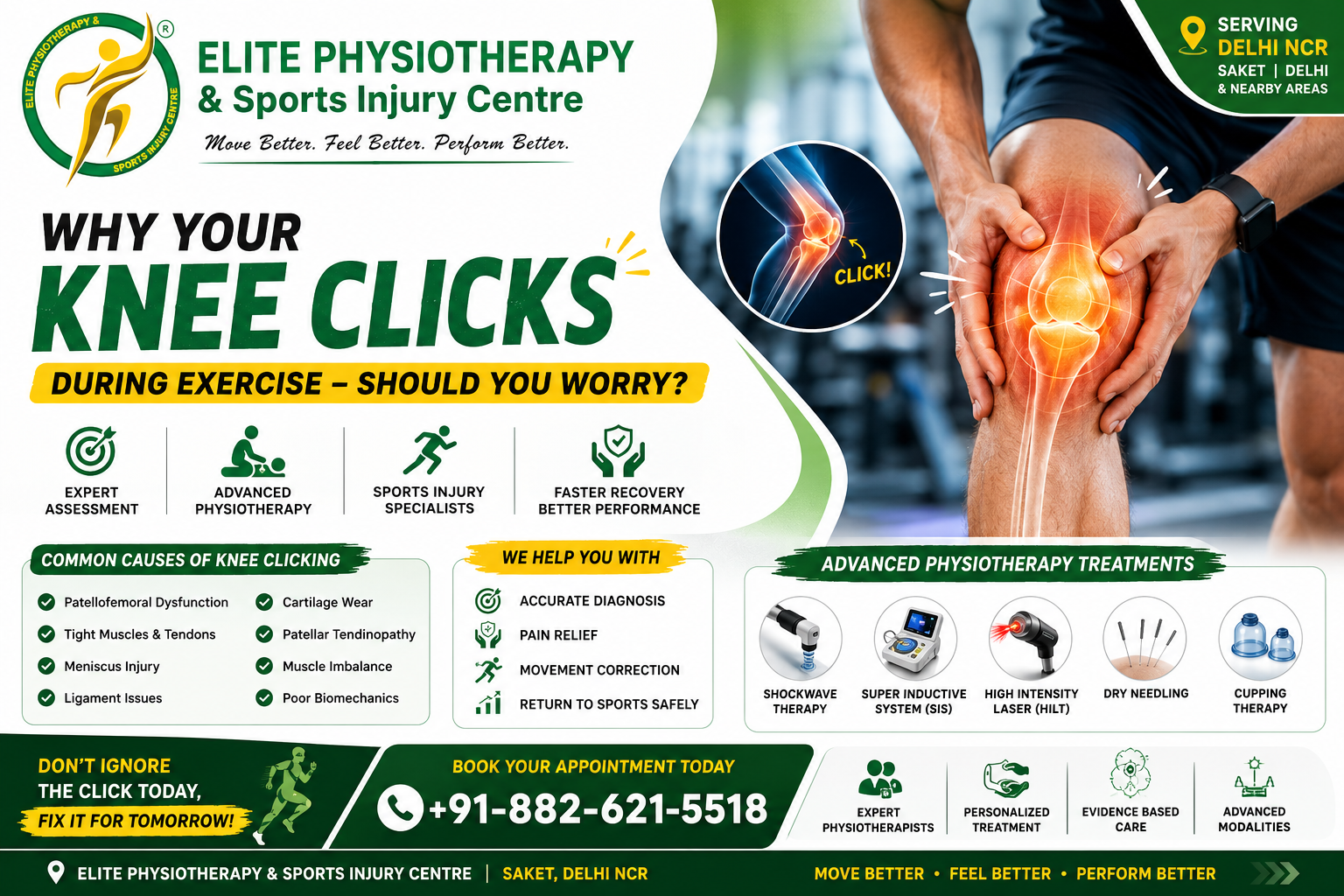
Should You Worry About Knee Clicking During Exercise?
During exercise, a lot of people hear odd noises coming from their knees. Running, stair climbing, squats, and other gym workouts might occasionally cause the knee to pop, fracture, or click. These sounds are often innocuous. However, some people report that the sound is accompanied by pain, swelling, or instability. Consequently, it becomes crucial to comprehend the cause of knee clicking during exercise.
We regularly evaluate athletes, fitness enthusiasts, runners, office workers, and gym patrons with knee issues at Elite Physiotherapy & Sports Injury Centre. Patients in Delhi NCR can receive evidence-based physiotherapy treatment regimens from our knowledgeable staff. Whether you’re looking for physiotherapy Saket, physiotherapy Delhi, or physiotherapy near me, our clinic focuses on treating the underlying problem rather than just the symptoms.
The causes, symptoms, diagnosis, physiotherapy evaluation, and advanced rehabilitation techniques for knee clicking during activity are all covered in this comprehensive book.
What Is Knee Clicking During Exercise?
The term “knee clicking” describes auditory or tactile noises produced by the knee joint during motion.
These noises could consist of:
Clicking
Popping
Cracking
Snapping
Grinding
This ailment is frequently referred to as “crepitus” by medical professionals. Certain clicking sounds are produced spontaneously by soft tissue movement, gas bubbles, or joint movement. On the other hand, chronic or painful clicking could be a sign of ligament damage, cartilage irritation, muscular imbalance, or joint dysfunction.
The knee joint is very intricate. Bones, cartilage, ligaments, tendons, muscles, and synovial structures are all included. As a result, even little movement mistakes can produce strange noises.
Is Knee Clicking Dangerous?
Not all the time.
In most cases, painless knee clicking is not dangerous. When squatting or ascending stairs, a lot of healthy people click without getting hurt. However, you should get evaluated by a physiotherapist if the clicking is connected to:
Pain
Swelling
Knee locking
Instability
Reduced motion
Difficulty exercising
Recent trauma
Recurrent giving way
To determine if the clicking is pathological or normal, Elite Physiotherapy & Sports Injury Center always conducts thorough biomechanical investigation.
Common Causes of Knee Clicking During Exercise
Patellofemoral Joint Dysfunction
When moving, the kneecap could not glide smoothly. Friction between the patella and femur results from this. When squatting or climbing stairs, this frequently makes clicking noises.
This condition is very prevalent among gym-goers and runners.
Contributing factors:
Weak quadriceps
Tight iliotibial band
Poor hip control
Muscle imbalance
Flat feet
Tight Muscles and Tendons
During movement, tendons can occasionally break across bone surfaces. Abnormal tracking may be caused by tight quadriceps, hamstrings, or the iliotibial band.
This is a common reaction of athletes to intense training loads.
Meniscus Injury
Inside the knee, the meniscus serves as a shock absorber. Clicking, catching, or locking sensations could be caused by a torn meniscus.
Common symptoms:
Joint line pain
Swelling
Locking
Pain during twisting
This issue is frequently brought on by sports injuries.
Ligament Injury
Knee mechanics may be affected by partial ligament damage. During exercise, clicking sounds may result from abnormal movement patterns.
Commonly involved ligaments include:
ACL
PCL
MCL
Cartilage Wear and Early Arthritis
Friction within the knee is increased by cartilage degradation. Commonly involved ligaments include:As a result, clicking and grinding noises could appear.
This is more common in:
Older adults
Obese individuals
Previous knee injury patients
Synovial Plica Syndrome
The knee joint contains a fold called the synovial plica. Sensations of snapping or clicking may result from irritation of this structure.
Athletes who frequently bend their knees are particularly vulnerable.
Patellar Tendinopathy
When jumping or landing, overuse of the patellar tendon can cause pain and clicking.
This condition is common in:
Basketball players
Volleyball athletes
Runners
Gym athletes
Gas Bubble Formation
Gas bubbles can occasionally occur in joint fluid. There is a bursting sound when these bubbles explode. Usually, this is harmless and painless.
Types of Knee Clicking
Physiological Clicking
This type is harmless.
Features:
No pain
No swelling
Full movement
Occasional sound only
Pathological Clicking
This requires medical assessment.
Features:
Painful clicking
Swelling
Locking
Instability
Reduced performance
Common risk factors:
Poor exercise technique
Muscle weakness
Sudden training increase
Previous knee injury
Obesity
Sedentary lifestyle
Tight muscles
Improper footwear
Poor biomechanics
Weak hip muscles
Physiotherapy Management for Knee Clicking During Exercise
Physiotherapy is the most effective conservative treatment for most knee clicking conditions.
At Elite Physiotherapy & Sports Injury Centre, treatment focuses on:
Reducing pain
Improving movement quality
Correcting biomechanics
Restoring muscle balance
Preventing recurrence
Returning patients to exercise safely
Pain Management and Activity Modification
Initially, painful activities are modified temporarily.
However, complete rest is rarely recommended. Controlled movement promotes healing and maintains strength.
Elite Physiotherapy & Sports Injury Centre provides advanced evidence-based rehabilitation across Delhi NCR.
Our clinic combines:
Sports physiotherapy expertise
Biomechanical analysis
Manual therapy
Advanced modalities
Athlete rehabilitation
Return-to-play testing
Whether you are searching for physiotherapy near me, physiotherapy Delhi, or physiotherapy Saket, our expert team delivers personalized rehabilitation programs for every patient.
We focus on restoring movement, reducing pain, and helping you return to activity confidently.
Conclusion
Exercise-related knee clicking is widespread. Thankfully, a large number of instances are benign. But clicking that hurts or doesn’t go away should never be disregarded.
The precise cause might be determined with the aid of a thorough physiotherapy evaluation. Early intervention promotes long-term knee health and stops symptoms from getting worse.
Our skilled physiotherapists at Elite Physiotherapy & Sporting Injury Centre provide individualized rehabilitation plans based on your functional objectives, sporting demands, and movement patterns.
Don’t wait for your knee to get worse if it clicks while you’re exercising. Your performance can be safely enhanced and pain-free movement restored with the right physiotherapy treatment.