



Inntroduction
- A lot of folks begin their rehabilitation with online activities. But healing isn’t usually that easy. Every injury has unique behavior. Treatment should therefore be tailored to the patient’s condition, objectives, degree of pain, and quality of movement. Athletes, office workers, fitness enthusiasts, and post-surgical patients frequently dispute the merits of home exercise programs vs supervised physiotherapy. Supervised physiotherapy offers professional direction, correction, advancement, and sophisticated rehabilitation techniques, while at-home exercises aid in maintaining strength and mobility.
- We integrate individualized rehabilitation programs with evidence-based physical therapy at Elite Physiotherapy and Sports Injury Centre. Accurate evaluation, movement correction, pain management, strength development, and return-to-performance training are the main areas of expertise for our Delhi NCR specialists.
- Knowing the difference between supervised rehabilitation and unsupervised at-home exercises will help you recover more quickly and safely, regardless of whether you look for physiotherapy in Saket, Delhi, or your area.
What Is a Home Exercise Program?
- A Home Exercise Program, or HEP for short, is a collection of recommended exercises done on your own at home. These exercises are often created by physiotherapists based on the patient’s condition and stage of rehabilitation.
- These exercises could consist of:
- Stretching exercises
- Mobility drills
- Strengthening exercises
- Postural correction exercises
- Core stability training
- Balance training
- Breathing exercises
- Home programs are crucial because they promote patient involvement. They also increase consistency in between sessions of physical treatment.
- But without supervision, a lot of patients do exercises wrong. As a result, they may develop compensating habits, prolonged discomfort, stiffness, or delayed healing.
What Is Supervised Physiotherapy?
- Rehabilitation under the supervision of a licensed physiotherapist is known as supervised physiotherapy. Pain, movement quality, muscle activation, biomechanics, and exercise progression are all regularly monitored by the therapist.
- Supervised rehabilitation at Elite Physiotherapy and Sports Injury Center consists of:
- Detailed physical assessment
- Movement analysis
- Manual therapy
- Exercise correction
- Strength progression
- Return-to-sport rehabilitation
- Pain management modalities
- Functional training
- Injury prevention strategies
- Every activity in supervised physiotherapy is tailored to the patient’s present level of physical capability.
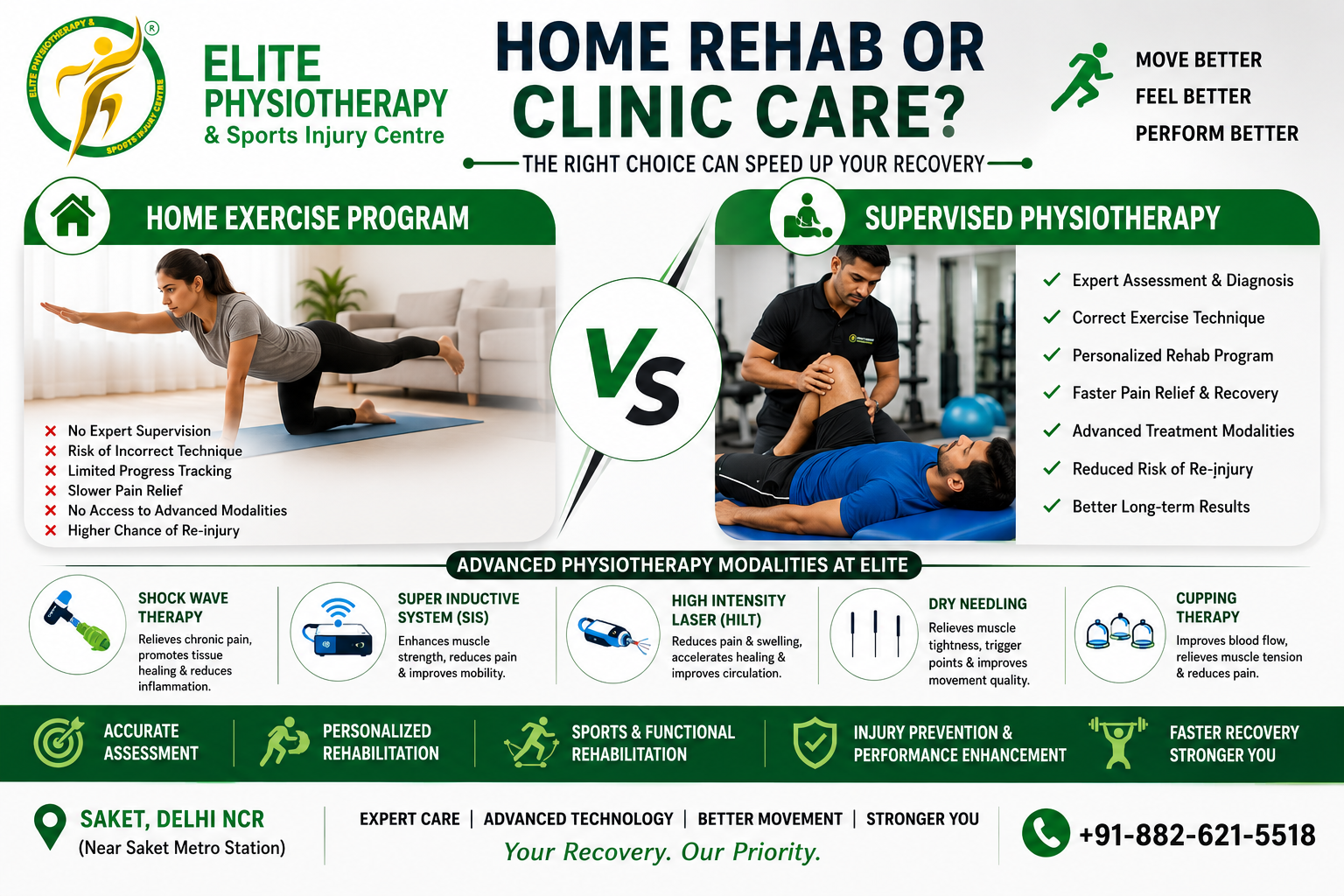
Supervised Physiotherapy vs Home Exercise Program
- Exercise Accuracy
- The therapist corrects posture, muscle activation, and movement mechanics during supervised physical therapy. Exercises done at home, however, frequently lack correction. As a result, patients could execute motions improperly.
- Motivation and Compliance
- Lack of motivation causes many patients to quit working out at home. Supervised sessions, on the other hand, enhance consistency and accountability.
- Injury Progression Monitoring
- Physiotherapists keep a close eye on strength, range of motion, discomfort, and edema. As a result, when symptoms change, exercises can be changed right away.
- Advanced Treatment Access
- Home exercise programs cannot provide advanced modalities such as:
- Shockwave Therapy
- Super Inductive System
- High Intensity Laser Therapy
- Dry Needling
- Cupping Therapy
- Home exercise programs cannot provide advanced modalities such as:
- These treatments are available during supervised physiotherapy sessions at Elite Physiotherapy and Sports Injury Centre.
- Faster Return to Activity
- A quicker and safer recovery is frequently the result of supervised rehabilitation. This is particularly true for people with chronic pain issues, athletes, and patients recovering from surgery.
Conditions That Require Supervised Physiotherapy
- Although home programs help mild conditions, supervised physiotherapy becomes essential in several situations.
- Sports Injuries
- Athletes require monitored rehabilitation to restore:
- Strength
- Agility
- Power
- Stability
- Movement efficiency
- Post-Surgical Rehabilitation
- Patients after ACL reconstruction, rotator cuff repair, meniscus surgery, or spinal surgery need controlled rehabilitation progression.
- Chronic Pain Conditions
- Persistent pain conditions often involve poor movement patterns and muscle imbalance. Therefore, expert supervision becomes necessary.
- Neurological Conditions
- Balance, coordination, and gait training require professional monitoring for safety.
- Elderly Rehabilitation
- Older adults need supervision to reduce fall risk and improve confidence.
Common Problems Seen With Unsupervised Home Exercise Programs
- Many patients search online for random exercises. Unfortunately, incorrect exercise selection can worsen symptoms.
- Common issues include:
- Increased pain
- Poor exercise technique
- Muscle compensation
- Delayed healing
- Reduced mobility
- Exercise fear
- Recurrent injury
- Poor posture
- Tendon irritation
- Common issues include:
- At Elite Physiotherapy and Sports Injury Centre, we frequently treat patients whose symptoms increased after unsupervised exercise routines.
Clinical Features and Symptoms Requiring Physiotherapy Supervision
- Patients may require supervised physiotherapy if they experience:
- Persistent pain
- Joint stiffness
- Reduced mobility
- Muscle weakness
- Swelling
- Instability
- Poor balance
- Difficulty walking
- Difficulty climbing stairs
- Reduced sports performance
- Recurrent injury
- Numbness or tingling
- Reduced endurance
- Fear of movement
- These symptoms indicate the need for professional physiotherapy assessment.
Physiotherapy Management: Why Supervised Rehabilitation Works Better
Pain Management
Pain reduction is the first goal of physiotherapy treatment.
- At Elite Physiotherapy and Sports Injury Centre, we use:
- Manual therapy
- Soft tissue mobilization
- Joint mobilization
- Taping techniques
- Movement correction
- Therapeutic exercises
- These techniques reduce pain while improving function.
Exercise Correction and Movement Retraining
- Exercise quality matters more than exercise quantity.
- Physiotherapists monitor:
- Joint alignment
- Muscle recruitment
- Breathing pattern
- Core activation
- Load distribution
- Physiotherapists monitor:
- Correct movement reduces stress on tissues and prevents reinjury.
Strength and Conditioning Rehabilitation
- Strength deficits commonly persist after injury. Therefore, rehabilitation must focus on progressive loading.
- Our physiotherapy programs include:
- Isometric strengthening
- Resistance training
- Functional strengthening
- Plyometric progression
- Sports-specific drills
- Core stability exercises
- Our physiotherapy programs include:
- Athletes at Elite receive advanced return-to-performance rehabilitation programs.
Mobility and Flexibility Restoration
- Restricted mobility can affect biomechanics and performance.
- Physiotherapists use:
- Joint mobilization
- Stretching techniques
- Myofascial release
- Mobility drills
- Neural mobilization
- These treatments improve movement quality and reduce stiffness.
Balance and Proprioception Training
- Balance deficits increase reinjury risk.
- Therefore, supervised rehabilitation includes:
- Single-leg balance training
- Dynamic stability exercises
- Perturbation training
- Reaction drills
- Sport-specific coordination exercises
- Therefore, supervised rehabilitation includes:
- This is particularly important after ankle sprains, ACL injuries, and neurological conditions.
Advanced Modalities at Elite Physiotherapy and Sports Injury Centre
- Shockwave Therapy
- Super Inductive System (SIS)
- High Intensity Laser Therapy (HILT)
- Dry Needling
- Cupping Therapy
Can Home Exercise Programs Still Help?
- Yes. Home exercise programs remain important.
- However, they work best when combined with professional supervision.
- At Elite Physiotherapy and Sports Injury Centre, patients receive:
- Customized exercise plans
- Exercise videos
- Progress tracking
- Rehabilitation monitoring
- Exercise progression guidance
- This hybrid approach improves long-term outcomes.
Who Benefits Most From Supervised Physiotherapy?
- Athletes
- Office Workers
- Elderly Individuals
- Post-Surgical Patients
- Chronic Pain Patients
Why Choose Elite Physiotherapy and Sports Injury Centre?
- At Elite Physiotherapy and Sports Injury Centre, we combine modern rehabilitation with evidence-based physiotherapy.
- Our clinic in Delhi NCR provides:
- Personalized physiotherapy treatment
- Sports rehabilitation
- Advanced pain management modalities
- Return-to-play rehabilitation
- Strength and conditioning
- Functional movement correction
- Athlete-specific rehabilitation
- Post-surgical rehabilitation
- Whether you search for physiotherapy Delhi, physiotherapy Saket, or physiotherapy near me, our team focuses on long-term recovery and performance optimization.
Conclusion
- Exercise regimens at home and physiotherapy under supervision are both crucial for healing. On the other hand, supervised rehabilitation offers sophisticated therapy alternatives, movement correction, expert assessment, and exercise progression.
- The finest recovery results are produced by combining planned at-home workouts with professional physiotherapy.
- At Elite Physiotherapy and Sports Injury Centre, we create customized rehabilitation plans that enable patients to heal safely, move with assurance, and come back stronger.
- Professional physiotherapy can make a big difference whether your everyday life or athletic performance is impacted by pain, stiffness, weakness, or injury.