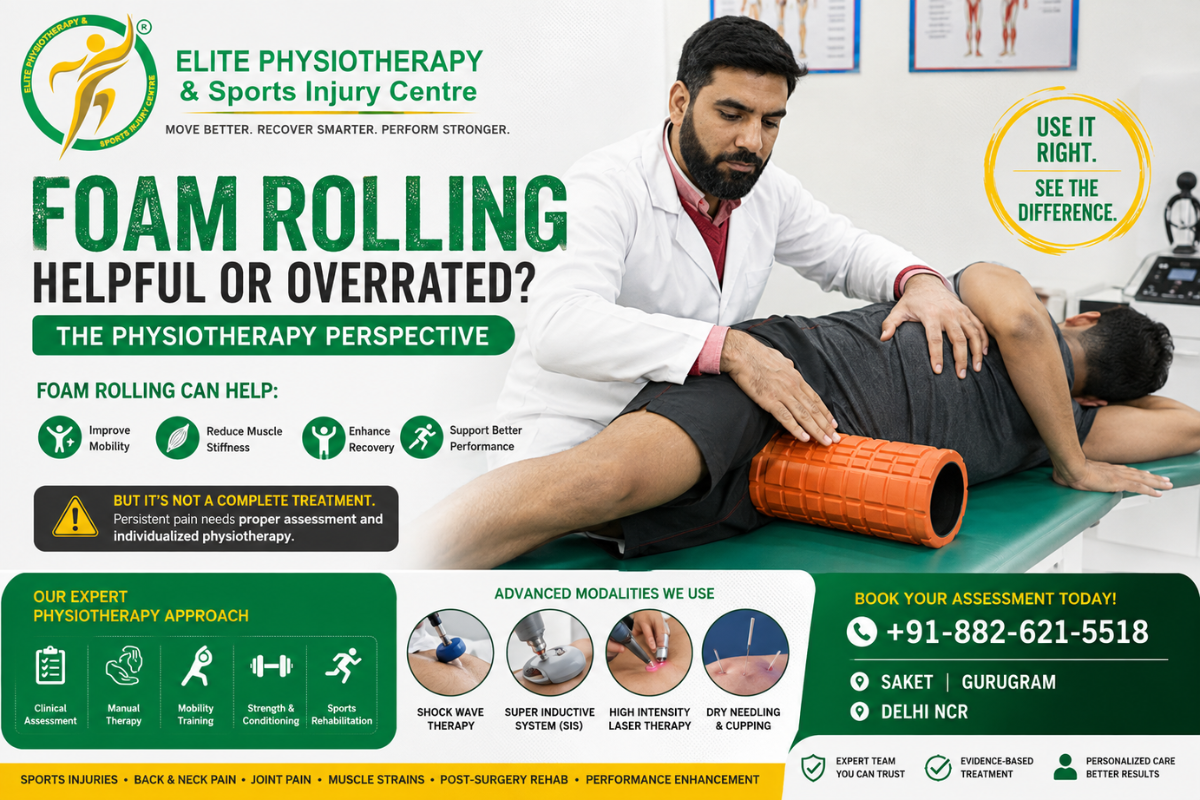
Athletes, gym-goers, runners, and active individuals have come to love foam rolling. Movement can be enhanced and perceived muscular stiffness can be decreased using foam rolling treatment. It is hardly a panacea, though.
Before working out, a lot of folks utilize foam rollers. Some use them to lessen discomfort following exercise. For pain relief, some people even use them every day.
Does foam rolling, however, really work?
Contrary to what social media frequently implies, the response is more impartial.
Foam rolling may aid in healing and increase range of motion, according to research. It does not, however, always perform better than every other warm-up technique. Physiotherapists should therefore apply it in accordance with each patient’s demands.
Foam rolling is a supplement to therapeutic rehabilitation at Elite Physiotherapy and Sports Injury Center. When necessary, our team integrates advanced physiotherapy, manual therapy, strengthening, mobility training, and movement correction.
Making muscles feel loose is not the only objective.
The objective is to improve your mobility, performance, and safety of recovery.
What Is Foam Rolling?
One method of self-myofascial release is foam rolling.
It entails exerting precise pressure on the surrounding soft tissues and muscles. The individual passes gently over a foam roller that is cylindrical in shape.
Foam rolling can affect range of motion, movement tolerance, muscular stiffness, and pain sensitivity.
It doesn’t actually “break up” muscles.
Additionally, not all so-called muscle knots are permanently removed by it.
Rather, transient alterations in the sensation of movement may be caused by the neural system and mechanical stimulation.
Foam rolling has been shown to improve joint range of motion. Crucially, these modifications do not always result in decreased muscle function.
Why Do People Feel Tight?
Tight muscles can result from a number of factors.
It’s not always the case that a tight sensation indicates a physically shortened muscle.
Common contributing factors include:
High training volume
Muscle fatigue
Delayed-onset muscle soreness
Reduced joint mobility
Poor movement control
Prolonged sitting
Repetitive activity
Sudden training increases
Previous injuries
Poor recovery
Stress
Lack of sleep
Reduced physical activity
A runner might roll their outside thigh repeatedly, for instance.
But hip weakness or bad running form could be the real issue.
In a similar vein, the calf may be rolled repeatedly.
The ankle joint may be the source of the actual limitation.
Thus, clinical reasoning should be the first step in foam rolling physiotherapy.
Is Foam Rolling a Treatment?
It is best to think of foam rolling as a self-management strategy.
It can help with physical rehabilitation.
It shouldn’t, however, be the first line of treatment for pain.
Appropriate evaluation is necessary for persistent discomfort.
At Elite Physiotherapy and Sports Injury Centre, our Team evaluates:
Pain
Mobility
Muscle strength
Joint function
Movement quality
Training load
Previous injuries
Functional limitations
Sports-specific demands
Elite offers sports and orthopedic physiotherapy services all across Delhi NCR. In addition, the clinic provides sports physiotherapy, strength training, gait and posture analysis, dry needling, functional manual therapy, and sports performance services.
Benefits of Foam Rolling
Temporary Range of Motion Improvement
Reduced Perceived Stiffness
Post-Exercise Recovery
Movement Preparation
Clinical Features That May Respond to Foam Rolling
General muscle stiffness
Exercise-related soreness
Perceived muscle tightness
Reduced mobility
Post-training discomfort
Temporary movement restrictions
Reduced flexibility
Muscle fatigue
However, persistent symptoms require assessment.
How to Perform Foam Rolling Correctly
Technique is important.
The patient should move slowly and deliberately.
The chosen muscle should be followed by the roller.
Steer clear of harsh pressure.
There could be some minor discomfort.
Sharp pain, though, is not the goal.
The individual should continue to breathe normally.
Avoid putting the roller directly on sore joints.
Additionally, it shouldn’t be applied forcefully to damaged tissue.
When Should You Avoid Foam Rolling?
Acute injuries
Open wounds
Significant bruising
Acute swelling
Fractures
Recent surgical sites
Severe unexplained pain
Medically concerning vascular areas
Common Foam Rolling Mistakes
Rolling Too Hard
More pressure does not mean better treatment.
Excessive pressure can increase sensitivity.
Rolling Through Sharp Pain
Sharp pain is a warning sign.
Do not use pain as proof that the technique is working.
Rolling for Too Long
Long sessions are not automatically better.
Use targeted and controlled treatment.
Ignoring Strength
Mobility without strength may not improve function.
Progressive strengthening remains essential.
Treating Every Problem as Muscle Tightness
Pain can originate from joints, tendons, nerves, ligaments, or other structures.
Assessment is therefore essential.
Ignoring Training Load
Repeatedly rolling an overloaded muscle does not correct excessive training volume.
Load management remains critical.
A Better Foam Rolling Strategy
Instead of rolling the entire body randomly, follow a structured approach.
Identify the Limitation
Determine the Relevant Tissue
Apply Controlled Foam Rolling
Follow With Mobility
Activate the Relevant Muscles
Strengthen
Reassess
How Elite Physiotherapy Uses Foam Rolling
We do not recommend foam rolling at Elite Physiotherapy and Sports Injury Center just because a muscle feels tight.
First, our team determines the root cause of the issue.
Next, we assess if foam rolling can aid in healing.
Depending on the evaluation, the program might incorporate:
Foam rolling
Manual therapy
Joint mobilization
Soft-tissue techniques
Mobility exercises
Strength training
Neuromuscular training
Dry needling
Cupping
Shock Wave Therapy
Super Inductive System
High-Intensity Laser Therapy
Sport-specific rehabilitation
Final Takeaway
Foam rolling is neither a worthless fitness fad nor a miracle treatment.
Short-term mobility may be enhanced by it.
It might lessen the impression of stiffness.
It might aid in recovery after physical activity.
However, a thorough clinical evaluation is necessary for chronic pain.
Our team at Elite Physiotherapy and Sports Injury Center integrates advanced modalities when necessary, mobility training, progressive strengthening, manual therapy, sports rehabilitation, and evidence-based physiotherapy.
Instead of using a foam roller to treat every problem, go for an assessment-driven strategy when looking for physiotherapy near me, physiotherapy Delhi, or physiotherapy Saket.