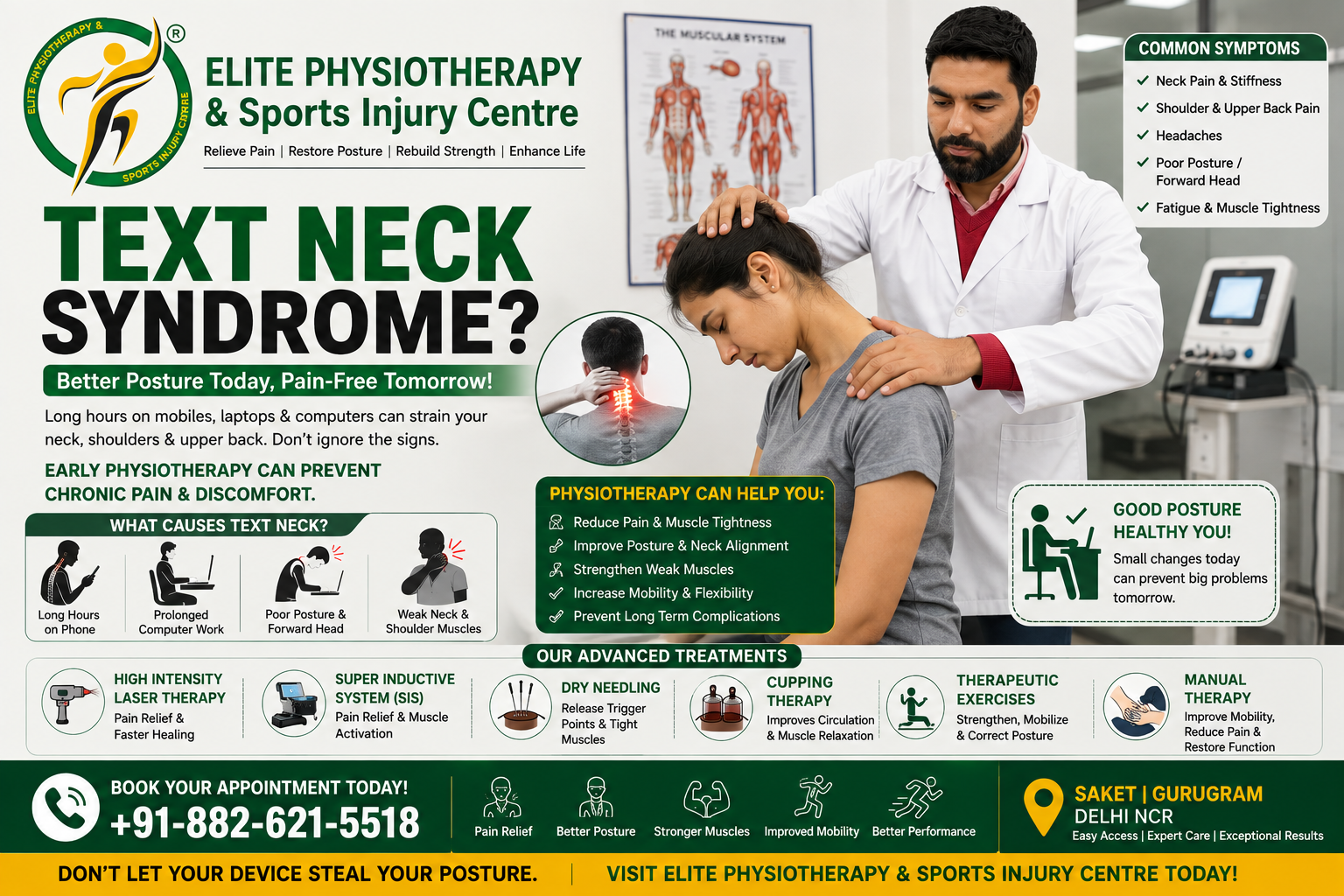
Computers, laptops, tablets, and smartphones are becoming necessities in everyday life. But extended screen time has also led to a contemporary health issue called Text Neck Syndrome. Teens use their phones for leisure and study purposes for several hours every day. Similarly, office workers frequently spend a lot of time sitting in front of computers. As a result, bad posture puts undue strain on the upper back, shoulders, and neck. In this article, we will discuss text neck syndrome treatment
Fortunately, early intervention with Text Neck Syndrome Physiotherapy can prevent long-term consequences, enhance muscular strength, restore posture, and lessen pain. Our team at Elite Physiotherapy and Sports Injury Centre uses cutting-edge technologies, customized rehabilitation plans, and sophisticated diagnostic methods to deliver evidence-based physiotherapy. Whether you’re looking for physiotherapy in Saket, Delhi, or nearby.
What is Text Neck Syndrome?
Long-term forward head bending while staring at smartphones, tablets, computers, or other digital devices can result in text neck syndrome, a repetitive stress injury. The cervical spine and associated soft tissues are subjected to an increased mechanical strain as a result of this prolonged position.
The average weight of a human head is between 4.5 and 5.5 kilograms. However, the effective stress on the cervical spine increases significantly as the head goes forward.
Head Position
Approximate Load on Neck
Neutral (0°)
5 kg
15° Forward
12 kg
30° Forward
18 kg
45° Forward
22 kg
60° Forward
27 kg
As a result, maintaining a slightly forward head posture for a few hours every day might result in joint dysfunction, ligament strain, muscle exhaustion, and persistent neck pain.
There is more than one illness associated with text neck syndrome. Rather, it is a confluence of cervical spine-related muscular, ligamentous, joint, and postural issues.
Why is Text Neck Becoming So Common?
Long-term device use is encouraged by modern lifestyles. Teens spend many hours per day playing games, using social media, and attending online classes. In a similar vein, office workers use computers for extended periods of time without proper ergonomic assistance.
Several factors contribute to this growing problem:
Increased smartphone use
Long computer working hours
Poor workstation ergonomics
Lack of physical activity
Weak postural muscles
Reduced awareness of correct posture
Continuous screen exposure without breaks
Remote work culture
Online education
As a result, physiotherapists now encounter Text Neck Syndrome more frequently than ever before.
Causes of Text Neck Syndrome
Poor Smartphone Posture
Prolonged Computer Work
Poor Laptop Position
Long Study Hours
Weak Postural Muscles
Lack of Exercise
Psychological Stress
Poor Ergonomics
Risk Factors
Certain individuals are more likely to develop Text Neck Syndrome.
These include:
Teenagers
College students
IT professionals
Graphic designers
Software engineers
Bank employees
Content creators
Call center executives
Gamers
Remote workers
Online teachers
Corporate professionals
The risk also increases with:
More than four hours of smartphone use daily
More than six hours of computer work
Sedentary lifestyle
Poor physical fitness
Obesity
Previous neck injury
How Does Text Neck Syndrome Develop?
Long-term neck flexion initially wears out the muscles. As a result, stabilizing muscles atrophy and overused muscles become taut.
Cervical joints are abnormally compressed as posture deteriorates. Overstretching of the ligaments results in altered movement patterns.
Over months or years, several changes may occur:
Forward head posture
Rounded shoulders
Reduced cervical lordosis
Joint stiffness
Myofascial trigger points
Muscle imbalance
Reduced cervical mobility
Decreased muscular endurance
Chronic pain sensitization
Without proper Text Neck Syndrome Physiotherapy, these changes may become progressively more difficult to reverse.
Shoulder Symptoms (Shoulder tightness, Upper trapezius pain, Scapular discomfort, Burning sensation between the shoulder blades)
Headache
Postural Changes (Forward head posture, Rounded shoulders, Increased thoracic kyphosis, Elevated shoulders, Scapular winging in some individuals)
Neurological Symptoms (Tingling in the arms, Hand numbness, Reduced grip strength, Arm heaviness)
Functional Limitations (Difficulty studying, Reduced work productivity, Pain while driving, Difficulty reading, Poor concentration, Sleep disturbance, Reduced sports performance)
Possible Complications if Left Untreated
Chronic neck pain
Persistent forward head posture
Cervical disc degeneration
Cervical radiculopathy
Cervicogenic headaches
Shoulder impingement
Thoracic outlet symptoms
Myofascial pain syndrome
Reduced work efficiency
Poor athletic performance
Sleep disturbances
Recurrent episodes of neck stiffness
Physiotherapy Management of Text Neck Syndrome
At Elite Physiotherapy and Sports Injury Centre, our Team follows an evidence-based rehabilitation approach. We combine hands-on therapy, corrective exercises, ergonomic education, movement retraining, and advanced physiotherapy technologies to achieve long-term recovery. Patients looking for physiotherapy Delhi, physiotherapy Saket, or physiotherapy near me receive personalized treatment plans designed to restore function and improve quality of life.
Pain Management During the Acute Phase Cervical mobility exercises Soft tissue relaxation Heat therapy for muscle tightness when appropriate Cold therapy if acute inflammation is present Gentle stretching within pain-free limits
Stretching Program Upper Trapezius Stretch Levator Scapulae Stretch Sternocleidomastoid Stretch Scalene Stretch Pectoralis Major Stretch Pectoralis Minor Stretch Thoracic Extension Stretch
Deep Cervical Flexor Training Supine chin nods. Pressure biofeedback exercises. Head lift progression. Functional sitting exercises. Standing posture exercises.
Scapular Stabilization Exercises Scapular setting. Scapular retraction. Wall slides. Prone Y exercises. Prone T exercises. Serratus punches. Dynamic hugging. Resistance band rows.
Postural Correction Training Chin tuck without excessive neck extension. Gentle scapular retraction and depression. Relaxed shoulder positioning. Neutral lumbar posture. Balanced weight distribution while standing. Maintaining the ears in line with the shoulders.
Motor Control Retraining Coordinated activation of deep cervical flexors. Proper timing of scapular stabilizers. Smooth cervical movements. Controlled transitions between sitting and standing. Functional movement during daily tasks.
Due to increased screen usage and bad posture, text neck syndrome has emerged as one of the most prevalent musculoskeletal issues among teens and office workers. Fortunately, pain can be effectively reduced, normal movement can be restored, posture can be improved, and long-term consequences can be avoided with early diagnosis and evidence-based physiotherapy.
Our team at Elite Physiotherapy and Sports Injury Centre offers complete Text Neck Syndrome Physiotherapy using advanced technologies like High-Intensity Laser Therapy (HILT), Super Inductive System (SIS), Dry Needling, and Cupping Therapy when clinically indicated, as well as individualized rehabilitation, ergonomic education, manual therapy, and progressive exercise prescription. People in Delhi NCR can confidently return to work, education, sports, and daily life with our patient-centered approach.
If you are looking for expert physiotherapy Delhi, physiotherapy Saket, elite rehabilitation, or physiotherapy near me, visit Elite Physiotherapy and Sports Injury Centre and let our Team help you restore healthy posture and pain-free movement.