



Scan or Skill? What Truly Guides Recovery
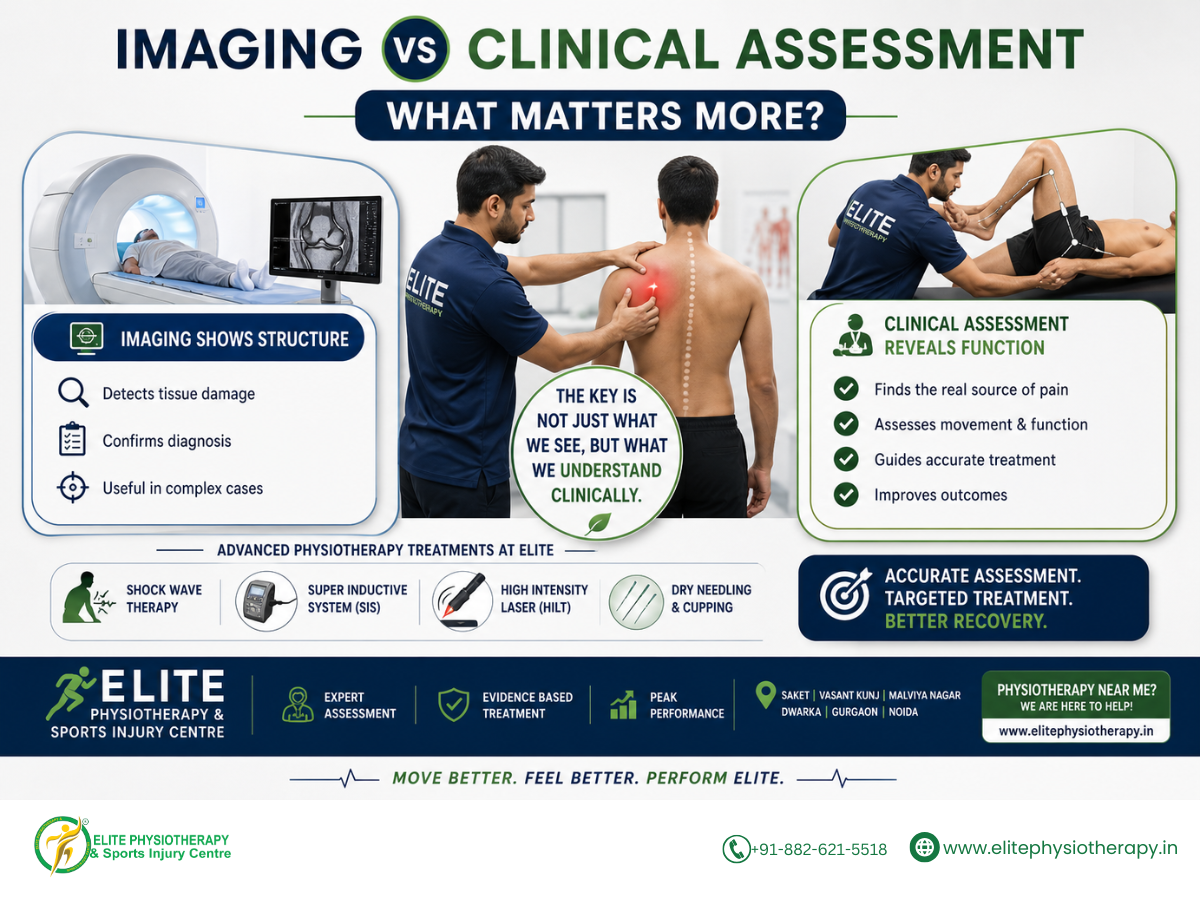
- A frequent argument in contemporary healthcare is between imaging and clinical assessment. A lot of patients think scans show everything. This isn’t always the case, though. At Elite Physiotherapy & Sports Injury Centre, we stress that both science and expert evaluation are necessary for a correct diagnosis.
- This balance is emphasized by the important phrase “clinical assessment vs imaging.” Clinical evaluation exposes function, whereas imaging reveals structure. Better results are thus guaranteed when both are combined.
- Knowing this idea might alter your recuperation process if you’re looking for physiotherapy nearby, particularly in Saket or Delhi.
What is Clinical Assessment vs Imaging?
- Imaging versus clinical assessment refers to two methods of diagnosis:
- Clinical Assessment: A physiotherapist’s practical assessment. It consists of unique testing, movement analysis, and history.
Imaging: Technology-based instruments such as CT, MRI, ultrasound, and X-ray. These display structural alterations. - Imaging helps with visual clarity, but it is not always able to explain discomfort or malfunction. As a result, clinical reasoning is crucial to physiotherapy.
- Clinical Assessment: A physiotherapist’s practical assessment. It consists of unique testing, movement analysis, and history.
Why Does This Debate Exist?
- Confusion between imaging and clinical assessment arises for several reasons:
- Over-reliance on MRI and scans
- Misinterpretation of imaging findings
- Incidental findings without symptoms
- Lack of functional assessment
- Patient expectations for “visible proof.”
- For instance, a lot of patients have MRI disc bulges but no pain. Others, however, experience excruciating agony during routine scans.
Types / Classification
The concept of clinical assessment vs imaging can be divided into:
- Structural Diagnosis (Imaging-Based)
Focuses on tissues like bones, discs, ligaments
Examples: MRI for ligament tears, X-ray for fractures - Functional Diagnosis (Clinical Assessment-Based)
Focuses on movement, strength, and biomechanics
Identifies root cause of dysfunction - Integrated Diagnosis
Combines both methods
Considered the gold standard in elite physiotherapy practice
Physiotherapy Management
At Elite Physiotherapy & Sports Injury Centre, we prioritize clinical assessment vs imaging for precise treatment planning.
- Pain Management
- First, we use modern methods to alleviate discomfort. Tissue repair is enhanced by high-intensity laser therapy. It successfully lowers inflammation. The Super Inductive System aids in pain management and neuromuscular activation.
- Shockwave therapy also works well for long-term ailments like tendinopathy. It promotes the regeneration of tissue. Cupping and dry needling relax tense muscles and enhance blood flow.
- Movement Correction
- We concentrate on fixing poor movement patterns after reducing pain. Poor biomechanics is a major cause of injuries.
- To restore normal movement, we employ focused physiotherapy activities. Soft tissue release and joint mobilization fall under this category. These methods lessen stiffness and increase flexibility.
- Strength and Stability Training
- Recurrent discomfort is frequently caused by muscle weakness. Strengthening is therefore crucial.
- We create individualized rehabilitation plans. These emphasize muscular balance, joint control, and core stability. To improve performance, athletes receive conditioning tailored to their particular sport.
- Functional Rehabilitation
- We then go on to functional training. This phase gets the patient ready for everyday tasks or athletic endeavors.
- Exercises imitate how people move in real life. This guarantees a safe resumption of activities. Our focus at Elite is on performance-based rehabilitation.
- Injury Prevention
- Lastly, we instruct patients. The secret to long-term health is prevention.
- We offer at-home workout regimens, ergonomic guidance, and posture correction techniques. This lowers the chance of future injuries.
Why Clinical Assessment Matters More
- Imaging has limitations despite its usefulness. It is unable to evaluate the quality of movement. It is also unable to quantify pain behavior.
- A comprehensive picture is provided by clinical examination. It pinpoints the underlying reason. Thus, functional evaluation should always take precedence over imaging in clinical assessment.
- Both methods are combined at Elite Physiotherapy & Sports Injury Center. This guarantees a precise diagnosis and a quicker recovery.
Conclusion
- The argument between imaging and clinical assessment is not about picking one over the other. Rather, it’s about making sensible use of both.
- Treatment is guided by clinical knowledge. Confirmation is supported by imaging. When combined, they produce the finest outcomes.
- Visit Elite Physiotherapy & Sports Injury Centre if you’re searching for professional physiotherapy in Saket or Delhi. Get cutting-edge care with a customized approach.