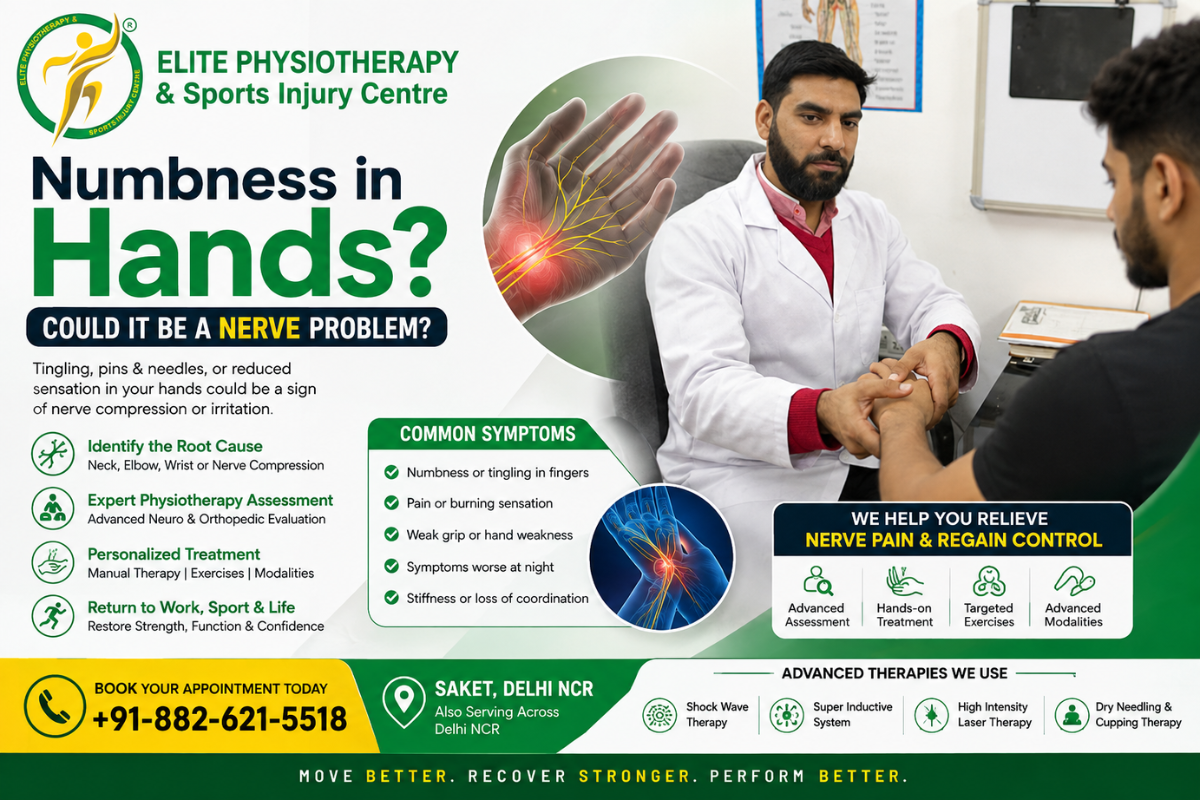
Your ability to work, sleep, exercise, and participate in sports can all be hampered by numb hands. Physiotherapy can assist in determining whether symptoms of hand numbness originate from the wrist, elbow, shoulder, neck, or peripheral nerves. As a result, persistent numbness should never be disregarded.
When using a laptop, you could get tingling. Additionally, you can feel numb while you sleep. Symptoms can occasionally show up when using sports equipment or lifting weights.
Important clinical information is provided by the site of numbness. However, the precise reason cannot be determined by symptoms alone.
From the cervical spine, the nerve system extends to the arm and shoulder. After then, it travels throughout a number of anatomical areas before arriving at the hand.
As a result, nerve irritation might happen in many places.
Our strategy at Elite Physiotherapy and Sports Injury Center is to pinpoint the cause of symptoms. Based on the results of the patient’s evaluation, we next create a customized rehabilitation program.
Sports, neurological, and orthopedic physiotherapy services are offered at our Delhi NCR facility. Additionally, the clinic provides choices for manual therapy and advanced rehabilitation.
What Is Hand Numbness?
Hand numbness describes reduced or altered sensation in part of the hand or fingers.
Patients may describe it as:
Pins and needles Tingling Reduced sensation Burning Electric-shock sensations Prickling Heaviness Altered temperature sensation Feeling of the hand “falling asleep”
When normal sensory nerve signaling is disrupted, numbness results. A peripheral nerve, nerve route, or nerve root may be affected.
Sometimes the issue stems from compression. However, nerve function can also be impacted by trauma, metabolic problems, inflammation, traction, or systemic neurological illnesses. Thus, pinpointing the precise position is crucial.
Why Do Hands Become Numb?
Several structures can contribute to hand numbness.
The most common possibilities include:
Cervical Radiculopathy
Carpal Tunnel Syndrome
Cubital Tunnel Syndrome
Guyon’s Canal Syndrome
Thoracic Outlet Syndrome
Peripheral Nerve Irritation
Diabetes and Peripheral Neuropathy
Vitamin and Nutritional Problems
Trauma and Nerve Injury
Repetitive Work and Poor Ergonomics
When Is Hand Numbness an Emergency?
Some symptoms require urgent medical evaluation.
Seek immediate medical attention when numbness develops suddenly with:
Facial weakness Speech difficulty Severe dizziness Sudden loss of coordination Severe weakness New difficulty walking Sudden vision changes Loss of consciousness
After severe trauma, prompt evaluation is also crucial. Exercises alone should not be used to treat progressive weakness or rapidly worsening neurological problems.
Physiotherapy for Hand Numbness: Treatment Approach
At Elite Physiotherapy and Sports Injury Centre, rehabilitation can combine education, manual therapy, therapeutic exercise, neural mobility, ergonomic correction, and progressive strengthening.
1. Activity Modification
Seldom is total relaxation the ideal long-term course of action. Rather, the therapist pinpoints actions that cause frustration.
For instance, a patient could have to adjust:
Long computer sessions Heavy gripping Prolonged wrist extension Repetitive lifting Sustained elbow flexion Overhead training
The goal is to maintain activity while controlling excessive neural loading.
2. Ergonomic Correction
Ergonomics can be particularly important for office workers.
The therapist may assess:
Chair height Desk height Monitor position Keyboard position Mouse use Wrist posture Elbow position Break frequency
Short movement breaks can reduce prolonged static loading.
3. Wrist Orthosis for Carpal Tunnel Syndrome
Excessive wrist positioning during sleeping might be minimized using a neutral wrist orthosis. When symptoms arise at night, this can be really helpful.
For many mild-to-moderate carpal tunnel presentations, the current 2026 clinical practice guideline suggests education and an adequate immobilization orthosis as the first physical therapy approach. The patient’s symptoms should determine the precise duration and usage.
4. Neural Mobilization
Nerve gliding is a popular term for neural mobilization. Stretching the nerve excessively is not the goal.
Rather, the therapist modifies neuronal excursion and tolerance through regulated motions. It is possible to choose radial, ulnar, or median nerve procedures.
The dosage needs to stay comfortable. After the workout, symptoms shouldn’t get worse over time.
There is currently conflicting information regarding neuronal mobilization in carpal tunnel syndrome. As a result, it need to be recommended based on personal results.
5. Cervical Mobility Exercises
When cervical involvement contributes to symptoms, treatment may include controlled cervical mobility.
Why Choose Elite Physiotherapy and Sports Injury Centre?
At Elite Physiotherapy and Sports Injury Centre, our rehabilitation philosophy focuses on identifying the underlying movement and neurological contributors.
Advanced physiotherapy, manual therapy, dry needling, orthopedic physiotherapy, neurophysiotherapy, spinal rehabilitation, sports physiotherapy, and performance-focused rehabilitation are among the treatments we offer.
Instead of treating just the hand that is symptomatic, we evaluate the whole kinetic chain. This strategy is very helpful for athletes and people who lead active lives.
With a clinic in Saket, Delhi, and additional NCR locations listed on the clinic website, Elite Physiotherapy provides services to patients in Delhi NCR.