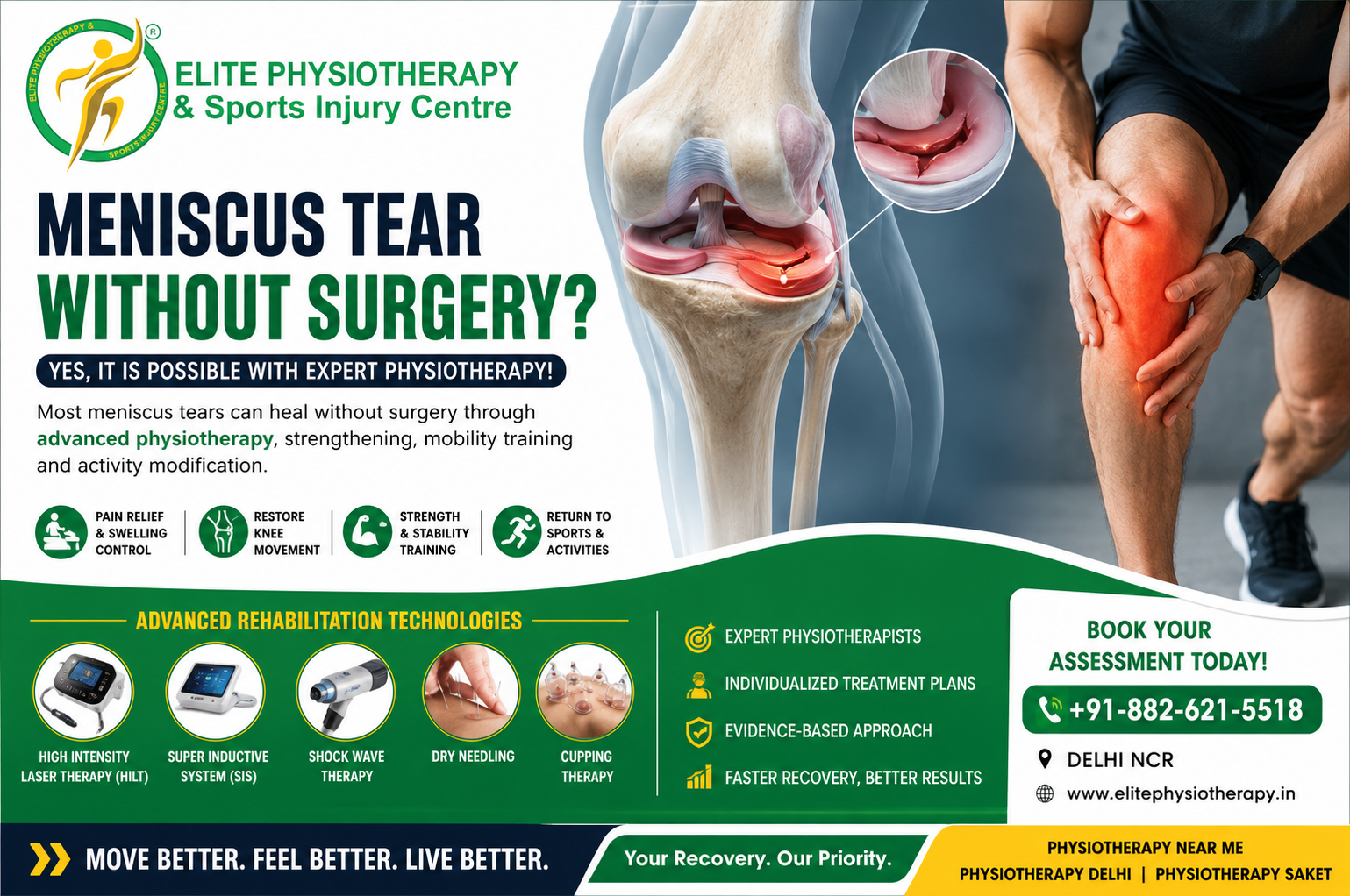
Meniscus Tear Without Surgery – Is It Possible?

Meniscus Tear Without Surgery

Can Physiotherapy Help You Avoid an Operation?

  • Every facet of daily living can be impacted by knee discomfort. Running, crouching, walking, climbing stairs, and participating in sports may become challenging. Meniscus injuries are among the most frequent causes of knee discomfort. Thankfully, surgery is not always required. Under the direction of skilled physiotherapists, Meniscus Tear Without Surgery is frequently a practical and effective therapy strategy.
  • Using evidence-based rehabilitation methods, we at Elite Physiotherapy & Sports Injury Centre frequently assist patients and athletes in recovering from meniscus injuries. Our objectives are to lessen discomfort, enhance strength, restore knee function, and enable people to safely resume their intended activities.
  • Knowing the function of physiotherapy in meniscus recovery will help you make wise choices whether you’re looking for physiotherapy, physiotherapy Delhi, physiotherapy Saket, physiotherapy near me, or specialized sports rehabilitation services.

What Is a Meniscus Tear?

  • Between the shin bone (tibia) and the thigh bone (femur) is a C-shaped cartilage structure called the meniscus. There are two menisci in each knee:
  1. Medial meniscus (inside)
  2. Lateral meniscus (outside)
  • Menisci serve as shock absorbers. They increase joint stability and disperse load across the knee joint. Additionally, they aid in preventing excessive stress on the articular cartilage.
  • When this cartilage is harmed by abrupt twisting, high loading, degeneration, or trauma, a meniscus tear results.
  • A lot of folks think that surgery is the only option. However, current research indicates that for certain patients, meniscus tears without surgery can be quite beneficial.

Can a Meniscus Tear Heal Without Surgery?

  • The response is contingent upon multiple factors:
    • Tear location
    • Tear size
    • Patient age
    • Activity level
    • Knee stability
    • Presence of locking symptoms
  • The blood supply is better in the meniscus’s outer region. As a result, tears in this area frequently heal more quickly.
  • Structured physiotherapy works incredibly well for many small-to-moderate rips. Without surgery, degenerative meniscus rips often heal.
  • Before suggesting a course of treatment, we at Elite Physiotherapy & Sports Injury Centre evaluate each case on an individual basis.

Types of Meniscus Tears

  • Understanding the tear pattern helps determine the most appropriate treatment plan.
  1. Longitudinal Tear
  • The tear runs along the length of the meniscus.
  1. Bucket Handle Tear
  • A large portion of the meniscus becomes displaced. This type may cause knee locking.
  1. Radial Tear
  • The tear extends from the inner edge outward.
  1. Horizontal Tear
  • The meniscus splits into upper and lower sections.
  1. Flap Tear
  • A loose fragment develops and may cause mechanical symptoms.
  1. Complex Tear
  • Multiple tear patterns occur simultaneously.
  1. Degenerative Tear
  • Usually develops gradually due to age-related wear and tear.

Causes of Meniscus Tear

  • Several factors contribute to meniscus injuries.
  1. Sports Injuries – Sudden twisting while the foot remains planted can tear the meniscus.
  2. Deep Squatting – Repeated deep squatting places significant stress on the meniscus.
  3. Sudden Direction Changes – Rapid pivoting movements can overload knee structures.
  4. Age-Related Degeneration – The meniscus becomes less flexible with age.
  5. Repetitive Knee Loading – Occupations involving kneeling and squatting increase risk.
  6. Previous Knee Injuries – Ligament injuries may increase meniscus stress.

Clinical Features and Symptoms

  • Knee pain
  • Joint line tenderness
  • Swelling
  • Stiffness
  • Clicking sensations
  • Locking episodes
  • Catching sensation
  • Reduced knee motion
  • Difficulty squatting
  • Pain during twisting
  • Instability feeling
  • Reduced athletic performance

Physiotherapy Management for Meniscus Tear Without Surgery

  • Physiotherapy is the cornerstone of conservative treatment.
  • The primary goals are:
    • Reduce pain
    • Control swelling
    • Restore movement
    • Improve strength
    • Improve stability
    • Restore confidence
    • Return to sport safely
  • At Elite Physiotherapy & Sports Injury Centre, rehabilitation programs are individualized according to the patient’s goals and clinical presentation.

Pain and Inflammation Management

  • Activity modification
  • Cryotherapy
  • Compression
  • Manual therapy
  • Protected loading

Restoring Knee Mobility

  • Joint mobilization
  • Soft tissue mobilization
  • Active range exercises
  • Stretching techniques

Quadriceps Strengthening

  • Static quadriceps contractions
  • Straight leg raises
  • Terminal knee extensions
  • Wall sits
  • Leg press variations

Hamstring Rehabilitation

  • Isometric exercises
  • Resistance band exercises
  • Eccentric strengthening
  • Functional strengthening drills

Hip and Core Strengthening

  • Glute strengthening
  • Core stabilization
  • Pelvic control exercises
  • Single-leg stability work

Balance and Proprioception Training

  • Single-leg stance exercises
  • Balance boards
  • Dynamic stability drills
  • Sport-specific control exercises

Functional Rehabilitation

  • Squatting progression
  • Lunges
  • Step-ups
  • Running drills
  • Agility exercises
  • Direction-change drills

Advanced Physiotherapy Modalities

  • High Intensity Laser Therapy (HILT)
  • Super Inductive System (SIS)
  • Shock Wave Therapy
  • Dry Needling
  • Cupping Therapy

When Is Surgery Necessary?

  • Although many patients succeed with Meniscus Tear Without Surgery, surgery may be considered when:
    • The knee repeatedly locks
    • Large displaced tears exist
    • Conservative treatment fails
    • Severe instability persists
    • Significant mechanical symptoms remain
  • A physiotherapy assessment can help determine the most appropriate pathway.

Why Choose Elite Physiotherapy & Sports Injury Centre?

  • Our approach includes:
    • Detailed assessment
    • Personalized treatment plans
    • Sports rehabilitation expertise
    • Advanced physiotherapy modalities
    • Return-to-sport testing
    • Patient education
  • Whether you are searching for physiotherapy Delhi, physiotherapy Saket, elite rehabilitation services, or physiotherapy near me, our team is committed to helping you move pain-free and return to the activities you enjoy.

Conclusion

  • Surgery is not always necessary when a meniscus tear occurs. A well-designed physiotherapy program can often prevent meniscus tears without the need for surgery. Knee function and quality of life can be greatly enhanced by appropriate evaluation, gradual strengthening, mobility restoration, and functional therapy.
  • Seek a professional checkup if you are having knee pain, locking, or trouble playing sports. Better results and quicker recovery are frequently the results of early intervention.

Leave a Reply

Your email address will not be published. Required fields are marked *