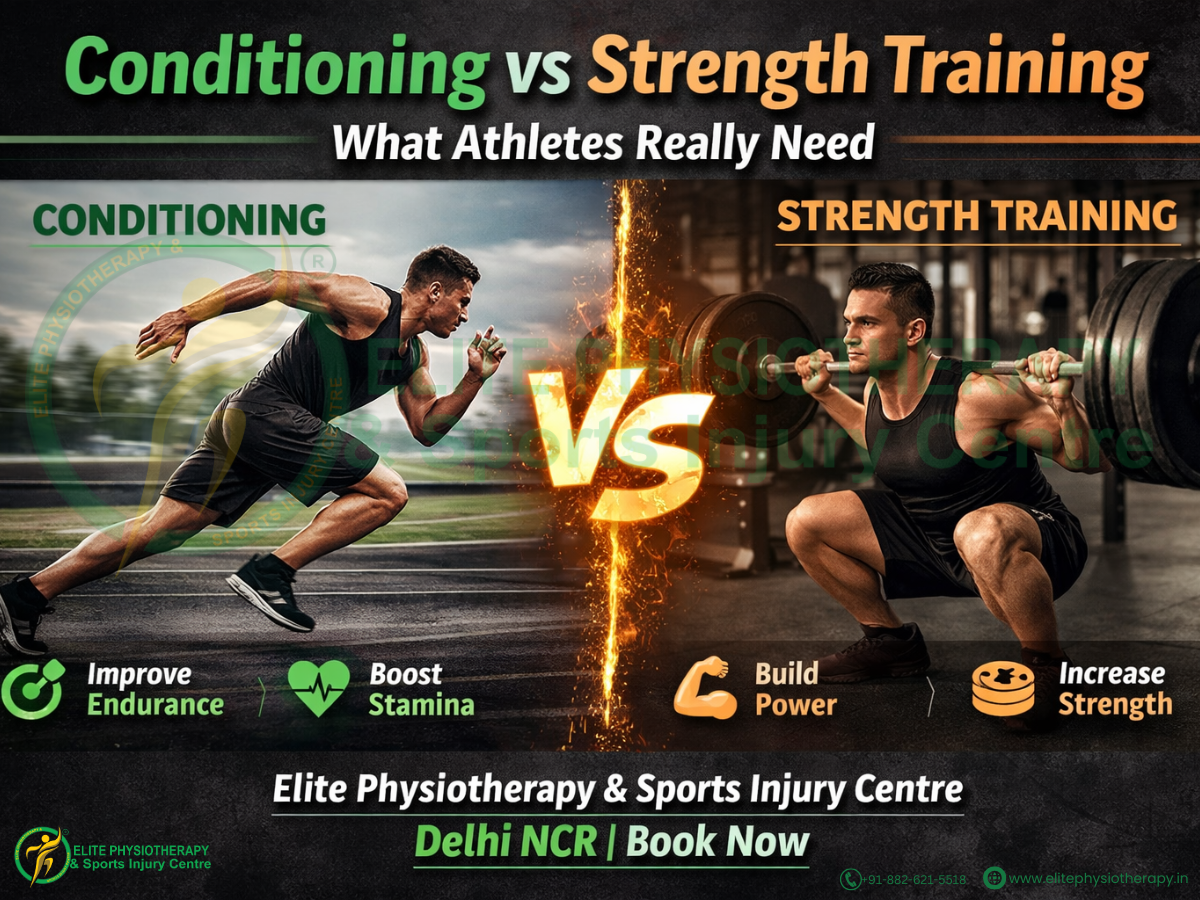
Athletes in contemporary sports frequently mix up strength training with conditioning. Both are necessary. However, performance and injury risk are defined by the proper balance. We witness athletes who overtrain one area while ignoring another at Elite Physiotherapy and Sports Injury Centre. Injuries rise and performance declines as a result.
For athletes, it is therefore essential to distinguish between strength training and conditioning. It enables athletes to perform consistently, recover more quickly, and train more intelligently.
What is Strength Training?
Enhancing muscle force output is the main goal of strength training. Power, joint stability, and general physical resilience are all improved by it.
Types of Strength Training
Maximal strength training
Hypertrophy training
Power training
Functional strength training
For contact sports, explosive movements, and injury prevention, strength training is crucial.
What is Conditioning Training?
Cardiovascular fitness, endurance, and recuperation ability are all enhanced by conditioning training. It encourages consistent performance during games or contests.
Types of Conditioning
Aerobic conditioning
Anaerobic conditioning
Speed and agility training
Sport-specific
Athletes who are conditioned are able to perform well even when they are exhausted.
Conditioning vs Strength Training for Athletes: Key Differences
Feature
Strength Training
Conditioning
Goal
Increase force
Improve endurance
Focus
Muscles
Cardiovascular system
Outcome
Power & stability
Stamina & recovery
Application
Explosive sports
Endurance sports
Why Imbalance Happens (Causes)
Athletes often develop an imbalance due to:
Poor training planning
Lack of professional guidance
Sport-specific bias
Overemphasis on the gym or cardio
Inadequate physiotherapy supervision
At Elite Physiotherapy, we correct these imbalances through structured programs.
Clinical Features of Imbalance
When conditioning vs strength training for athletes is not balanced, symptoms appear:
Early fatigue during games
Reduced power output
Muscle tightness
Recurrent injuries
Poor recovery
Joint instability
These signs indicate the need for professional physiotherapy intervention.
Physiotherapy Management at Elite Physiotherapy
At our physiotherapy Saket clinic, we follow a comprehensive and athlete-specific approach.
Individualized Training Balance
We design programs combining:
Strength cycles
Conditioning blocks
Recovery sessions
This ensures optimal performance.
Strength Training Rehabilitation
We focus on:
Progressive overload
Functional strengthening
Core stability
Plyometric integration
Exercises include:
Squats and deadlifts
Olympic lifts
Resistance band training
This improves power and reduces injury risk.
Conditioning Optimization
We structure conditioning based on sport demands:
Interval training
Sprint drills
Agility ladder work
Endurance circuits
This enhances stamina without compromising strength.
Advanced Physiotherapy Modalities
At Elite Physiotherapy, we integrate high-end technologies:
Shock Wave Therapy
Super Inductive System (SIS)
High Intensity Laser Therapy
Dry Needling & Cupping
Injury Prevention Strategy
We emphasize:
Load management
Movement correction
Mobility training
Recovery protocols
This reduces injury risk significantly.
Why Athletes Need Both
Conditioning vs strength training for athletes is not a choice. It is a combination.
One thing any athlete looking for physiotherapy nearby has to know. Balance is essential for performance. For athletes, conditioning vs strength training needs to be organized carefully.
Expert advice is crucial if you want to increase performance and avoid injuries. Our Delhi NCR Team offers cutting-edge, scientifically supported physiotherapy treatments.