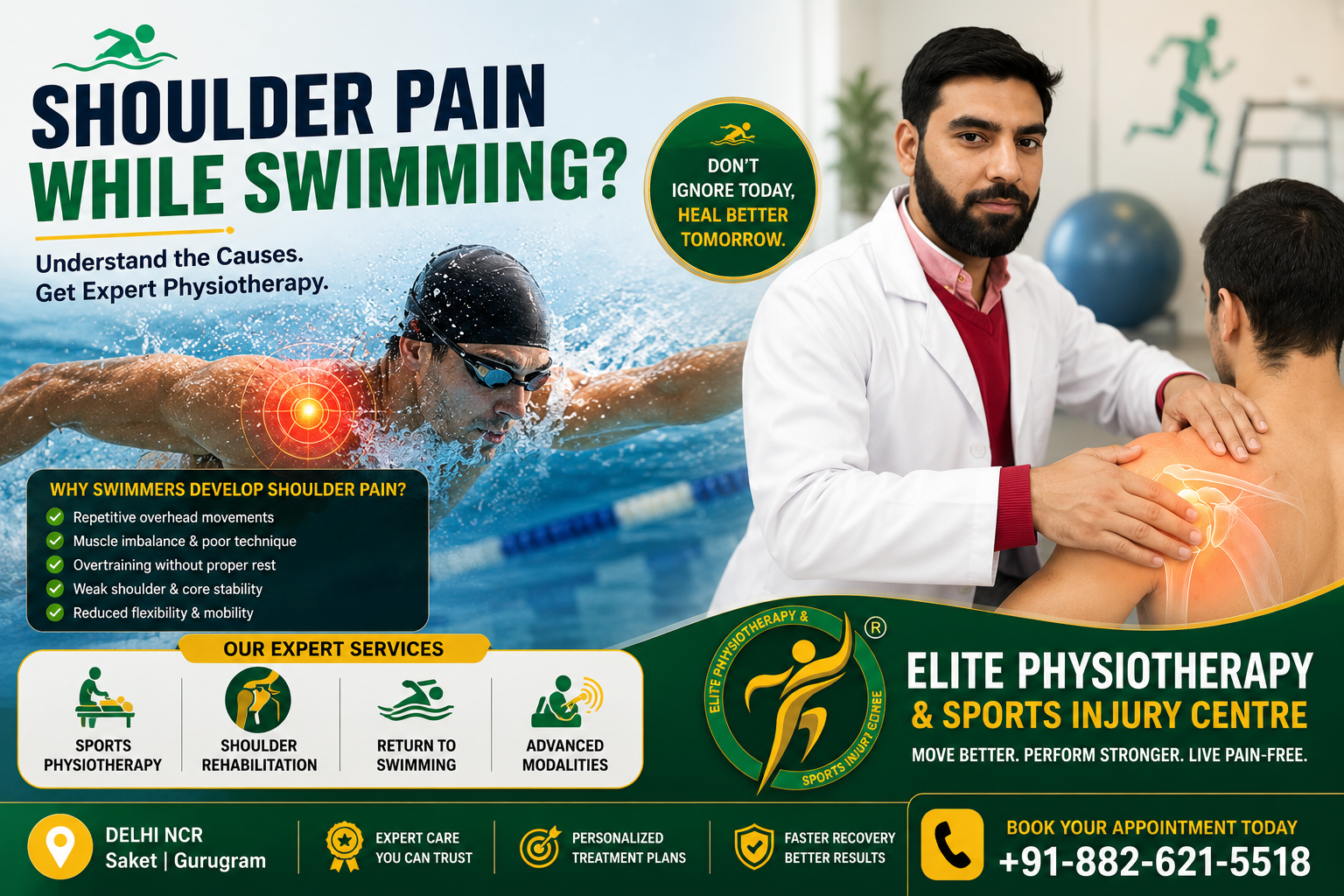
One of the healthiest sports is swimming. It increases general body strength, flexibility, muscular endurance, and cardiovascular health. But each week, swimmers execute thousands of overhead arm motions. As a result, the shoulder joint is under tremendous strain from repeated force.
In order to prevent injuries, lessen pain, restore shoulder function, and assist swimmers in safely returning to the pool, swimmer shoulder physical therapy is crucial. In addition to reducing discomfort, early physiotherapy intervention boosts athletic performance, avoids recurrence, and improves swimming mechanics.
Both leisure and competitive swimmers have shoulder soreness. According to studies, between 40 and 90 percent of elite swimmers have shoulder pain at some point in their careers. Rather than being caused by a single injury, the syndrome typically develops gradually as a result of repeated microtrauma.
Our sports physiotherapists at Elite Physiotherapy and Sports Injury Centre in Delhi NCR are experts at identifying and treating swimmer’s shoulder through thorough clinical evaluation, movement analysis, and evidence-based rehabilitation. In order for athletes to return stronger and more productive, we aim to address the underlying problem in addition to providing pain relief.
Whether you’re looking for physiotherapy in Saket, Delhi, or nearby, our knowledgeable staff offers customized rehabilitation programs for swimmers of all skill levels.
Understanding the Shoulder in Swimmers
The shoulder is the most mobile joint in the human body. It allows movements in multiple directions, making it ideal for swimming strokes such as freestyle, butterfly, backstroke, and breaststroke.
The shoulder complex consists of:
Glenohumeral joint
Acromioclavicular joint
Sternoclavicular joint
Scapulothoracic articulation
These joints work together with numerous muscles, tendons, ligaments, and the shoulder capsule.
Important muscles include:
Rotator cuff muscles
Deltoid
Serratus anterior
Trapezius
Rhomboids
Latissimus dorsi
Pectoralis major
Biceps brachii
During one swimming session, a swimmer may perform more than 2,500 overhead arm cycles. Therefore, even a small muscle imbalance can eventually lead to pain and dysfunction.
What Is Swimmer’s Shoulder?
There is more than one diagnosis for swimmer’s shoulder. Rather, it refers to a collection of excruciating shoulder disorders brought on by frequent overhead swimming motions.
It frequently involves inflammation of the bursae, tendons, muscles, or joints that support the stability of the shoulder.
Because cumulative overload is brought on by repetitive overhead activities, the disease develops gradually. At first, pain only manifests after swimming. But if you ignore it, you can experience pain when exercising, going about your everyday business, and eventually even when you’re at rest.
Athletes frequently adjust with changed movement patterns in the absence of proper swimmer shoulder physical treatment, which puts more strain on the surrounding tissues and results in chronic shoulder trouble.
Why Do Swimmers Develop Shoulder Pain?
Swimming appears smooth and effortless. Nevertheless, each stroke generates considerable force around the shoulder.
Why Choose Elite Physiotherapy and Sports Injury Centre?
Our specialty at Elite Physiotherapy and Sports Injury Centre is evidence-based rehabilitation for athletes and active people in Delhi NCR. Our skilled sports physiotherapists are aware of the particular physical demands that overhead sportsmen and swimmers face.
Our comprehensive approach includes:
Detailed biomechanical assessment.
Sports-specific physiotherapy evaluation.
Individualized rehabilitation programs.
Manual therapy techniques.
Progressive exercise therapy.
Return-to-sport planning.
Advanced physiotherapy technologies, including High-Intensity Laser Therapy (HILT), Super Inductive System (SIS), and Shock Wave Therapy where clinically indicated.
Dry Needling and myofascial techniques when appropriate.
Education on injury prevention and performance optimization.
Whether you’re looking for physiotherapy in Saket, Delhi, or nearby, our hardworking team is committed to ensuring your safe recovery and optimal performance.
Conclusion
One of the most frequent overuse injuries among swimmers is shoulder soreness, but it’s also one of the most avoidable. Successful recovery depends on early symptom detection, prompt diagnosis, and organized therapy.
In addition to reducing discomfort, swimmer shoulder physical therapy aims to improve strength, restore shoulder mechanics, address movement abnormalities, and avoid further injuries. The complete kinetic chain is addressed by a thorough rehabilitation program, guaranteeing that the shoulder performs well during each swimming stroke.
To assist swimmers in returning to the pool with confidence, we at Elite Physiotherapy and Sports Injury Centre, Delhi NCR, integrate cutting-edge clinical assessment, evidence-based physiotherapy, and contemporary rehabilitation technologies.
Do not wait for shoulder pain to develop into a chronic issue if it is interfering with your training or performance. Early intervention can safeguard your long-term shoulder health, enhance performance, and reduce recovery time.