Cross Bracing Protocol (CBP) for ACL Rehab

What is the Cross Bracing Protocol?

For certain acute ACL ruptures, the Cross Bracing Protocol (CBP) is a time-sensitive, non-surgical treatment option. For the first four weeks, the knee is in a 90° flexion position. After that, the brace is gradually unlocked to restore motion, to mimic the remaining ACL so that the native ligament can repair. Early results from prospective cohorts report high rates of MRI continuity at 3 months; clinical trials are still being conducted to determine suitable individuals and longer-term outcomes.

Why it matters

A totally ruptured ACL was formerly thought to be incapable of healing, necessitating early repair or conventional rehabilitation without bracing. Recent data casts doubt on that belief. In a secondary analysis of the KANON trial, approximately one-third of ACLs treated solely with rehabilitation had MRI evidence of healing at two years (and roughly one-half when those who underwent surgery were excluded), and the healed group had better patient-reported outcomes. By purposefully placing the knee to encourage tissue apposition as soon as possible after injury, CBP enhances this healing potential.

Who is (and isn’t) a Candidate?

The best candidates typically show up early (preferably within 10 days after the injury), have an MRI showing an acute ACL rupture, and can follow bracing and follow-up instructions to the letter. MRI morphology (such as remnant quality, displacement, and gap distance) and patient characteristics (sport demands, support, and comorbidities) are progressively taken into account during the selection process.

Not suitable for all: Clinicians are frequently pushed onto alternative approaches due to multi-ligament injuries, displaced bucket-handle meniscal tears/loose bodies requiring urgent surgery, extremely delayed presentation, or enhanced thrombosis risk. (CBP-using programs typically sort them out in the early stages of MRI-guided decision making.)

How the Protocol Works

The basic idea is to protect the healing ACL from anterior tibial translation and pivoting by initially reducing and immobilizing (similar to a fracture) and then gradually restoring motion every week.

Weeks 1–4

  • Brace: locked at 90° (24/7; sleep in brace).
  • Weight-bearing: Non-weight-bearing (NWB) with crutches.
  • Goals: protect the healing zone, maintain patellofemoral mobility, prevent deconditioning (safe isometrics).

5th Week

  • Brace 60–90°. Continue NWB. Begin gentle, brace-permitted ROM drills; progress isometric hamstring/quadriceps sets in allowed angles.

6th Week

  • Brace ~45–90°. Still NWB. Add stationary bike within brace limits if permitted.

7th Week

  • Brace 30–120°. Partial weight-bearing begins; gait retraining within brace range. Light closed-chain work in safe angles.

Week 8

  • Brace 20–120°. Progress PWB loading, proprioception in brace.

Week 9

  • Brace 10–120°. Full weight-bearing as tolerated in brace; advance strength, balance, conditioning tasks (pool if available) without pivoting/cutting.

Weeks 10–11

  • Unrestricted brace during the day; remove for sleep. Continue progressive strengthening, linear conditioning, and landing mechanics in straight plane.

Week 12

  • MRI and clinical review. The brace is taken off, and criterion-based rehabilitation continues if the MRI reveals sufficient continuity and clinical stability. If not, a “cross-over” to surgery or an extension of bracing may be part of the collaborative decision-making process.

Beyond 12 weeks (typical milestones)

  • Weeks 16–17: Start straight-line running (criteria-based).
  • ~6–12 months: Athletes gradually return to training and then progress to sport-specific change of direction once they achieve goals for strength, symmetry, hop testing, and movement quality. Many programs plan for nine to twelve months before a complete return to pivoting sports.

Rehabilitation Priorities

Protection & monitoring (0–12 wks)

  • Teach people to use crutches, wear braces strictly, and refrain from twisting or pivoting.
  • Ankle pumps, hip/glute/hamstring isometrics, and early patellar mobilization (knee maintained within brace limits).
  • Some programs aggressively monitor DVT risk (local techniques vary; some reported early DVTs spurred teams to embrace pharmacologic prophylaxis).

Strength & motor control (weeks 5–12)

  • Avoid anterior shear (no open-chain knee extension in vulnerable ranges) and increase closed-chain strength in safe arcs.
  • Brace ROM connects directly with balance, trunk/hip control, and graded conditioning (bike, pool, and later treadmill).

Run-jump-cut reconditioning (post-brace)

  • Linear running → decel/accel → low-level plyometrics → planned change-of-direction → unplanned COD and sport skills after meeting patient-reported outcomes targets and ROM/strength/hop/movement benchmarks.

To prevent vasoconstriction during the initial healing window, some CBP teams prohibit the use of NSAIDs, knee aspiration, and even cryotherapy.

What Does the Evidence Say (so far)?

  • High MRI early healing with CBP: Three months after CBP, a prospective cohort reported ~90% ACL continuity, and patients with greater early MRI healing achieved better results. Researchers still need randomized longer-term results.
  • In certain situations, ACLs can heal without surgery: In the KANON dataset, MRI showed healing in around 30 to 50% of patients who underwent rehabilitation alone, independent of CBP.. The KOOS results of the healed groups were better than those of the non-healed/reconstructed groups.
  • Risk-benefit balance: Although reviews point to encouraging healing, they also emphasize the danger of stiffness, the necessity of careful selection and adherence, and the possibility that some patients will require surgery.

CBP vs. Traditional ACL Management

DimensionCross Bracing ProtocolTraditional Reconstruction / Standard Non-Op
Primary goalHeal the native ACL (biologic healing)Replace with graft (surgery) or compensate via neuromuscular rehab
Early positioningImmobilize at 90° flexion for 4 weeks, then staged ROMPrioritize full extension early; brace often locked in extension initially post-op; no prolonged flexion immobilization
Weight-bearing (early)NWB first weeks; add load as brace range increasesWBAT early after ACLR; progress as swelling/quad control allow
ROM strategyDelayed extension; weekly unlock scheduleImmediate mobilization, especially regain full extension to avoid arthrofibrosis
Cryotherapy & NSAIDsSome programs limit early NSAIDs/icing (program-specific)Commonly used to control pain/effusion post-injury/surgery
MonitoringScheduled MRI at ~3 months to confirm continuityImaging usually not required once post-op course is stable
Time to pivot sportsTypically ≥9–12 months and criteria-basedAlso ≥9–12 months and criteria-based (graft maturity & testing)
Key risksStiffness/extension loss if mishandled; non-healing → cross-over to surgeryGraft failure, donor-site morbidity, cyclops lesions, and surgical risks
Time to pivot sportsMotivated, early-presenting patients willing to adhere strictly; favorable MRI patternGraft failure, donor-site morbidity, cyclops lesions, surgical risks

At Elite Physiotherapy and Sports Injury Centre, we integrate the latest evidence-based approaches, such as the Cross-Bracing Protocol (CBP), alongside traditional ACL rehabilitation and surgical recovery programs. With our advanced facilities—including Super Inductive Stimulation (SIS), Class 4 Laser Therapy, CRET Therapy, Shockwave Therapy, and Hydrotherapy—we ensure that every patient receives a personalized, high-end rehabilitation plan. Our focus is not just on healing the ligament but also on restoring strength, balance, and performance, so athletes and active individuals can safely return to their sport or lifestyle with confidence.

ACL Injuries: Its Best Physiotherapy Treatment

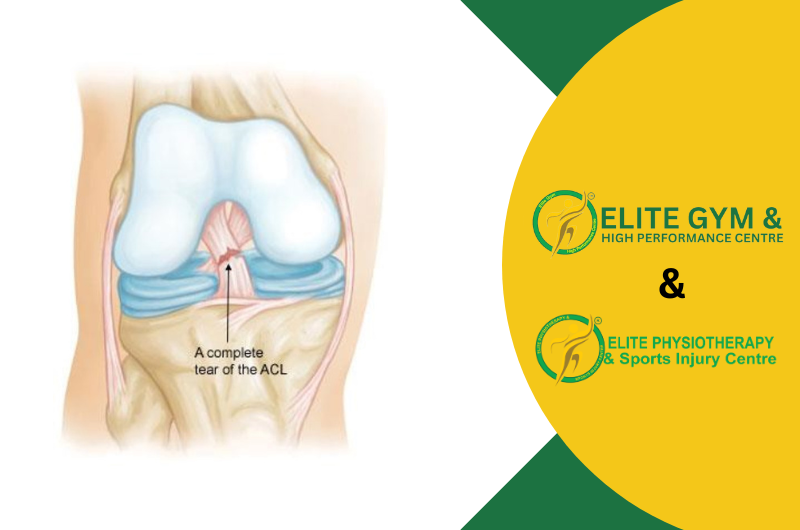
One of the main stabilizers of the knee joint is the Anterior Cruciate Ligament (ACL), which controls rotational stability and limits the tibia’s excessive forward motion in relation to the femur. ACL injuries are among the most frequent sports-related injuries, especially among athletes who play activities like football, cricket, basketball, skating, and weightlifting that require abrupt stops, direction changes, and jumping. To assist athletes and active people in their recovery, Elite Physiotherapy and Sports Injury Centre offers specialist, evidence-based treatment for ACL injuries.

Understanding ACL Injuries

The ACL is a strong band of tissue that connects the tibia (shinbone) and femur (thigh bone) inside the knee joint. It is essential for maintaining knee stability during pivoting, cutting, and leaping motions. An injury to the ACL can cause a variety of symptoms and limitations, such as:

  1. Sudden and intense pain Usually occurs as soon as an injury occurs, followed by swelling that happens quickly.
  2. A popping sensation: Many people claim to have heard or felt a “pop” at the scene of the injury.
  3. Instability: The sensation of the knee “giving way” when moving, particularly when twisting or pivoting.
  4. Stiffness and swelling: Stiffness and swelling can develop in a matter of hours, causing limited mobility and trouble bending or straightening the knee.

Diagnosis of ACL Injuries

Appropriate treatment requires an accurate diagnosis. Usually, the diagnostic procedure entails:

  • Physical Examination: Specific tests that evaluate ligament integrity include the Lachman Test, Pivot Shift Test, and Anterior Drawer Test.
  • MRI (Magnetic Resonance Imaging) is frequently used to discover related damage (such as meniscal tears, bone bruising, or damage to other ligaments), confirm the diagnosis, and assess the degree of the injury.

Management Approaches for ACL Injuries

Several variables, such as the severity of the injury, the patient’s age, activity level, and rehabilitation objectives, influence the decision between surgery and non-surgical treatment. A thorough analysis of both strategies is provided below:

Surgical Management

1. Surgical Indications

In general, surgery is advised for:

  • People with total ACL injuries, particularly those who want to resume pivoting or high-impact sports.
  • Those whose knee instability does not go away after therapy.
  • Individuals with meniscal tears or other ligament damage in addition to their knee ailments.

2. Surgery: Reconstruction of the ACL

The most popular surgical technique is ACL repair, which includes:

  • Graft Selection: Surgeons employ either allografts (donor tissue) or autografts (from the patient’s own body, usually from the hamstring or patellar tendon). Every graft type offers benefits, and the patient’s age, degree of activity, and preferences will determine the best for them.
  • Arthroscopic surgery is a minimally invasive treatment that is guided using an arthroscope, which is a tiny camera. After removing the torn ACL, screws or other fixation devices are used to place and secure the new graft.
  • Rehabilitation Protocol: To restore knee function, strength, and stability following surgery, rehabilitation is crucial.

3. Post-Surgical Rehabilitation Stages

We provide a systematic rehabilitation program at Elite Physiotherapy and Sports Injury Centre that is customized to meet the needs of each patient:

  • Phase 1 (0–2 weeks post-op): Prioritize knee extension recovery, quad activation promotion, and pain and inflammation reduction. Manual treatment, cryotherapy, and mild range-of-motion exercises are used.
  • Phase 2 (2–6 weeks): To enhance joint stability and muscle control, gradually move into weight-bearing activities and strengthening exercises such as heel slides, mini squats, and straight leg lifts.
  • Phase 3 (6–12 weeks): Focus on functional and dynamic activities, such as teaching proprioception and balance using equipment like Bosu balls and wobble boards.
  • Phase 4 (three to six months): Return to sports training, emphasizing plyometrics, agility exercises, and sport-specific drills to regain full function and get ready for safe

Non-Surgical Management

Non-surgical treatment may be a good choice for individuals with partial ACL injuries, minimal activity levels, or those who do not participate in high-impact sports. It consists of:

First Stage: Immobilization and Rest

To manage pain and swelling after an accident, rest and immobilization are crucial. During this stage, a knee brace may be utilized to offer support and stability.

Physiotherapy-Based Strengthening Program

A thorough physiotherapy program is essential for increasing stability and strength. Our main priorities at Elite Physiotherapy are:

  • Strengthening the Hamstrings and Quadriceps: The stabilizing role of the ACL can be somewhat compensated for by strengthening these muscle groups. There are exercises like lunges, leg presses, and hamstring curls.
  • Strengthening the hips and core: The stability of the knee is greatly influenced by the hip and core muscles. To make sure these muscles are strong and effective, we use exercises like planks, hip abductions, and bridges.

Proprioceptive and Balance Training

It is crucial to improve knee stability using proprioceptive exercises. We enhance neuromuscular control and coordination using single-leg exercises, Bosu balls, and balance boards.

Gradual Return to Activity

Patients are progressively reintroduced to functional exercises and sport-specific drills as their strength and stability increase. Our method guarantees that every stage of the progression is tailored to the recuperation and objectives of the individual.

Physiotherapy Management: A Comprehensive Approach at Elite Physiotherapy and Sports Injury Centre

Whether ACL injuries are treated surgically or non-surgically, physiotherapy is essential to the healing and rehabilitation process. Our team of skilled physiotherapists at Elite Physiotherapy creates customized rehabilitation plans to reduce the chance of re-injury while recovering function, strength, and mobility.

Rehabilitation Before Surgery (Prehab)

Physiotherapy before surgery focuses on:

  • Lowering pain and swelling
  • Getting back into range of motion
  • Enhancing hip, hamstring, and quadriceps strength By ensuring that the knee is in optimal condition before surgery. Prehab enhances surgical results and expedites the healing process following surgery.

Physiotherapy Following Surgery

We break down our post-operative programs into distinct stages:

  • Acute Phase: Electrical methods such as TENS (Transcutaneous Electrical Nerve Stimulation), manual therapy, and cryotherapy are used to manage pain and swelling.
  • Progressive Strengthening Phase: To restore strength when discomfort and swelling have subsided, we incorporate more strenuous workouts including lunges, step-ups, and resistance band training.
  • Advanced Functional Training: To get the player ready for a safe return to play, plyometric training, agility drills, and sport-specific workouts are employed. These programs are customized according to the sport and the unique requirements of the athlete’s position.

Prevention Programs

Elite Physiotherapy places a high premium on preventing re-injuries. Our programs for preventing ACL injuries include:

  • Instruction on appropriate movement mechanics, such as landing and leaping methods
  • Routines for strengthening and core stability
  • Exercises for flexibility and agility to support healthy muscular growth

Conclusion

Because ACL injuries can be complicated, a thorough approach is necessary to guarantee a full recovery. Our mission at Elite Physiotherapy and Sports Injury Centre is to enhance athletic performance and recovery potential by offering patient-centered, evidence-based care. Our knowledgeable staff is dedicated to assisting you in regaining function, avoiding further injuries, and reaching your physical objectives, regardless of whether you are a top athlete or an active person.

For expert, individualized care if you have an ACL injury or would want more information about our ACL rehabilitation programs, contact Elite Physiotherapy and Sports Injury Centre. Allow us to accompany you on your path to recuperation and peak performance.