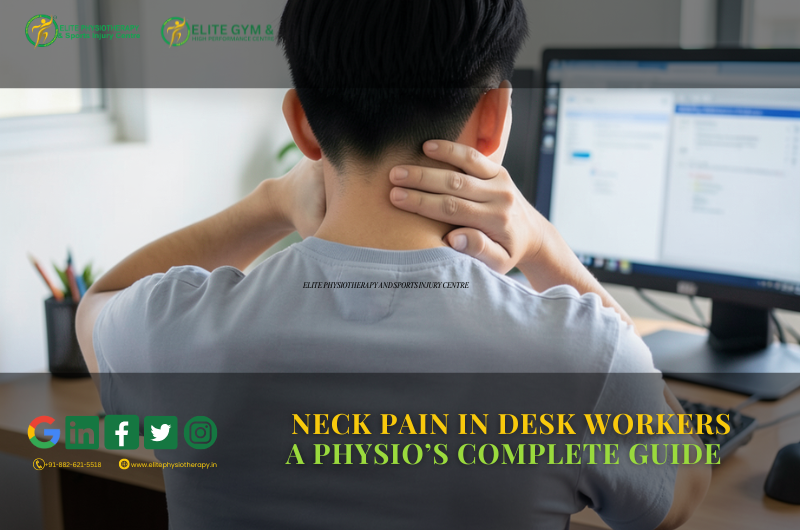
Neck Pain in Desk Workers: A Physio’s Complete Guide

Introduction

  • Your neck is subtly harmed by prolonged desk work. Bad posture. position of the head forward. restricted mobility. Because of this, a lot of professionals now look for neck pain physiotherapy in Delhi NCR daily. Desk workers no longer experience sporadic neck aches. Rather, it has evolved into a contemporary pandemic.
  • We use cutting-edge technology, individualized treatment, and evidence-based physiotherapy to treat this problem on a regular basis at Elite Physiotherapy and Sports Injury Centre. This article will assist you in understanding your discomfort and its remedies if you’re looking for reliable physiotherapy Delhi services or physiotherapy near me.

What Is Neck Pain in Desk Workers?

  • Sitting for extended periods of time and maintaining bad posture can cause neck pain in desk workers. The head advances, the upper back stiffens, and the shoulders round. Cervical joints overload as a result. exhaustion of the muscles. It irritates the nerves. This eventually results in headaches, stiffness, persistent discomfort, and decreased productivity. Early neck pain physiotherapy in Delhi NCR is so crucial.

Common Causes of Desk-Related Neck Pain

  • Forward head posture
  • Rounded shoulders
  • Prolonged screen time
  • Poor workstation ergonomics
  • Weak deep neck flexors
  • Tight upper trapezius and levator scapulae
  • Reduced thoracic mobility
  • Stress-related muscle tension
  • Lack of movement breaks
  • Moreover, laptop use on low tables worsens neck loading.

Types and Classification of Neck Pain

  • Desk-related neck pain usually falls into these categories:
  1. Mechanical Neck Pain
  • Pain increases with movement or posture.
  1. Postural Neck Pain
  • Pain appears after prolonged sitting.
  1. Myofascial Neck Pain
  • Trigger points cause local and referred pain.
  1. Cervicogenic Headache
  • Neck dysfunction creates headache symptoms.
  1. Nerve-Related Neck Pain
  • Disc or joint irritation affects nerve roots.
  • Each type needs a different physiotherapy approach. That is why assessment matters.

Clinical Features and Symptoms

  • Neck stiffness
  • Dull or sharp pain
  • Shoulder tightness
  • Headaches
  • Reduced neck mobility
  • Arm heaviness or tingling
  • Fatigue while working
  • Pain after long sitting
  • Difficulty sleeping

Diagnostic Methods and Physiotherapy Examination

  • At Elite, diagnosis begins with a detailed clinical assessment. We focus on movement, posture, and tissue health.
  • Physical Examination Includes:
    • Postural analysis in sitting and standing
    • Cervical range of motion testing
    • Muscle length and strength testing
    • Segmental joint mobility assessment
    • Scapular control evaluation
    • Neurological screening when required
  • Special Physiotherapy Tests Used During Assessment
    • Spurling’s Test – checks nerve root compression
    • Cervical Distraction Test – confirms neural involvement
    • Valsalva Maneuver – screens disc-related symptoms
    • Shoulder Abduction Test – evaluates nerve irritation
    • Upper Limb Tension Tests – assess neural mobility
    • Deep Neck Flexor Endurance Test – checks cervical stability

Detailed Physiotherapy Management at Elite

  • Our Neck Pain Physiotherapy in Delhi NCR follows a structured, progressive approach. Every program is customized.
  1. Pain Reduction Phase
  • First, we calm irritated tissues.
  1. Mobility Restoration Phase
  • Next, we restore lost movement.
  • This includes:
    • Cervical and thoracic mobilizations
    • Stretching tight muscles
    • Neural gliding exercises
    • Scapular mobility drills
  1. Strengthening and Postural Re-education
  • This phase builds long-term protection.
  • We train:
    • Deep neck flexors
    • Scapular stabilizers
    • Upper back extensors
    • Core muscles
    • Exercises progress from basic to functional. Additionally, we teach ergonomic corrections for desk setup. This prevents recurrence.
  1. Functional and Workplace Integration
  • Finally, we integrate therapy into your daily routine.
  • We provide:
    • Desk posture education
    • Micro-break strategies
    • Home exercise programs
    • Laptop and chair height guidance
    • Return-to-work conditioning
    • This makes results sustainable.

Why Choose Elite Physiotherapy and Sports Injury Centre?

  • At Elite, we combine clinical expertise with technology.
  • We offer:
    • Personalized physiotherapy plans
    • Advanced pain-relief modalities
    • One-on-one supervised sessions
    • Sports and orthopedic specialization
    • Evidence-based protocols
    • Whether you search for physiotherapy Saket, physiotherapy Delhi, or physiotherapy near me, Elite delivers premium care across Delhi NCR.
    • Your recovery is our mission.

Prevention Tips for Desk Workers

  • Adjust the screen to eye level
  • Keep your feet flat on the floor
  • Sit tall every 30 minutes
  • Perform neck mobility breaks
  • Strengthen your upper back regularly
  • Avoid prolonged phone bending

Final Words

  • Neck pain from a desk can be treated. Ignoring it, however, results in long-term issues. Comfort, posture, and productivity are all improved with early neck pain physiotherapy in Delhi NCR. Allow our skilled physiotherapists to assist you with your recuperation when you visit Elite Physiotherapy and Sports Injury Centre in Delhi NCR.

Frequent Upper Trapezius Tightness: And Headache

Introduction

People with bad posture habits, office workers, and athletes frequently complain of upper trapezius tightness. Due to tight upper traps, we frequently see clients at Elite Physiotherapy and Sports Injury Centre who struggle with persistent stiffness, discomfort, and decreased neck-shoulder mobility. The causes, evaluation techniques, and our cutting-edge physiotherapy strategy for efficient and long-lasting relief are all explained in this article.

Understanding the Upper Trapezius Muscle

The trapezius muscle group, which extends from the neck to the shoulder, includes the upper trapezius. Its main purposes are to help with scapular upward rotation, neck extension, and shoulder elevation. Chronic tightness of this muscle can limit movement, produce pain, and possibly aggravate migraines.

Common Causes of Frequent Upper Trapezius Tightness

  1. Bad Posture: Round shoulders and a forward head put more strain on the muscles.
  2. Repetitive Overuse: Activities requiring prolonged computer use or frequent lifting.
  3. Tension and Stress: Involuntary muscular tightening is frequently brought on by emotional stress.
  4. Muscle Imbalance: The upper trapezius is overworked by weak deep neck flexors and lower trapezius.
  5. Compensatory Patterns: The upper traps may over-activate after neck or shoulder pain.
  6. Sports Overload: Repetitive shoulder elevation causes tension in overhead athletes (weightlifters, badminton players, and volleyball players).
  7. Cervical or Thoracic Dysfunction: Adaptive muscle shortening may result from spinal stiffness in cases of cervical or thoracic dysfunction.

Signs and Symptoms

  • Constant stiffness or tightness in the neck and upper shoulder
  • Pain that could radiate to the scapula or head
  • Decreased mobility in the shoulders and neck
  • The sensation of tenderness
  • Heightened discomfort from extended postures or stress
  • Potential headaches caused by tension

Assessment at Elite Physiotherapy and Sports Injury Centre

Our assessment combines functional analysis, postural evaluation, and special physiotherapy tests to identify the root cause.

1. History and Postural Observation

  • We look at ergonomic setup, sporting activity, and work habits. Shoulder symmetry, scapular posture, and cervical alignment are all observed.

2. Palpation

  • Gentle palpation helps identify trigger points, muscle spasm severity, and referred pain patterns.

3. Range of Motion (ROM) Testing

  • We assess active and passive cervical and shoulder movements to detect restrictions.

4. Special Physiotherapy Tests

  • The cervical flexion-rotation test finds restrictions in the upper cervical joints that cause tension.
  • Assesses if increasing scapular mobility lowers upper trapezius stress using the Scapular Assistance Test (SAT).
  • Upper Limb Neurodynamic Test (ULNT) to rule out nerve tension as a contributing factor.

5. Functional Movement Analysis

  • We assess shoulder elevation, scapular rhythm, and neck stability during sport-specific or daily tasks.

Physiotherapy Management at Elite Physiotherapy and Sports Injury Centre

Our treatment approach targets both symptom relief and prevention of recurrence. We use evidence-based manual therapy, advanced modalities, and corrective exercises.

1. Manual Therapy

  • Trigger Point Release: Direct pressure to deactivate activated myofascial points.
  • Soft Tissue Mobilization: Increases blood flow and lessens rigidity.
  • Cervical and Thoracic Mobilizations: Restoring spinal mobility with cervical and thoracic mobilizations lowers compensatory trap activation.

2. Advanced Modalities

At Elite Physiotherapy, we use high-end physiotherapy technology to accelerate recovery:

  • Super Inductive System (SIS): Stimulates deep tissue relaxation and pain relief.
  • CRET Therapy: Enhances tissue healing and reduces muscle spasm.
  • Class 4 Laser Therapy: Promotes blood flow, reduces inflammation, and accelerates recovery.
  • Dry Needling: Releases deep-seated muscle knots and improves flexibility.

3. Corrective Exercises

  • Scapular Retraction and Depression Drills: To balance muscular activity, strengthen your mid and lower traps.
  • Enhance neck alignment and lessen upper trap overactivation with chin tucks.
  • Stretches for the levator scapula and upper traps will help you stay flexible and avoid recurrence.
  • Wall Angels and YTWL Drills: Restore scapular control and shoulder mechanics.

Why Choose Elite Physiotherapy and Sports Injury Centre?

Our clinic successfully treats frequent upper trapezius tightness by combining precise diagnosis, individualized rehabilitation strategies, and cutting-edge technology. Because of our expertise in orthopaedic and sports physiotherapy, we not only treat pain but also address its root cause, guaranteeing long-term comfort and enhanced performance.

Conclusion

More than just a muscle problem, frequent upper trapezius tightness is frequently a sign of underlying biomechanical or lifestyle issues. In order to restore ideal muscle function and avoid recurrence, we at Elite Physiotherapy and Sports Injury Centre offer comprehensive, athlete-focused, technology-assisted care.