Skip to content
Introduction
- Athletes and active people frequently sustain ligament injuries. Early warning indicators are frequently disregarded, though. Early detection and accurate rehabilitation are our main priorities at Elite Physiotherapy and Sports Injury Centre, Delhi NCR. Prompt physiotherapy prevents chronic pain and long-term instability.
What are Ligament Injuries?
- Strong connective tissues are called ligaments. They serve as a link between bones. Their function is to keep joints stable when moving. When these fibers rip or overstretch, ligament damage results. This typically occurs during abrupt or uncontrollable motions.
Common Causes of Ligament Injuries
- There are various causes of ligament injuries.
- First, Abrupt twisting or pivoting stresses the joints.
- Second, excessive force results from direct trauma.
- Thirdly, Inadequate neuromuscular control increases risk.
- Additionally, Fatigue and muscular imbalance also play a role.
- Inadequate warm-up and improper training are also factors.
Warning Signs and Clinical Features
- Early symptoms should never be disregarded.
- Pain might come on suddenly or gradually.
- The area surrounding the joint becomes swollen.
- It’s common to feel like a joint is giving way.
- Bruising may appear within a matter of hours.
- The patient’s range of motion is limited.
- It feels dangerous or unsteady to engage in functional activities.
Physiotherapy Management: A Detailed Approach
- The foundation of healing from ligament injuries is physiotherapy. We follow an athlete-focused, methodical, and progressive strategy.
Acute Phase Management
- Initially, Physiotherapists prioritize pain and swelling control.
- Modification of the activity stops additional harm.
- Manual therapy improves circulation.
- Mild mobility activities maintain joint nutrition.
- Isometric strengthening prevents muscle inhibition.
Subacute Phase Rehabilitation
- Controlled strengthening starts gradually.
- Closed kinetic chain exercises restore stability.
- Proprioceptive training enhances joint awareness.
- Drills for balance lower the chance of re-injury.
- Physiotherapists gradually advance range-of-motion exercises.
Advanced Strength and Functional Training
- Physiotherapists implement dynamic strengthening later.
- Physiotherapists progressively add sport-specific drills.
- Plyometric exercises enhance neuromuscular control.
- Agility training restores confidence.
- Decisions on returning to sports are supported by evidence.
Advanced Physiotherapy Modalities at Elite Physiotherapy
- We integrate advanced technologies for faster recovery.
Why Choose Elite Physiotherapy and Sports Injury Centre?
- We integrate cutting-edge technology with clinical knowledge. Each rehabilitation program is unique. We give equal consideration to both athletes and non-athletes. Long-term joint health is the main emphasis of our Delhi NCR clinic. Our goal is a full, safe, and self-assured recovery.
Conclusion
- You should never disregard warning signs of ligament injuries. Early physiotherapy prevents chronic instability. Expert evaluation ensures an accurate diagnosis. Targeted rehabilitation restores strength and confidence. Elite Physiotherapy is dedicated to your healing process.
Introduction
- Sports and everyday activities can result in ligament Injuries.
- Early warning indicators are frequently disregarded, though.
- Minor injuries consequently develop into long-term issues.
- Early intervention, in our opinion at Elite Physiotherapy and Sports Injury Center, avoids both chronic pain and surgery.
- The warning signals of ligament injuries are explained in detail in this article.
- It also highlights our center’s sophisticated physiotherapy management.
What Is a Ligament Injury?
- Strong fibrous tissues make up ligaments.
- They stabilize joints and attach bones.
- When these tissues rupture or stretch, a ligament injury results.
- Usually, excessive force or inadequate joint control cause this.
- Ligament injuries have a significant impact on joint stability.
- Untreated injuries thereby raise the chance of re-injury.
Common Causes of Ligament Injuries
- There are several reasons why ligament injuries occur.
- Among the most typical causes are:
- Abrupt pivoting or twisting motions
- Collisions or direct trauma
- Making mistakes when landing from a jump
- Inadequate neuromuscular regulation
- Fatigue and an imbalance of muscles
- Untreated joint injuries in the past
- Repetitive stress further deteriorates ligament integrity in athletes.
Types and Classification of Ligament Injuries
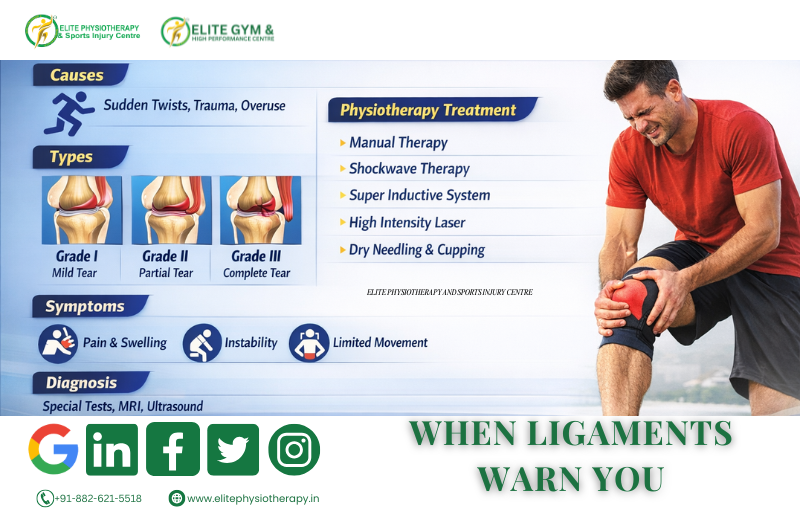
- Ligament injuries are often categorized according to their severity.
Grade I: Mild Sprain
- There is microscopic tearing.
- There is very little pain or swelling.
- There is no loss of joint stability.
IInd Grade: Moderate Sprain
- There is some ripping.
- Pain and swelling worsen.
- When moving, the joint feels unsteady.
Grade III: Severe Sprain
- There is a total rupture of the ligament.
- There is obvious severe instability.
- It becomes challenging to move functionally.
- For effective rehabilitation, early grade identification is essential.
Warning Signs of a Ligament Injury
- It’s critical to identify early warning indicators.
- Typical signs and symptoms include:
- Joint soreness that persists after exercise
- Swelling that does not go away
- Reduced range of motion or tight joints
- Instability or a sense of giving way
- Severe discomfort when changing directions
- Having trouble carrying weight
- Frequent locking or catching of joints
- These symptoms quickly get worse if neglected.
Clinical Features and Functional Limitations
- Localized pain is a clinical manifestation of ligament damage.
- There could be a joint effusion.
- Protective muscular spasms frequently occur.
- Movement patterns change as a result.
- Poor biomechanics cause cartilage stress over time.
- Secondary joint degeneration could therefore happen.
Physiotherapy Management: The Elite Approach
- The foundation of healing from ligament injuries is physiotherapy.
- Performance, stability, and healing are the main goals of our treatment.
Phase 1: Pain and Inflammation Control
- Pain management is given top priority at first.
- Circulation is improved by manual therapy.
- Stiffness is avoided with gentle motion.
- Tissue healing is accelerated by advanced therapies.
Phase 2: Restoring Mobility and Strength
- Joint range is gradually regained.
- Isometric activities engage supporting muscles.
- Progressive loading increases ligament strength.
- Neuromuscular reeducation enhances joint awareness.
3rd Phase: Stability and Proprioception Training
- Clinicians demonstrate exercises for control and balance.
- Closed kinetic chain training improves joint protection.
- Sport-specific exercises come next.
- This stage successfully stops recurrence.
Phase 4: Return to Sport or Activity
- Lastly, patients complete high-load functional tasks.
- Clinicians constantly observe movement quality.
- Safe return procedures decrease the risk of re-injury.
Advanced Modalities Used at Elite Physiotherapy
- We integrate technology for faster and safer recovery.
- These techniques support exercise-based rehabilitation.
- We integrate clinical knowledge with evidence-based practice.
- Every rehabilitation program is unique.
- We continue to prioritize long-term joint health.
- Active people and athletes have faith in our outcomes.
Conclusion
- Ligament injuries rarely heal on rest alone.
- You must not ignore early warning signs.
- Timely physiotherapy ensures complete recovery.