Introduction
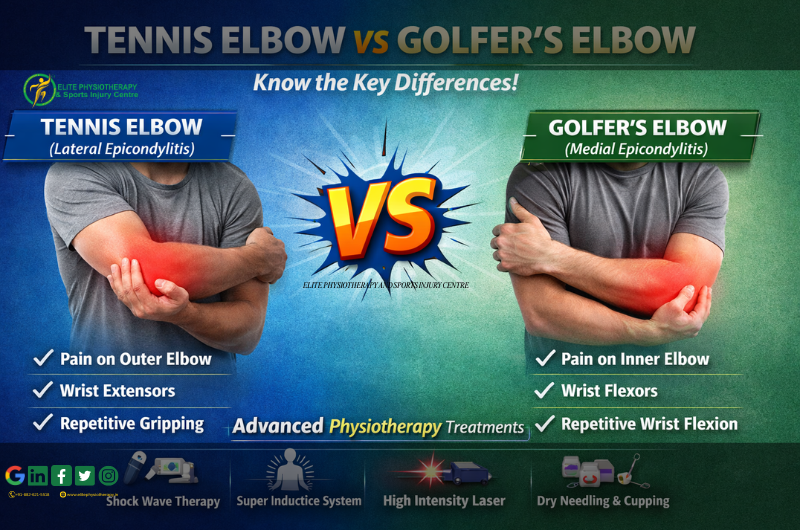
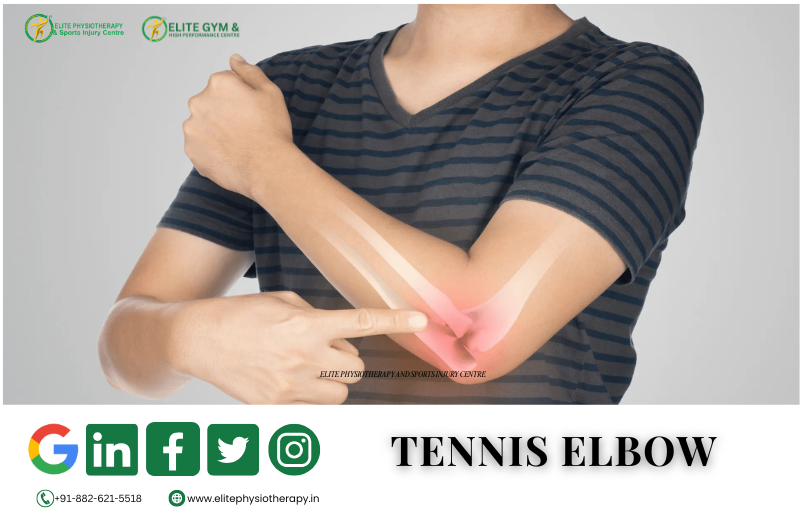
Tennis Elbow, medically known as Lateral Epicondylitis, is a frequent overuse condition that affects the outside elbow region. It is brought on by microtears or repetitive strain in the extensor muscles of the forearm, namely the Extensor Carpi Radialis Brevis (ECRB).
Our goal at Elite Physiotherapy and Sports Injury Centre is to speed healing through accurate evaluation and individualized physiotherapy care with cutting-edge techniques.
What is Tennis Elbow?
Tennis Elbow is an inflammation or degeneration of the tendons attached to the lateral epicondyle of the humerus. In addition to tennis players, it frequently affects anyone who engages in repetitive wrist extension or gripping tasks, such as manual laborers, office workers, and fitness enthusiasts.
Pain starts off slowly and gets worse as you continue to strain.
Causes of Tennis Elbow
- Repetitive motions of the forearm and wrist.
- Poor technique in sports like squash, badminton, or tennis.
- Excessive lifting or clutching when extending the wrist.
- Overuse in occupations like carpentry or typing.
- Muscle exhaustion or abrupt, unfamiliar exercise.
Signs and Symptoms of Tennis Elbow
- Discomfort across the humerus’s lateral epicondyle.
- Forearm pain that radiates.
- Tenderness over the root of the common extensor tendon.
- Discomfort when lifting, grasping, or extending the wrist.
- Hand grip strength weakness.
- Difficulty performing everyday tasks like holding a cup, turning a doorknob, or shaking hands.
Examination for Tennis Elbow
A thorough physical examination is necessary for a precise diagnosis. Evidence-based tests are used by the physiotherapists at Elite Physiotherapy to rule out other diagnoses and establish the problem.
Special Physiotherapy Tests include:
- Cozen’s Test: When the elbow is extended, the patient opposes wrist extension. A favorable outcome is indicated by pain at the lateral epicondyle.
- Mill’s Test: Pain is reproduced by passively stretching the wrist extensors by flexing the wrist and pronating the forearm.
- Maudsley’s Test: Pain is felt across the lateral epicondyle when the third finger is not extended.
Physiotherapy Management at Elite Physiotherapy and Sports Injury Centre
At Elite Physiotherapy and Sports Injury Centre, Tennis Elbow management focuses on pain relief, restoring function, and preventing recurrence.
Physiotherapists design each treatment plan after a detailed biomechanical assessment and functional evaluation.
1. Pain Relief and Inflammation Control
The main objective during the acute period is to lessen pain and inflammation.
Physiotherapists make use of:
- Physiotherapists recommend rest and reduced activity to decrease tendon tension.
- Using cold, or cryotherapy, can reduce inflammation early.
- Stretching gently will preserve the range of motion without overtaxing the tendon.
2. Advanced Physiotherapy Modalities
For quicker recovery and pain relief, Elite Physiotherapy incorporates state-of-the-art physiotherapy technologies:
- Shock Wave Therapy: Encourages collagen synthesis, lessens chronic pain, and speeds up tendon recovery.
- Super Inductive System (SIS): High-intensity electromagnetic fields are used by the Super Inductive System (SIS) to improve muscle activation, promote tissue healing, and lessen discomfort.
- High-Intensity Laser Therapy: Reduces inflammation, speeds up tissue repair, and improves blood circulation.
- Dry Needling: Releases myofascial trigger points, decreases pain, and restores normal muscle function.
- Cupping Therapy: Promotes tissue regeneration, eases tension, and increases local blood flow.
Physiotherapists combine these modalities based on each patient’s needs for a faster and longer-lasting recovery.
3. Manual Therapy and Soft Tissue Mobilization
- Myofascial release, joint mobilization, and deep friction massage are examples of manual therapy procedures that increase tissue flexibility and reduce pain.
- Physiotherapists use radial head mobilization and soft tissue manipulation around the forearm to improve joint mechanics and tendon healing.
4. Therapeutic Exercises
- Stretching Exercises: To increase flexibility, perform mild wrist flexor and extensor stretches.
- Eccentric Strengthening: The wrist extension’s controlled lowering motions increase the resilience and strength of the tendons.
- Isometric Exercises: To preserve strength without causing tendon inflammation, start early.
- Proprioceptive and Functional Training: Restores neuromuscular coordination for return to daily or sports activities.
5. Maintenance and Prevention
- Maintenance Exercises aim to stop recurrence once pain has subsided.
- Athletes are led through flexibility exercises, sport-specific conditioning, and a phased return to play.
- Regular follow-ups ensure sustained improvement and prevent chronic tendinopathy.
Why Choose Elite Physiotherapy and Sports Injury Centre?
Precision, creativity, and patient-centered treatment are the cornerstones of rehabilitation at Elite Physiotherapy and Sports Injury Centre.
To accelerate healing, we integrate our physical expertise with cutting-edge technologies, including Shock Wave, SIS, High-Intensity Laser, Dry Needling, and Cupping.
Physiotherapists tailor every treatment plan to align with your specific activity goals, occupation, and pain level, ensuring a comprehensive and safe recovery.
Conclusion
If left untreated, tennis elbow can have a major negative influence on both performance and quality of life.
However, healing is quicker and more efficient at Elite Physiotherapy and Sports Injury Centre because of their superior physiotherapy care and evidence-based treatment.
Restoring function and avoiding recurrence requires early diagnosis, enough rest, and planned therapy.