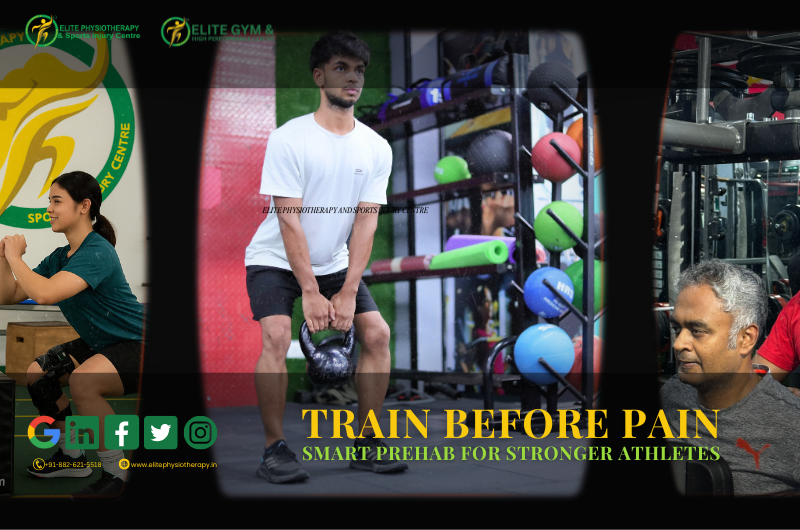
Today’s athletes begin their recovery process before they are injured. Rather, they concentrate on Athlete Injury Prehab, a proactive approach to physical therapy that gets the body ready before issues arise.
We at Elite Physiotherapy and Sports Injury Centre think that performance is enhanced by prevention. Smart athletes perform with confidence, recover more quickly, and maintain consistency.
Fatigue, poor movement control, and repetitive load all raise the risk of injury in competitive sports. Athletes can thus develop resilience with the use of organized physiotherapy sessions. Preventive physiotherapy is becoming crucial due to the rise in sports involvement, particularly in the Delhi NCR area.
Movement quality, strength balance, neuromuscular control, and recovery optimization are the main goals of athlete injury rehab.
What is Athlete Injury Prehab?
A preventative physiotherapy approach is called Athlete Injury Prehab. It finds risk variables before an accident occurs.
Strength training, recuperation methods, remedial exercise, and evaluation are all combined. The objective is straightforward: increase athletic efficiency while lowering the likelihood of injury.
Prehab starts when the athlete feels well, in contrast to rehabilitation.
Why Do Athletes Need Prehab? (Causes of Future Injuries)
Muscle imbalance between agonist and antagonist groups
Poor biomechanics during running, jumping, or lifting
Limited joint mobility
Weak core and hip stability
Overtraining and inadequate recovery
Previous untreated injuries
Poor warm-up strategies
Types of Athlete Injury Prehab Programs
Mobility-Based Prehab
Improves joint range and movement efficiency.
Stability and Control Prehab
Enhances neuromuscular coordination and balance.
Strength Balance Prehab
Corrects asymmetry between limbs and muscle groups.
Sport-Specific Prehab
Targets movements required in football, wrestling, cricket, or running.
Early Clinical Signs Athletes Often Ignore
Recurrent tightness after training
Reduced performance output
Joint stiffness
Early fatigue
Mild recurring pain after activity
Poor landing mechanics
Loss of power generation
Physiotherapy Management: The Core of Athlete Injury Prehab
The cornerstone of injury prevention continues to be physiotherapy. Individualized treatment programs are developed based on biomechanics and athletic demands.
Movement Correction Training
Defective patterns are first retrained. Proper squatting, landing, and cutting mechanics are taught to athletes. This lessens excessive joint stress.
Strength Optimization
Weak muscular chains are the focus of progressive resistance training. Particular attention is paid to the scapular muscles, glutes, and core stabilizers. Force transfer is enhanced by balanced strength.
Neuromuscular Control Training
Proprioceptive exercises and reaction drills enhance joint awareness. As a result, athletes respond more quickly under erratic sporting circumstances.
Mobility Restoration
Joint range is restored with active mobility exercises and manual treatment. Greater mobility avoids compensating overload in other areas.
Core Stability Integration
Core training connects movement between the upper and lower body. This preserves the spine and improves power generation.
Load Management Education
Athletes gain knowledge of fatigue monitoring, warm-up design, and recovery planning. Education is still a vital part of physical therapy.
Athletes often notice performance gains even without injury.
Benefits include:
Faster sprint mechanics
Improved agility
Better endurance
Reduced fatigue
Enhanced recovery
Therefore, prehab becomes performance training, not just prevention.
Why Choose Elite Physiotherapy?
Our top-tier physiotherapy programs blend scientific knowledge with athletic expertise. We use cutting-edge technology and assessment to create athlete-specific routines.
Our team provides systematic preventive care for long-term performance, whether you’re looking for skilled physiotherapy in Saket, expert physiotherapy in Delhi, or physiotherapy near me.
Conclusion
Preventing injuries is now a must. Athletes can maintain their availability, consistency, and competitiveness with the aid of athlete injury therapy.
Athletes develop stronger and safer bodies through modern modalities, corrective exercise, and professional physiotherapist evaluation. To avoid rehabilitation tomorrow, train wisely today.