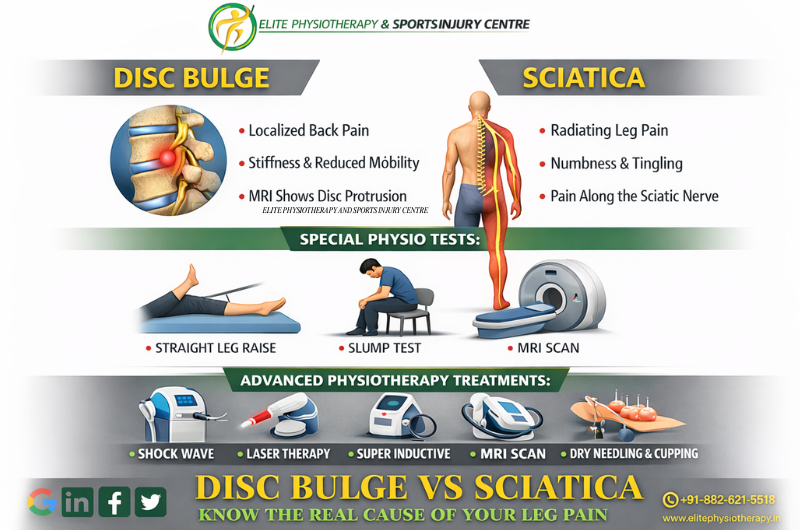
Disc Bulge vs Sciatica: Know the Real Cause of Your Leg Pain

DISC BULGE VS SCIATICA
  • Leg and low back pain frequently perplex individuals. A common misconception is that the two circumstances are interchangeable. Disc bulge and Sciatica, however, are two distinct clinical issues. Comprehending this distinction facilitates the selection of appropriate physiotherapy interventions and speeds up recovery.
  • Patients from Delhi NCR who are looking for physiotherapy are regularly treated at Elite Physiotherapy and Sports Injury Centre. Successful rehabilitation is always guided by an accurate diagnosis.

Disc Bulge vs Sciatica – What Is the Difference?

What is a Disc Bulge?

  • When the spinal disc protrudes past its natural border, it is known as a disc bulge. The outermost layer weakens but stays intact. This could irritate neighboring nerves.
  • It frequently appears in the lumbar spine as a result of bad posture or ongoing stress.

What is Sciatica?

  • Sciatica is not a diagnosis. Instead, it describes nerve pain along the sciatic nerve pathway. The pain travels from the lower back to the leg.
  • Sciatica typically happens when the nerve is compressed or irritated by a structure. One frequent reason is a disc bulge.
  • Thus, one is structural, and the other is a pattern of symptoms in disc bulge vs. sciatica.

Causes of Disc Bulge vs Sciatica

Causes of Disc Bulge

  • Prolonged sitting posture
  • Weak core muscles
  • Sudden lifting injuries
  • Degenerative spinal changes
  • Sports overload
  • Poor biomechanics

Causes of Sciatica

  • Disc bulge or disc herniation
  • Piriformis muscle compression
  • Spinal stenosis
  • Facet joint dysfunction
  • Muscle imbalance
  • Trauma

Types and Classification

Disc Bulge Classification

  • Circumferential disc bulge
  • Posterolateral bulge (most common)
  • Foraminal bulge
  • Central bulge

Sciatica Types

  • True nerve root sciatica
  • Piriformis-related sciatica
  • Mechanical sciatica due to spinal dysfunction
  • Understanding classification improves physiotherapy planning.

Clinical Features: Disc Bulge vs Sciatica

Disc Bulge Symptoms

  • Localized low back pain
  • Stiffness during bending
  • Pain after prolonged sitting
  • Reduced spinal mobility
  • Muscle guarding

Sciatica Symptoms

  • Sharp radiating leg pain
  • Tingling or numbness
  • Burning sensation
  • Weakness in leg muscles
  • Pain worsening during coughing or sneezing
  • Sciatica pain usually travels below the knee, unlike simple disc pain.

Physiotherapy Management in Disc Bulge vs Sciatica

  • Physiotherapy is still the most common kind of treatment. When rehabilitation starts early, surgery is rarely necessary.
  • The goals of treatment at our Delhi physiotherapy clinic include long-term prevention, nerve healing, and pain alleviation.

Phase 1: Pain Reduction and Nerve Calm Down

  • Initially, therapists reduce inflammation and nerve irritation.
  • Position correction education
  • McKenzie extension protocols
  • Gentle neural unloading techniques
  • Activity modification
  • High-intensity laser therapy accelerates tissue repair and reduces inflammation. Patients’ pain is reduced more quickly.
  • Super Inductive System (SIS) securely reduces deep spinal pain and enhances neuromuscular activation.

Phase 2: Mobility Restoration

  • Once pain reduces, restoring movement becomes essential.
  • Lumbar mobilization techniques
  • Neural gliding exercises
  • Pelvic alignment correction
  • Controlled stretching
  • Shock Wave Therapy increases circulation around inflamed areas and promotes tissue restoration.

Phase 3: Muscle Activation and Stability

  • Weak muscles increase recurrence risk. Therefore, strengthening is crucial.
  • Core stabilization training
  • Multifidus activation
  • Glute strengthening
  • Postural correction drills
  • These exercises protect discs and reduce nerve compression.

Phase 4: Advanced Functional Rehabilitation

  • Patients gradually return to work and sports.
  • Functional lifting retraining
  • Dynamic balance exercises
  • Sport-specific conditioning
  • Ergonomic education
  • This stage prevents relapse, especially for desk workers.

Why Early Physiotherapy Matters

  • Delayed treatment increases nerve sensitivity. Consequently, recovery becomes slower.
  • Early physiotherapy:
  • Reduces pain naturally
  • Prevents surgery
  • Restores movement faster
  • Improves spinal stability
  • Prevents recurrence

Disc Bulge vs Sciatica – Key Takeaway

  • A disc bulge is a spinal structural problem. Compression-induced nerve pain is referred to as sciatica. A thorough clinical evaluation distinguishes between the two disorders.
  • Evidence-based physiotherapy and cutting-edge technologies are combined in individualized treatment regimens at Elite Physiotherapy and Sports Injury Centre. Our top-notch rehabilitation method assists patients in Delhi NCR in safely resuming pain-free activity.

Leave a Reply

Your email address will not be published. Required fields are marked *