Thumb Pain That Slows You Down : De Quervain’s Tenosynovitis

Introduction

  • Thumb and wrist pain can silently affect daily tasks and sports performance. One common cause is De Quervain’s tenosynovitis. At Elite Physiotherapy and Sports Injury Centre, we manage this condition with precision and advanced care. Our approach focuses on pain relief, tendon healing, and safe return to activity.

What Is De Quervain’s Tenosynovitis?

  • Wrist tendon inflammation is known as De Quervain’s tenosynovitis. The tendons of the extensor pollicis brevis and abductor pollicis longus are involved. These tendons pass through the first dorsal compartment of the wrist. Inflammation makes thumb movements more painful and increases friction.

Causes of De Quervain’s Tenosynovitis

  • Tendon loading is increased by a number of reasons.
  • Repetitive thumb and wrist motions are common reasons.
  • Nowadays, the extended use of mobile phones is a significant factor.
  • Frequent lifting of infants might also cause problems.
  • Risk is increased by manual labor, weight training, and racquet sports.
  • Tendon stress is exacerbated by poor wrist biomechanics.

Clinical Features and Symptoms

  • Usually, symptoms appear gradually.
  • The thumb side of the wrist starts to hurt.
  • Gripping or pinching activities exacerbate pain.
  • It is possible to see swelling close to the radial styloid.
  • Weakness with lifting is a common complaint from patients.
  • You can feel crepitus when you move your thumb.

Special Physiotherapy Tests

  • Finkelstein’s Test
    • The patient clenches their thumb into a fist.
    • Gently shift the wrist into ulnar deviation.
    • Positivity is indicated by sharp pain across the radial wrist.
  • Eichhoff’s Test
    • The patient bends the thumb into the palm.
    • The examiner deviates the wrist ulnarward.
    • Pain reproduction supports the diagnosis.

Physiotherapy Management at Elite Physiotherapy

  • Physiotherapy is the gold-standard conservative treatment. We provide individualized, goal-oriented care. Our main goals are to reduce pain, heal tendons, and restore function.

Pain and Inflammation Control

  • Thumb spica taping reduces tendon strain.
  • Cryotherapy is used for acute pain control.

Advanced Electro-Physical Modalities

Manual Therapy Techniques

  • Soft tissue mobilization reduces tendon adhesions.
  • Myofascial release improves local circulation.
  • Joint mobilization restores wrist biomechanics.
  • These techniques reduce mechanical stress on tendons.

Dry Needling and Cupping Therapy

  • Dry needling targets myofascial trigger points.
  • It reduces muscle overactivity around the wrist.
  • Cupping improves blood flow and tissue nutrition.
  • Both techniques support faster pain reduction.

Therapeutic Exercise Program

  • Exercise forms the core of rehabilitation.
  • Isometric thumb exercises begin early.
  • Progressive resistance training follows gradually.
  • Eccentric loading strengthens tendon fibers.
  • Grip strengthening restores hand function.
  • Proprioceptive drills improve movement control.

Why Choose Elite Physiotherapy and Sports Injury Centre?

  • We deliver evidence-based physiotherapy care.
  • Each program is data-driven and customized.
  • Faster recovery is possible by advanced modalities.
  • Sports and work-related injuries are among our areas of expertise.
  • We prioritize long-term outcomes over short-term respite.

Conclusion

  • Expert physiotherapy works well for De Quervain’s tenosynovitis.
  • Early management can prevent chronic pain and disability.
  • We effectively restore pain-free thumb function at Elite Physiotherapy.
  • Make an appointment for your evaluation to advance more quickly and effectively.

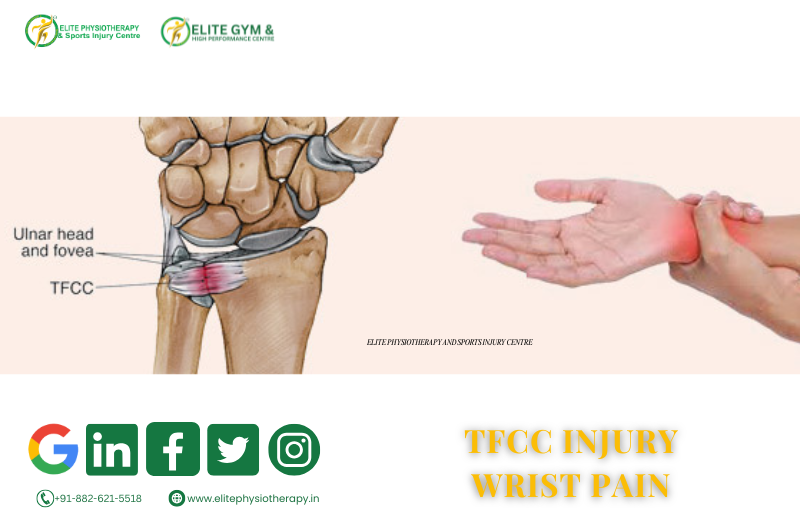
TFCC Tear: The Hidden Cause of Ulnar Wrist Pain

Introduction

  • Ulnar-sided (Pinky finger side) wrist pain often limits grip, push, and rotational activities. One common yet overlooked reason is a TFCC injury.
  • At Elite Physiotherapy and Sports Injury Centre, we specialize in precise diagnosis and advanced physiotherapy-led recovery.

What Is the Triangular Fibrocartilage Complex (TFCC)?

  • On the ulnar side of the wrist, the TFCC is a strong fibrocartilaginous structure.
  • When the forearm rotates, it keeps the distal radioulnar joint stable.
  • Additionally, it relieves pressure between the carpal and ulna bones.
  • As a result, it is essential to wrist performance and stability.

Causes of TFCC Injury

  • Trauma or degeneration are the causes of TFCC damage.
  • A fall on an outstretched hand is one of the common reasons.
  • The TFCC can also be harmed by sudden wrist twisting when playing sports.
  • Risk is increased by repetitive loading in weightlifting, wrestling, and gymnastics.
  • Furthermore, compressive stress is increased by positive ulnar variance.

Types and Classification of TFCC Injuries

  • TFCC injuries are broadly classified into two groups.
  1. Traumatic TFCC Tears
  • These result from acute injury.
  • They are common in athletes and active individuals.
  1. Degenerative TFCC Tears
  • These develop gradually with age or repetitive stress.
    They are common in manual workers and veteran athletes.

Clinical Features and Symptoms

  • Patients typically complain of ulnar wrist pain.
  • When squeezing or rotating the forearm, pain intensifies.
  • It’s typical to report clicking or catching feelings.
  • Reduced load tolerance and wrist weakness are common symptoms.
  • In acute situations, there may be swelling.

Special Physiotherapy Tests for diagnosis

  1. TFCC Compression Test:
    • Ulnar deviation with axial loading reproduces deep ulnar wrist pain.
  2. Supination Lift Test:
    • Pain occurs when lifting against resistance with supinated forearm.
  3. Press Test:
    • Pain appears while pushing up from a seated position.
  • Positive findings guide targeted physiotherapy planning.

Physiotherapy Management of TFCC Injury

  • Physiotherapy is the cornerstone of conservative TFCC management.
  • Our approach is personalized, progressive, and evidence-based.

Phase 1: Pain and Inflammation Control

  • Our first goal is to lessen pain and swelling.
  • The healing TFCC is protected by activity modulation.
  • External support is provided by wrist bracing or tape.
  • High Intensity Laser Therapy accelerates tissue healing.
    • It reduces inflammation and improves microcirculation.
  • Super Inductive System (SIS) decreases pain and muscle guarding.
    • It also improves neuromuscular activation safely.

Phase 2: Mobility and Stability Restoration

  • Controlled mobility starts as soon as the discomfort subsides.
  • We progressively regain range of motion in the wrist and forearm.
  • Painless movements are emphasized.
  • Exercises for stabilizing the distal radioulnar joint are presented.
  • Joint awareness and control are enhanced by proprioceptive training.

Phase 3: Strengthening and Load Progression

  • Strengthening focuses on forearm rotators and wrist stabilizers.
  • Eccentric and isometric exercises are carefully progressed.
  • Grip endurance training restores functional capacity.
  • Shock Wave Therapy may be used in chronic degenerative cases.
    • It stimulates tissue regeneration and pain modulation.

Phase 4: Advanced Modalities and Soft Tissue Care

  • Dry Needling reduces myofascial tightness around the wrist and forearm.
    • It improves movement efficiency and pain tolerance.
  • Cupping Therapy enhances local blood flow and fascial mobility.
    • It supports recovery in chronic and overuse presentations.

Phase 5: Return to Sport and Prevention

  • Sport-specific drills are gradually introduced.
  • Load management strategies reduce reinjury risk.
  • Technique correction improves long-term wrist health.
  • Return-to-sport decisions are criteria-based, not time-based.

Why choose Elite Physiotherapy and Sports Injury Centre for TFCC injury?

  • We combine advanced technology with expert clinical reasoning.
  • Each TFCC case receives individualized attention.
  • Our focus remains on complete recovery and performance optimization.
  • We treat athletes, professionals, and active individuals alike.

Conclusion

  • TFCC injuries demand early diagnosis and expert physiotherapy care.
  • Ignoring symptoms can lead to chronic wrist instability.
  • With advanced modalities and structured rehabilitation, recovery is achievable.

Swollen Tip of the Elbow: Understanding Olecranon Bursitis

What Is Subcutaneous Olecranon Bursitis?

  • Inflammation of the bursa over the point of the elbow is known as subcutaneous olecranon bursitis.
  • This bursa is located between the olecranon process and the skin.
  • It typically lessens friction when moving the elbow.
  • On the other hand, inflammation results in swelling and fluid buildup.
  • Pain and functional limitations may consequently arise.
  • The condition is often treated conservatively at Elite Physiotherapy and Sports Injury Centre.
  • Early physiotherapy guarantees a quicker recovery and guards against recurrence.

Causes of Subcutaneous Olecranon Bursitis

  • Stress that occurs frequently or suddenly might cause olecranon bursitis.
  • Typical reasons consist of:
    • Frequently resting on your elbows when working or training
    • Direct injury or an elbow fall
    • Extended pressure while performing floor workouts
    • Overuse in contact sports and throwing
    • After a skin abrasion, infection
    • Associated conditions like gout or rheumatoid arthritis
  • For tailored physiotherapy care, determining the precise etiology is crucial.

Clinical Features and Symptoms

  • Firm or soft, variable swelling
  • Pain that is mild to moderate
  • Palpable local tenderness
  • In acute situations, warmth and redness
  • limited flexion of the elbow because of edema
  • Elbow pain when leaning or loading
  • Elbow range of motion, however, typically stays full.

Special Tests and Examination Techniques

  • Testing for Elbow Range of Motion
    • The majority of movement is still painless.
    • Pain increases with compression, not movement.
  • Bursal Compression Test
    • The symptoms are replicated with little pressure over the bursa.
    • Superficial bursal involvement is confirmed by this.
  • Resisted Muscle Testing
    • There is no pain associated with triceps resistance.
    • This distinguishes tendon pathology from bursitis.
  • Observation While Performing Functional Tasks
    • When bearing weight via the elbows, pain intensifies.

Detailed Physiotherapy Management

  • Physiotherapy remains the cornerstone of treatment.
  • Treatment focuses on inflammation control, load modification, and prevention.

Phase 1: Pain and Inflammation Control

  • Initially, reducing swelling is the priority.
  • Activity modification is advised immediately
  • Elbow padding prevents further compression
  • Cryotherapy helps reduce inflammation
  • Compression taping supports the bursa
  • Gentle active range exercises maintain mobility
  • At this stage, aggressive loading is strictly avoided.

2nd Phase: Advanced Electro-Physical Modalities

  • Elite Physiotherapy uses advanced technology for faster recovery.
    • High Intensity Laser Therapy
      • This reduces inflammation at the cellular level.
        It accelerates tissue healing and fluid resorption.
    • Super Inductive System (SIS)
      • SIS improves circulation and lymphatic drainage.
        It also reduces pain without direct contact.
    • Shock Wave Therapy
      • Shock waves stimulate tissue regeneration.
        They are useful in chronic, non-resolving bursitis.
        However, intensity is carefully controlled.
  • These modalities significantly shorten recovery time.

Phase 3: Manual Therapy and Soft Tissue Care

  • Manual techniques are applied once the pain reduces.
  • Gentle myofascial release around the elbow
  • Soft tissue mobilization of the triceps region
  • Skin and fascia mobility restoration
  • If indicated:
    • Cupping Therapy
      • Cupping improves local blood flow.
        It reduces tissue congestion and stiffness.
    • Dry Needling
      • Dry needling addresses surrounding muscle tightness.
        It helps normalize loading patterns around the elbow.
  • These techniques are always applied judiciously.

4th Phase: Strengthening and Load Re-education

  • Once swelling subsides, strengthening begins.
  • Progressive triceps strengthening
  • Forearm flexor and extensor conditioning
  • Scapular and shoulder stability exercises
  • Kinetic chain strengthening
  • Importantly, load tolerance is rebuilt gradually.

5th Phase: Functional and Sport-Specific Training

  • Finally, functional retraining is introduced.
  • Weight-bearing tolerance training
  • Technique correction during sports skills
  • Ergonomic advice for workplace activities
  • Return-to-sport criteria followed strictly
  • This phase prevents recurrence effectively.

Why Choose Elite Physiotherapy and Sports Injury Centre?

  • Elite Physiotherapy delivers evidence-based and personalized care.
  • Every program is athlete-centric and goal-oriented.
  • Advanced modalities are integrated with manual therapy.
  • Return-to-sport decisions are data-driven and safe.
  • As a result, outcomes are faster and long-lasting.

Prevention Tips

  • Avoid prolonged elbow pressure
  • Use protective padding during training
  • Correct faulty techniques early
  • Maintain upper limb strength and balance
  • Seek early physiotherapy assessment
  • Early care prevents chronic complications.

Conclusion

  • Subcutaneous olecranon bursitis is a common but manageable condition.
  • Timely physiotherapy ensures complete recovery.
  • Advanced modalities enhance healing significantly.
  • At Elite Physiotherapy and Sports Injury Centre, care is precise and personalized.
  • Therefore, ignoring elbow swelling should never be an option.

Radial Collateral Ligament (LCL) of Elbow Injury

Understanding the Radial Collateral Ligament of the Elbow

  • An important factor in joint stability is the elbow’s Radial collateral ligament.
  • It shields the elbow from undue varus strain.
  • Additionally, it keeps the forearm rotating smoothly during everyday and athletic tasks.
  • We regularly treat Radial elbow instability in athletes and active people at Elite Physiotherapy and Sports Injury Centre.

What Is the Radial Collateral Ligament of the Elbow?

  • The Radial collateral ligament complex lies on the outer side of the elbow.
  • It joins the ulna to the Radial epicondyle of the humerus.
  • It provides both static and dynamic stability by collaborating with the surrounding muscles.
  • During pushing and weight-bearing activities, it stops the elbow from opening abnormally.

Components and Classification

  • The Radial collateral ligament is a complex structure.
  • It includes several distinct parts.
  1. Radial Collateral Ligament
  2. Lateral Ulnar Collateral Ligament
  3. Annular Ligament

Causes of Radial Collateral Ligament Injury

  • Overload or trauma are the most common causes of Radial ligament injury.
  • The following are typical causes.
    • Fall on an outstretched hand with elbow extension
    • Repetitive pushing activities
    • Throwing sports with poor biomechanics
    • Elbow dislocations
    • Sudden varus stress during contact sports
  • At Elite Physiotherapy, we also see chronic injuries from improper training load.

Clinical Features and Symptoms

  • The intensity of the injury determines the symptoms.
  • Nonetheless, the following are typical clinical characteristics.
    • Pain in the lateral elbow
    • A sense of weakness or instability
    • Pain when pushing out of a chair
    • The sense of clicking or catching
    • Inadequate grasp strength
    • A decrease in self-assurance when participating in sports
    • When bearing weight on the hand, pain often worsens.

Diagnostic Methods and Investigations

  • Accurate diagnosis is essential for complete recovery.
  • At Elite Physiotherapy and Sports Injury Centre, we follow a structured approach.
    • Clinical Examination – Detailed history, Palpation, Range of motion, and functional tasks are assessed carefully.
    • Imaging Investigations- MRI provides a detailed visualization of ligament damage.

Physiotherapy Assessment Techniques

  1. Varus Stress Test
  2. Posterolateral Rotatory Instability Test
  3. Chair Push-Up Test

Physiotherapy Management at Elite Physiotherapy and Sports Injury Centre

  • Physiotherapy is the first line of treatment in most cases.
  • Our management is individualized and sports-specific.

Phase 1: Pain and Protection

  • Initially, the focus is on pain control.
  • Activity modification prevents further ligament stress.
  • Cryotherapy and protective taping are used strategically.
  • Early gentle mobility prevents stiffness.

2nd Phase: Restore Mobility and Muscle Activation

  • Gradual range of motion exercises are introduced.
  • Forearm, wrist, and elbow mobility are restored carefully.
  • Isometric strengthening begins for pain-free activation.
  • Scapular stabilizers are trained simultaneously.

3rd Phase: Strengthening and Dynamic Stability

  • Progressive resistance exercises are introduced gradually.
  • Emphasis is placed on the wrist extensors and flexors.
  • The flexor-pronator and extensor-supinator groups are strengthened.
  • Closed-chain exercises improve joint co-contraction.
  • Proprioceptive drills enhance neuromuscular control.

Phase 4: Functional and Sports-Specific Training

  • Functional loading prepares the elbow for real demands.
  • Physiotherapists retrain throwing, pushing, or grappling patterns.
  • Kinetic chain integration reduces elbow overload.
  • Clinicians follow return-to-sport criteria strictly.

Advanced Physiotherapy Modalities Used

  • At Elite Physiotherapy, advanced technology enhances recovery.
  1. Shock Wave Therapy
  2. Super Inductive System
  3. High Intensity Laser Therapy
  4. Dry Needling and Cupping Therapy

Prevention and Long-Term Care

  • Prevention is essential for lasting elbow health.
  • Correct biomechanics reduce ligament stress.
  • Strength balance across the upper limb is crucial.
  • Regular mobility and recovery sessions prevent overload.
  • At Elite Physiotherapy, education is part of every program.

Why Choose Elite Physiotherapy and Sports Injury Centre?

  • We combine clinical expertise with advanced technology.
  • Physiotherapists personalize every program and focus it on clear goals.
  • Athletes receive sport-specific rehabilitation strategies.
  • Our focus remains on safe return to performance.

Final Words

  • You should never ignore Radial collateral ligament injuries.
  • Early physiotherapy ensures stability and confidence.
  • With expert care, full recovery is achievable.

Book your assessment at Elite Physiotherapy and Sports Injury Centre today.

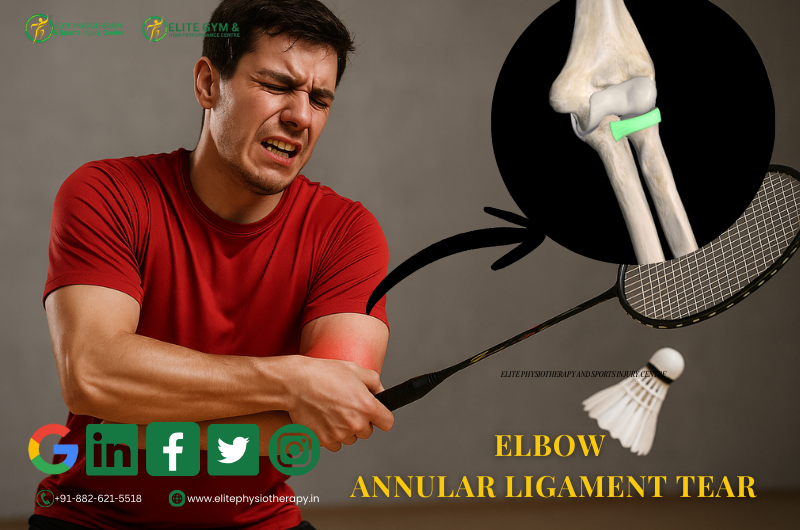
Elbow Annular Ligament Injury: A Complete Physiotherapy Guide for Faster Elbow Recovery

Introduction

  • Elbow mobility and stability are impacted by annular ligament injury. Athletes and active people are more likely to have the disorder. The annular ligament permits smooth forearm rotation while stabilizing the radial head. Everyday activities and sports become uncomfortable when one is injured.
  • For these kinds of problems, Elite Physiotherapy and Sports Injury Centre offers sophisticated evaluation and top-notch physiotherapy treatment. Our evidence-based methods guarantee a quick and secure recuperation.

What Is an Annular Ligament Injury?

  • The annular ligament surrounds the radial head. During pronation and supination, it maintains joint alignment. When a ligament tears or stretches, damage results. Pain and instability result from the elbow’s loss of smooth rotational control.

Causes of Annular Ligament Injury

  • Sudden pulling force on the forearm
  • Fall on an outstretched hand
  • Repetitive overhead activities
  • Forceful twisting of the forearm
  • Direct trauma to the lateral elbow
  • Poor lifting biomechanics during sports
  • Weak dynamic stabilizers around the elbow

Types / Classification

  1. Annular Ligament Sprain
    • The fibers stretch without structural disruption. Pain appears during movement.
  2. Partial Tear
    • Some fibers tear. Pain increases during rotation and lifting.
  3. Complete Tear / Radial Head Subluxation
    • The ligament fails to hold the radial head. A “pulled elbow” may occur.

Clinical Features / Signs & Symptoms

  • Sharp lateral elbow pain
  • Pain during pronation and supination
  • Tenderness over the radial head
  • Weak grip strength
  • Difficulty lifting objects
  • Clicking or catching sensation
  • Limited end-range elbow rotation
  • Mild swelling around the lateral elbow
  • Feeling of instability while rotating the forearm

Physiotherapy Management at Elite Physiotherapy and Sports Injury Centre

  • Our centre uses the latest sports physiotherapy protocols designed for athletes and active individuals. We employ advanced technology and personalized care for optimal recovery.

1. Pain and Inflammation Management

  • We begin by reducing acute pain.
  • Cryotherapy aids in reducing edema.
  • Strain is lessened by gentle protection positions.
  • In the early stages, we steer clear of aggressive movement.

2. Manual Therapy

  • Manual techniques restore soft tissue mobility.
  • Joint alignment is improved by mild radial head mobilization.
  • Muscle guarding is lessened by soft tissue relaxation.
  • Circulation is enhanced by myofascial procedures.

3. High-End Modalities at Elite Physiotherapy

  1. Shock Wave Therapy
    • Tissue repair is helped by shock waves.
    • It promotes the production of collagen and lessens chronic inflammation.
    • In cases of chronic annular ligament irritation, it is effective.
  2. Super Inductive System (SIS)
    • Deep stabilizing muscles are activated by SIS.
    • It lessens pain and enhances neuromuscular control.
    • During rotation, it improves radial head stability.
  3. High-Intensity Laser Therapy (HILT)
    • Tissue regeneration is accelerated by HILT.
    • It lessens chronic pain and increases blood flow.
    • It relieves persistent ligament pain and partial rips.
  4. Dry Needling
    • Tight supinator and extensor muscles are released by dry needling.
    • It lessens the radial head’s protective spasm.
    • It swiftly recovers functional mobility.
  5. Cupping Therapy
    • The circulation surrounding the lateral elbow is enhanced by cupping.
    • It lessens stiffness and eliminates local congestion.

4. Corrective and Strengthening Exercises

  1. Phase 1: Early Activation
    • Isometric elbow flexion and extension
    • Isometric pronation and supination
    • Scapular setting exercises
  2. Phase 2: Dynamic Control
    • Theraband resisted supination
    • Controlled pronation strengthening
    • Wrist extensor strengthening
    • Radial head stabilization drills
  3. Phase 3: Functional Strengthening
    • Closed-chain weight-bearing drills
    • Forearm rotational endurance
    • Sport-specific patterns for athletes

5. Proprioception & Neuromuscular Retraining

  • Ball rotation drills
  • Elastic band perturbation
  • Eyes-closed rotational control

6. Return-to-Sport Rehabilitation

  • We ensure safe return to training.
  • Athletes undergo:
  • Functional strength testing
  • Throwing mechanics analysis
  • Grip and rotation endurance testing
  • Load progression for heavy lifts

When Surgery Is Needed

  • Physiotherapy helps most cases recover.
  • However, surgical repair may be necessary for total ligament rips accompanied by radial head subluxation.
  • In these situations, we offer post-operative rehabilitation.

Prevention Tips from Elite Physiotherapy

  1. Warm up before sports
  2. Strengthen forearm muscles regularly
  3. Avoid sudden pulling of the arm
  4. Use correct lifting mechanics
  5. Follow a recovery routine after heavy training

Conclusion

  • An annular ligament injury can restrict performance and everyday activities. On the other hand, early diagnosis and advanced physiotherapy ensure quick and secure healing. We employ state-of-the-art techniques and customized rehabilitation plans at Elite Physiotherapy and Sports Injury Centre for athletes and active people.
  • Our staff prioritizes full recuperation, long-term stability, and a return to optimal performance.

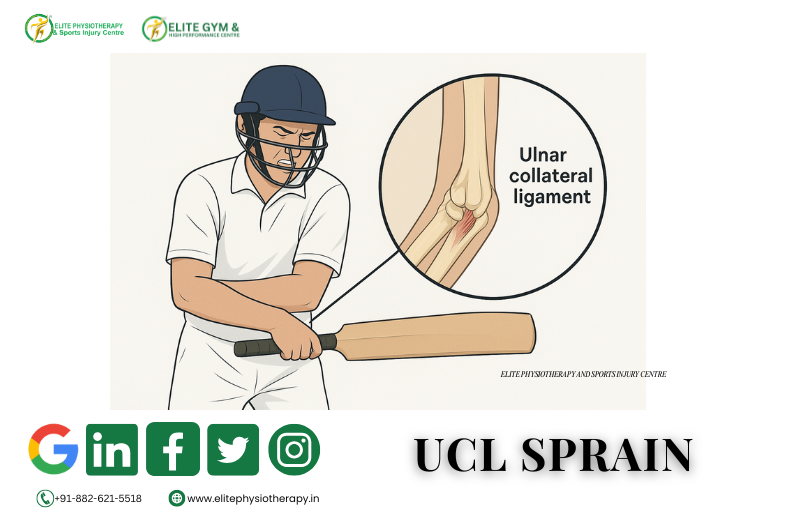
UCL Sprain: Modern Treatment, Better Recovery

Athletes who engage in frequent overhead or throwing motions are susceptible to ulnar collateral ligament (UCL sprain ). The Lite Physiotherapy and Sports Injury Centre offers cutting-edge, research-based treatment for this distressing condition. To restore strength, stability, and performance, the clinic employs cutting-edge modalities and contemporary assessment techniques.

What Is a UCL Sprain?

A partial or total rupture of the ligament on the inside of the elbow is known as a UCL sprain. During valgus stress, this ligament keeps the elbow stable. Pain and instability arise when the ligament tears or overstretches. Throwers, wrestlers, weightlifters, Ballers in cricket and athletes participating in racquet sports are frequently affected by the injury.

Causes of UCL Sprain

  • Throwing repeatedly puts stress on the medial elbow.
  • Poor throwing mechanics increase the valgus load.
  • The ligament is strained by abrupt falls or direct impact.
  • Dynamic stability is diminished by muscle weakness.
  • Micro-trauma accumulates as a result of overtraining.

To guarantee precise treatment planning, we at Elite Physiotherapy pinpoint the precise cause.

Types or Classification of UCL Sprains

  • Grade I
    • The ligament is overstretched but intact. Pain is present but stability is maintained.
  • Grade II
    • A partial tear occurs. Pain increases and mild instability appears.
  • Grade III
    • A complete tear occurs. Instability is obvious during movement or loading.

Proper diagnosis is essential because management differs for each grade.

Clinical Features / Signs and Symptoms

  • Medial elbow pain during throwing
  • Pain during resisted wrist flexion
  • Tenderness along the UCL
  • Decreased throwing speed or power
  • A feeling of looseness in the elbow
  • Swelling around the medial joint line
  • Pain during valgus stress

Diagnostic Methods and Investigations

  • Clinical Examination
    • A thorough history pinpoints the injury mechanism, exercise volume, and symptoms.

Special Tests

  • Valgus Stress Test
    • In this test, the elbow is subjected to a controlled valgus force at 20 to 30 degrees. A UCL damage is indicated by increased pain or severe gapping.
  • Moving Valgus Stress Test
    • The examiner applies valgus stress while moving the elbow from full flexion to extension. UCL pathology is indicated by pain that ranges from 70 to 120 degrees.
  • Milking maneuver
    • To produce a valgus force, the clinician tugs the patient’s thumb. UCL involvement is suggested by medial discomfort.

Without citing any outside sources, these tests aid in confirming the diagnosis.

Imaging

  • Ultrasound, MRI, X-ray

Physiotherapy Management of UCL Sprain at Elite Physiotherapy and Sports Injury Centre

  • Physiotherapy remains the first-line treatment for most UCL injuries. At Elite Physiotherapy, we uses advanced techniques and high-end modalities to ensure fast and safe recovery.

1. Pain Reduction and Inflammation Control

  • Cryotherapy
    • During the acute period, cold treatment lessens inflammation.
  • Shock Wave Treatment
    • Shock wave therapy lessens persistent discomfort and encourages tissue regeneration.
  • High-Power Laser Treatment
    • This technique enhances collagen alignment and speeds up recovery.
  • System Super Inductive (SIS)
    • SIS rapidly lessens pain by promoting deep muscle activity.
  • Dry Needling
    • Dry needling lessens medial elbow strain and relaxes tense muscle bands.
  • Cupping Treatment
    • Cupping lessens fascial limitations around the elbow and increases blood flow.
  • These techniques promote quicker recovery and less pain.

2. Restoring Range of Motion

  • Elbow stiffness is lessened, and elbow movement is restored with gentle mobility exercises.
  • Flexion and extension of the elbow passively
  • Pronation and supination of the forearm
  • Drills for shoulder mobility to lessen compensatory tightness
  • Adhesive tissue development is inhibited by controlled movement.

3. Strengthening Program

  • Elite Physiotherapy employs a methodical approach to strengthening.
  • Phase 1: Strengthening Isometrically
    • Wrist flexor, extensor, and pronator pain-free isometrics start early.
  • Phase 2: Strengthening Dynamically
    • Light resistance bands strengthen the flexor-pronator mass.
    • Scapular stability exercises enhance shoulder mechanics.
    • Eccentric loading enhances tendon resilience.
  • Phase 3: Advanced Strengthening
    • Eccentric loading enhances tendon resilience.
    • Plyometric exercises prime the elbow for high-intensity sports.

4. Correction of Throwing Mechanics

  • The corrective procedure prevents recurrence.
  • Elite Physiotherapy examines throwing patterns and makes the following corrections:
    • Position of the arm slot
    • Mechanisms of trunk rotation
    • Pattern of follow-through
    • Distribution of force among joints
  • The corrective procedure prevents recurrence.

5. Proprioception and Neuromuscular Training

  • Proprioceptive exercises improve dynamic elbow stability.
    • Drills using weight-bearing
    • Ball-catch exercises
    • Techniques for functional tapping
  • These workouts get the athlete ready for duties unique to their sport.

6. Return-to-Sport Programming

  • A methodical return procedure ensures safety.
  • Stage 1: Regulated Throwing
    • Athletes use low volume for light tosses.
  • Stage 2: Throwing Progressively
    • While keeping an eye on symptoms, intensity progressively rises.
  • Stage 3: Exercises Particular to Sports
    • Athletes restart competitive or fast-paced drills.
    • Physiotherapists at Elite Physiotherapy customize this path for every athlete.

7. Elite Physiotherapy’s Preventive Techniques

  • For long-term elbow health, prevention is crucial.
    • Frequent evaluations of strength
    • Monitoring the throwing load
    • Maintaining mobility
    • Soft tissue maintenance
    • Corrections for skill-based training
  • These methods ensure long-term performance and safety..

Conclusion

  • Although dangerous, a UCL sprain is treatable. Athletes can safely return to sport with the right diagnosis, cutting-edge physiotherapy, and contemporary techniques. At Elite Physiotherapy and Sports Injury Centre, we use cutting-edge technologies like Shock Wave, SIS, High-Intensity Laser, Dry Needling, and Cupping to provide individualized, evidence-based rehabilitation. Our methodical evaluation and rehabilitation process ensures long-term elbow stability and full recovery.