17 Nov 2026 · 11 min read
SI Joint Pain: The Hidden Signs
Lower Back Pain · SIJ Pain
Image: SI joint pain: physiotherapy assessment and treatment at Elite Physiotherapy
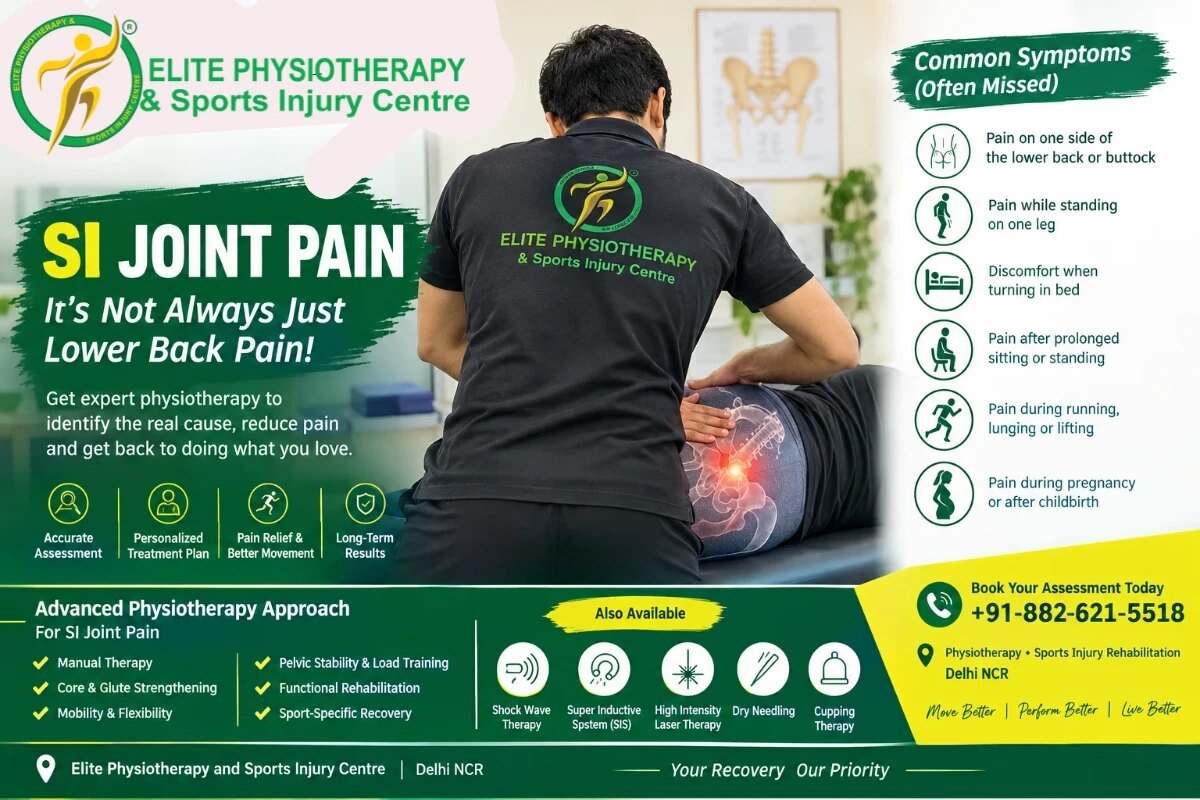
Do you have pain low in your back, in your buttock or around your pelvis that does not behave like ordinary back pain? The sacroiliac (SI) joint is often overlooked as a cause, and its symptoms are easily mistaken for back pain, sciatica or a hip problem.
- SI joint pain usually sits on one side, near the dimples at the base of the spine, below the belt line.
- Typical triggers: standing on one leg, stairs, turning in bed, long sitting, running and lunging.
- It does not mean the joint is "out of place"; no single test confirms it.
- Assessment-led, exercise-based physiotherapy is the main treatment.
Could your back pain be coming from the SI joint?
The sacroiliac joints connect the sacrum (the base of the spine) to the iliac bones of the pelvis. They transfer load between the spine and the legs and help keep the pelvis stable when you walk, run, lift and go about daily tasks.
SI joint pain can build up gradually or start after an injury. It affects pregnant women, athletes, office workers and active adults alike, and it can appear during movements that do not seem connected to the lower back. At Elite Physiotherapy and Sports Injury Centre, we focus on finding the source of your pain and restoring comfortable movement, combining a thorough physiotherapy assessment with a personalised rehabilitation plan.
What is SI joint pain?
SI joint pain is pain that comes from the sacroiliac joint or the structures that support it. Each person has two SI joints, one on each side of the sacrum, held together by very strong ligaments that help pass forces through the pelvis.
Unlike the hip or shoulder, the SI joint moves only a little, but it plays an important role in distributing load during everyday activities. Pain can come from the joint surfaces, the surrounding ligaments or nearby tissues, and changes in loading, injury and inflammation can all contribute. That is why the whole lumbopelvic region, not just one joint, needs to be assessed.
SI joint pain does not automatically mean the joint is displaced or misaligned, and tenderness alone cannot confirm the diagnosis. A careful examination is what separates SI joint pain from other conditions.
10 SI joint pain symptoms most people miss
Recognising the less obvious signs can help you get the right care sooner, because SI joint pain does not always feel like typical lower back pain.
1. Pain on one side of the lower back
Pain is usually felt near the dimples at the back of the pelvis, below the belt line. It may stay on one side or affect both, and is often described as a deep ache rather than a sharp pain.
2. Buttock pain without obvious back pain
The pain may sit mainly in the buttock while the lower back feels fine, so people often assume it is a tight gluteal muscle or piriformis problem.
3. Pain while standing on one leg
Climbing stairs, getting dressed or putting on trousers can bring on symptoms, because these movements test pelvic stability and load transfer through one leg.
4. Discomfort when turning in bed
Rolling over, changing sleeping position or getting out of bed can reproduce the pain, as position changes put extra stress on sensitive tissues.
5. Pain after prolonged sitting or standing
Some people struggle with long periods of sitting; others with standing or walking for a long time. The aggravating activity differs from person to person.
6. Pain during running, lunging or lifting
Athletes may notice pain during single-leg exercises, cutting, acceleration or heavy lifting, which place high demands on trunk and pelvic control.
7. Pain that travels into the thigh
SI joint pain can spread into the buttock or thigh. Pain below the knee, tingling, numbness or weakness, however, needs assessment for nerve involvement such as sciatica; see disc bulge vs sciatica.
8. Pain during pregnancy or after childbirth
Pregnancy changes pelvic loading and the structures around the SI joints. Pregnancy-related pelvic girdle pain can involve several structures, so the whole picture should be assessed by a professional. Our women's health physiotherapy covers pregnancy and postnatal care.
9. Difficulty finding a comfortable position
Some people keep shifting position to ease the discomfort, and long journeys, desk work and household chores become difficult.
10. Symptoms that settle, then keep coming back
Rest or light movement may bring short-term relief, but symptoms return when the same demanding activity resumes. Repeated recurrence is a sign that a thorough assessment is needed.
Causes of SI joint pain
SI joint pain can develop in several ways, and identifying the likely contributors guides effective physiotherapy:
- Repetitive loading and sudden increases in activity: a jump in running mileage, training volume or physical work can overload the joint and its ligaments.
- Sports injuries: falls onto the buttock, awkward landings, and sports with kicking, cutting or single-leg loading such as football, cricket and running.
- Pregnancy and postpartum changes: hormonal changes, weight gain and altered posture change how the pelvis handles load.
- Reduced trunk and pelvic load tolerance: low endurance or control of the trunk and hip muscles can leave the pelvis less able to cope with demand; see core stability vs core strength.
- Previous injuries or surgery: earlier back, hip or pelvic problems, including lumbar fusion, can change how load passes through the SI joints.
- Inflammatory conditions: conditions such as ankylosing spondylitis can cause inflammation of the SI joints and need medical assessment.
- Degenerative changes: age-related changes in the joint can contribute, although they are also common in people without pain.
- Repeated asymmetrical activities: always carrying a child or bag on one side, one-sided sports and standing with weight on one leg.
How our physiotherapists interpret SI joint tests
Clinicians often use a cluster of six provocation tests: distraction, compression, thigh thrust, sacral thrust, FABER and Gaenslen's test. When three or more are positive, SI joint pain becomes more likely, but positive tests do not prove the diagnosis, because other conditions can produce similar symptoms. When an appropriate cluster is negative, the SI joint is a less likely source.
Tests of pelvic movement, such as the Gillet test, are sometimes used, but they should not be treated as proof of abnormal movement or misalignment. The final clinical impression combines your history, these tests, an examination of the lower back and hip, and your functional limitations. Current guidelines also stress the limits of physical examination and the importance of ruling out other causes.
When to seek urgent medical care
Seek urgent medical attention for new bladder or bowel problems, numbness around the groin or saddle area, rapidly worsening leg weakness, back or pelvic pain with fever or feeling unwell, unexplained weight loss, or severe pain after a significant fall or accident. See back pain red flags.
SI joint pain physiotherapy: our treatment approach
Physiotherapy for SI joint pain aims to reduce symptoms, improve load tolerance, restore movement and support a return to normal activity or sport. Treatment is guided by your assessment and goals, and our team builds programmes for athletes, working people, active adults and postnatal patients.
1. Education and activity modification
The first step is understanding your symptoms and which activities aggravate them. Temporary changes might include reducing heavy lifting, limiting painful single-leg tasks or lowering running intensity. Complete bed rest is usually not needed for mechanical pain; instead, we encourage comfortable movement and a gradual return to normal activity. For example, someone who hurts during long sitting may benefit from regular movement breaks, while an athlete may briefly reduce sprinting and heavy single-leg loading. The goal is to stay active without repeatedly provoking severe symptoms, then build up as tolerance improves.
2. Pain management and comfortable movement
During an irritable phase, gentle mobility exercises, pacing and positioning help limit unnecessary flare-ups. Some people tolerate short walks or gentle pelvic movements better than long periods of rest; others need to reduce certain activities for a short time. We monitor symptoms during and after treatment, and exercise should not cause new nerve symptoms or significantly increase pain.
3. Manual therapy when appropriate
Gentle mobilisation of the lumbar spine, hip or nearby tissues and soft-tissue techniques may help with associated muscle pain. Manual therapy supports active rehabilitation rather than replacing it, and there is no need to assume the pelvis is "out" and must be corrected; see functional manual therapy.
4. Deep core and trunk strengthening
Rehabilitation may start with low-load exercises such as gentle abdominal bracing, modified dead bugs and controlled heel slides, adjusted for range, resistance and repetitions. As control improves, exercises progress to resisted trunk movements, loaded carries and more demanding functional tasks to build strength and endurance for daily life.
5. Gluteal and hip strengthening
The hip muscles help control the pelvis during walking, lifting and single-leg movements. Bridges, clamshells, resisted hip abduction and sit-to-stand exercises are common starting points, progressing to step-ups, split squats, single-leg work and resisted hip extension. These are chosen when the assessment shows relevant strength or endurance deficits, not simply on the assumption that weak glutes cause SI joint pain.
6. Pelvic control and load transfer training
Some people find it hard to transfer weight between the legs. Rehabilitation can start with supported weight shifts and progress to step-ups, controlled lunges, single-leg balance and gait-related exercises, while also working on technique, breathing and confidence in movement.
7. Mobility exercises
Where limited hip or lumbar movement contributes, comfortable lumbar movements and targeted hip mobility can help. Stretching should target a restriction found in the assessment, such as the hip flexors, glutes or hamstrings, because aggressive stretching can make symptoms worse for some people.
8. Progressive functional rehabilitation
Once symptoms are more manageable, exercises are matched to your daily demands: sitting and walking tolerance for office workers, progressive lifting for manual workers, and cutting, landing, acceleration and deceleration for athletes. Weightlifters return gradually to squats, pulls and heavy hip-hinge patterns. Difficulty, volume, speed and resistance increase step by step according to your symptoms and movement quality. Early examples include:
- Gentle abdominal bracing
- Glute bridge
- Sit-to-stand
- Supported weight shifts
- Walking
9. Gait and running retraining
For runners, we review training load, recent mileage changes, speed, cadence, terrain and recovery. Not every runner needs to change technique; any change should address a relevant finding and improve comfort or performance. Return to running usually starts with comfortable walking and short running intervals, progressing according to symptoms and recovery between sessions. Our gait and posture analysis supports this stage.
10. Pregnancy-related pelvic pain rehabilitation
During pregnancy and after childbirth, rehabilitation focuses on comfortable movement, suitable hip and trunk exercises, pacing and advice on everyday tasks. A pelvic support belt can help some people during demanding activities, but it is an optional aid, not a solution for everyone. We adapt positions and exercises to your symptoms, stage of pregnancy and medical advice, and a female physiotherapist is available on request.
Where useful, supporting treatments such as dry needling, cupping, high-intensity laser, Super Inductive System (SIS) or shock wave therapy may be added for selected patients after assessment, always alongside exercise; see advanced physiotherapy. For more on treatment options, read SI joint pain explained.
Why choose Elite Physiotherapy and Sports Injury Centre?
We focus on individual assessment and functional rehabilitation, looking at the lumbar spine, hips, pelvis, movement patterns and relevant medical history. Treatment is tailored to your symptoms, physical capacity and goals and may include progressive strengthening, movement training, activity modification and selected supporting therapies. We work with office workers, active adults, athletes and people recovering from pain, and our sports physiotherapists support return to sport.
Visit us in Saket, South Delhi or Sector 70, Gurugram. For related problems, see back pain, low back pain in young adults and lumbar instability. Book an assessment to find out whether your pain is coming from the SI joint.
Frequently asked questions
Where is SI joint pain usually felt?
Most often on one side, low down near the dimples at the base of the spine, below the belt line, and sometimes into the buttock or the back of the thigh. Pain below the knee, tingling, numbness or weakness points more towards a nerve problem and needs checking.
How do I know if my pain is from the SI joint or my lower back?
Symptoms overlap, so self-diagnosis is unreliable. A physiotherapist combines your history, a cluster of SI joint provocation tests and an examination of the lumbar spine and hip to decide which is the most likely source.
Is my SI joint "out of place"?
Almost never. SI joint pain does not mean the joint is displaced or misaligned, and treatment does not need to "put it back". Rehabilitation focuses on your symptoms, load tolerance and function.
Can SI joint pain happen during pregnancy?
Yes. Pregnancy changes the load on the pelvis and its ligaments, and pelvic girdle pain is common during and after pregnancy. Physiotherapy with tailored exercise, pacing and activity advice can help, and a female physiotherapist is available at our clinics.
How long does SI joint pain take to settle with physiotherapy?
It varies with how long you have had it, your activity demands and how well you can adjust aggravating activities. Many people notice improvement within a few weeks of a structured programme, while long-standing or sport-related problems usually need a longer, progressive plan.
This article is general information from our physiotherapy team. It does not replace an individual assessment by a physiotherapist or doctor.