17 Nov 2026 · 10 min read
Core Stability vs Core Strength: What Matters Most?
Core · Strength & Conditioning
Image: Core stability vs core strength: physiotherapist coaching a bird-dog exercise
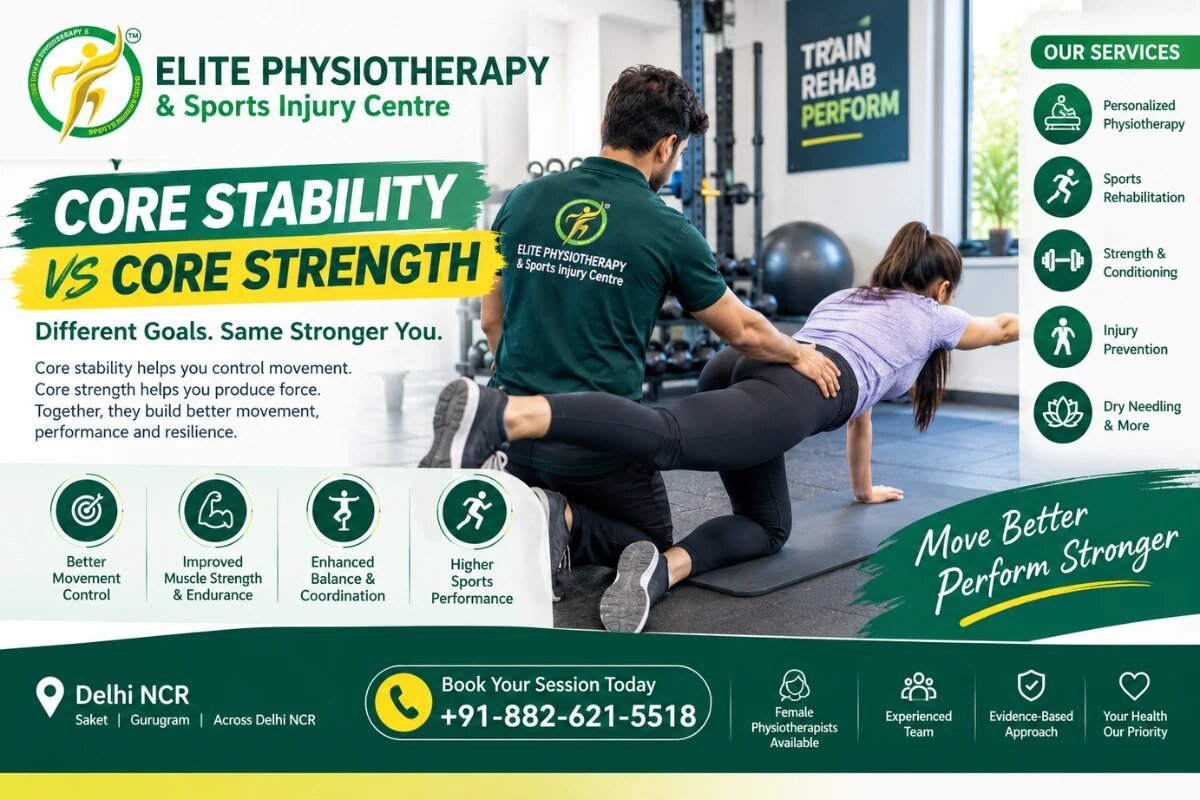
Understanding the difference between core stability and core strength helps anyone who wants to move better, recover from injury or perform better in sport. The two terms sound alike, but they describe different qualities of trunk muscle function. Both help the body control movement, maintain posture and transfer force efficiently.
- Core stability = controlling the trunk and pelvis during movement and against outside forces.
- Core strength = the trunk muscles producing force against resistance.
- You need both. The right balance depends on your symptoms, sport and goals.
- Good core training also involves the hips, breathing, endurance and sport-specific movement.
Your core does much more than your abdominal muscles. It links the movements of your upper and lower body, supports your spine and controls your pelvis. That is why a strong core does not always mean good movement control. At Elite Physiotherapy and Sports Injury Centre, we assess both qualities based on your symptoms, physical demands and performance goals, and build programmes that combine clinical assessment, targeted exercise and progressive functional training.
What is the core?
The core is the group of muscles and supporting tissues around the trunk and pelvis. Key muscles include the rectus abdominis, transversus abdominis, internal and external obliques, multifidus and erector spinae. The diaphragm and pelvic floor help coordinate the system and control pressure inside the trunk.
The gluteal and other hip muscles support control of the lower back and pelvis during functional movement, and the core also works together with the shoulders, hips and legs. During walking, running, lifting, jumping and throwing, the body constantly coordinates these muscles to control unwanted movement and transfer force between body segments.
What is core stability?
Core stability is the ability to control the position and movement of the trunk over the pelvis. It depends on coordinated muscle activity, sensory feedback and appropriate reactions to changing physical demands.
Imagine reaching forward while standing on one leg: your arms and leg move, but your trunk and pelvis must stay controlled. A wrestler must resist an opponent's pull while controlling trunk rotation, and a runner must control the trunk through thousands of single-leg landings.
Core stability does not mean keeping the spine rigid. It means controlling movement in a way that suits the task. Someone with good stability can adapt to unexpected forces and stay in control during slow and fast movements, which requires timing, coordination, strength, endurance and a good movement strategy.
What is core strength?
Core strength is the ability of the trunk muscles to produce force against resistance: to flex, extend and rotate the trunk, or to resist being moved. A weighted sit-up challenges trunk flexor strength, for example, while a cable rotation challenges the muscles that produce and control rotational force.
Athletes need enough core strength to tolerate demanding training and to run, throw, grapple, lift and change direction. But strength alone does not ensure efficient movement: a person can produce high force yet still struggle to control the trunk during single-leg tasks. A good programme therefore develops strength together with coordination, endurance and task-specific control.
Core stability vs core strength: key differences
Core stability focuses on controlling movement and holding the trunk in an appropriate position. Core strength focuses on using the trunk muscles to produce force. The two overlap, because muscles must produce force to control the spine and pelvis, but the main goal should guide exercise choice and assessment.
Core stability usually emphasises:
- Coordinated muscle activation
- Control of the spine and pelvis
- Resisting unwanted movement
- Balance while changing position
- Keeping technique under fatigue
- Responding to external forces
Core strength usually emphasises:
- Producing force against resistance
- Increasing muscular capacity
- Progressive loading and overload
- More force during trunk movements
- Tolerance for demanding tasks
- Supporting strength and conditioning goals
A dead bug, for example, mainly trains trunk control and coordination, while a progressively loaded cable crunch mainly builds trunk flexor strength. No exercise trains only one quality: the load, technique, speed, fatigue and goal all shape the result.
Types of core training
1. Static core stability
Controlling the trunk while holding a position, such as planks, side planks and adapted bridge holds. These exercises test whether you can sustain muscle activity without losing technique, and they can be useful early in rehabilitation when dynamic movement is still uncomfortable.
2. Dynamic core stability
Controlling the trunk while the arms, legs or body move. Common examples are dead bugs, bird dogs, controlled lunges and single-leg tasks. These improve coordination as positions change; progression should match your symptoms and capacity.
3. Reactive core stability
Reacting to unexpected movement or outside forces, using resistance-band tasks, partner drills and controlled perturbations. Athletes need this to react to an opponent or absorb contact. Exercises should progress gradually before adding high-speed or unpredictable demands.
4. Core muscle strength
Training the trunk muscles against progressively higher resistance: weighted carries, cable rotations, resisted trunk flexion and targeted extension exercises. Resistance should only increase when you can keep good technique.
5. Core muscular endurance
The ability to hold or repeat force over time. Side bridges, front planks and controlled repeated trunk movements can measure and improve it. Endurance is different from maximal strength, and both matter during long training sessions and competition.
6. Anti-movement training
Exercises that challenge the trunk to resist unwanted movement: anti-extension (dead bug), anti-rotation (Pallof press) and anti-lateral flexion (suitcase carry). They build control when outside forces try to move the trunk.
Why do people develop poor core function?
- Inadequate training: core work that is missing, too easy or limited to crunches does not prepare the trunk for real-life and sporting demands.
- Prolonged inactivity: long periods of sitting and low activity reduce trunk endurance and coordination.
- Previous injuries: back, hip or groin injuries can change how and when the trunk muscles switch on, and these changes may persist after pain settles.
- Poor exercise technique: repeating exercises with compensations trains the compensation, not the intended quality.
- Training load errors: sudden increases in load, volume or difficulty can exceed what the trunk is ready for.
- Reduced coordination and balance: poor balance or body awareness makes it harder to control the trunk during single-leg and fast movements.
Signs your core control may need attention
Poor core function does not always cause symptoms. Some people have movement-control problems without pain, while others have pain despite good strength. Possible signs include:
- Difficulty controlling the trunk during exercise
- Reduced tolerance for long periods of activity
- Early fatigue during planks or loaded carries
- Difficulty controlling the pelvis during single-leg tasks
- Excessive compensation when lifting
- Reduced balance during challenging movements
- Difficulty transferring force during sports skills
- Back discomfort during certain activities
- Reduced confidence when twisting or bending
Recurring back pain with a feeling of poor control can be linked to lumbar instability; see also low back pain in young adults.
Physiotherapy management for core stability and core strength
Treatment starts with an assessment of your symptoms, movement, strength, endurance and goals. The programme then progresses step by step:
- Pain management and activity modification: settling irritated tissues and adjusting, not stopping, activity so training can continue.
- Diaphragmatic breathing and trunk coordination: learning to breathe normally while the trunk muscles work, instead of holding your breath.
- Deep trunk muscle activation: gentle, well-timed activation of the transversus abdominis and multifidus.
- Dead bug exercise: controlling the lower back while the arms and legs move, a key anti-extension drill.
- Bird dog exercise: keeping the trunk and pelvis steady while reaching with the opposite arm and leg.
- Plank progressions: from short, well-controlled holds to longer holds and more challenging variations.
- Side plank progressions: building lateral trunk and hip endurance, from knees to full side planks with movement.
- Gluteal and hip strengthening: bridges, hip hinges and single-leg work so the hips control the pelvis.
- Progressive core strength training: adding load to trunk exercises once control is reliable, supported by our strength training specialists.
- Anti-rotation training: Pallof presses and cable holds to resist twisting forces.
- Loaded carries: farmer's and suitcase carries to build trunk control while walking under load.
- Dynamic and sport-specific training: applying control and strength to running, landing, throwing, lifting and contact, with our sports physiotherapists.
Where pain or stiffness limits progress, treatment may also include functional manual therapy or dry needling, always alongside exercise. Athletes can continue their programme in the gym at our High Performance Centre in Sector 70, Gurugram.
Common mistakes during core training
- Focusing only on abdominal appearance: visible abs say little about how well your trunk controls movement or handles load.
- Using difficult exercises too early: advanced variations before you have control lead to compensation and sometimes pain. Master the basics first.
- Holding your breath unnecessarily: brief bracing has its place in heavy lifting, but for most core exercises you should breathe steadily.
- Ignoring symptoms: pain that increases during or after core training is a reason to adjust the exercise or get assessed, not to push through.
- Neglecting the hips and legs: the core works as part of a chain, so hip strength and leg control are part of core training.
Read how core stability supports athletes in core stability for better sports performance, and why mobility matters more than flexibility.
When should you see a physiotherapist?
Consider a professional assessment if back pain keeps interfering with daily activities or training, or if lifting technique, balance or sport-specific movement remain difficult. A physiotherapist can work out whether pain, strength, endurance, mobility, coordination or something else is the main limitation, so treatment targets the real problem instead of following a generic routine.
Seek urgent medical attention for severe or rapidly worsening symptoms, new significant leg weakness, numbness in the saddle area, or new loss of bladder or bowel control. These can indicate a serious spinal problem; see back pain red flags.
Why choose Elite Physiotherapy and Sports Injury Centre?
We provide personalised physiotherapy and sports rehabilitation across Delhi NCR. Our approach is built on clinical assessment, measurable goals and progressive exercise, and we take your symptoms, physical demands and goals into account before planning treatment. Care combines active rehabilitation, functional training and appropriate hands-on treatment, with selected advanced modalities when clinically suitable.
Whether you want performance-focused training or injury rehabilitation, visit us in Saket, South Delhi or Sector 70, Gurugram. A female physiotherapist is available on request. Book an assessment to get a core programme built around you.
Frequently asked questions
What is the difference between core stability and core strength?
Core stability is the ability to control the position and movement of the trunk and pelvis, especially while the arms and legs move or outside forces act on you. Core strength is the ability of the trunk muscles to produce force against resistance. They overlap, but they are trained with different exercises and progressions.
Which is more important for back pain, core stability or core strength?
It depends on what the assessment finds. Many people with recurrent back pain first need better control, endurance and confidence in movement, then progressive strength. A physiotherapist can identify which is limiting you.
Are planks enough to build a strong core?
Planks are useful for trunk endurance, but on their own they are not enough. A balanced programme also includes dynamic control (dead bugs, bird dogs), anti-rotation work (Pallof press), loaded carries, hip strength and sport-specific movements.
How often should I train my core?
Most people benefit from core work two to four times a week, built into their warm-up or strength sessions. Quality and progression matter more than doing a large number of repetitions.
Can a weak core cause injuries in sport?
Poor trunk control is one of several factors linked to lower-limb and back injuries, especially in sports with landing, cutting and throwing. Core training works best as part of a complete strength and conditioning programme.
This article is general information from our physiotherapy team. It does not replace an individual assessment by a physiotherapist or doctor.