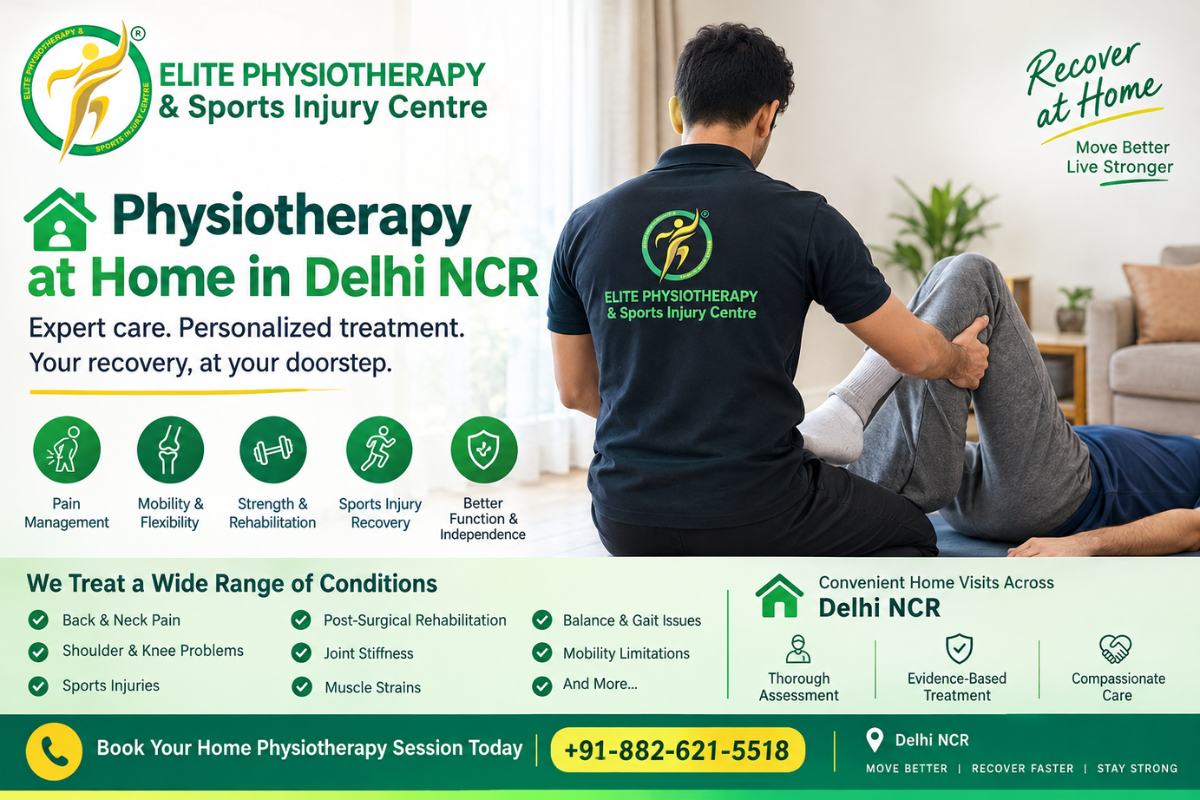
Introduction: Better Recovery, Right at Home
• Professional rehabilitation care is delivered right to your home with Physiotherapy at Home in Delhi NCR. It facilitates recovery without needless travel, waiting, or interference with regular activities. Pain control, strength development, mobility restoration, and functional rehabilitation can all be aided by home physical therapy.
• Our team at Elite Physiotherapy and Sports Injury Center offers customized physiotherapy depending on your goals and condition. Before developing a treatment plan, we evaluate your range of motion, strength, mobility, discomfort, and functional restrictions.
• Athletes, busy professionals, individuals with limited mobility, older citizens, and postoperative patients can all benefit from home-based care. Patients who have trouble traveling to the clinic in the early stages of rehabilitation may also benefit from it.
• Our strategy goes beyond short-term pain management. We establish a progressive rehabilitation program after identifying significant elements. As a result, every session has a distinct clinical goal.
• Home rehabilitation might offer an additional practical choice if you're looking for physiotherapy near me, physiotherapy Delhi, or trustworthy physiotherapy Saket services.
What Is Physiotherapy at Home in Delhi NCR?
Physiotherapy at Home in Delhi NCR means receiving professional physiotherapy services at your home. A qualified physiotherapist performs an assessment and provides appropriate treatment in your home environment.
Treatment may include:
- Pain management
- Joint mobility exercises
- Soft tissue techniques
- Manual therapy
- Stretching
- Strength training
- Balance training
- Postural correction
- Neuromuscular re-education
- Functional rehabilitation
- Gait training
- Sports rehabilitation
- Home exercise programs
- Ergonomic education
- Injury prevention strategies
• Your diagnosis, symptoms, physical capabilities, and rehabilitation objectives all influence the course of treatment.
• Every patient at Elite is not treated according to the same program. Rather, our Team, progress, progress, treatment, response.Many orthopedic, musculoskeletal, neurological, and sports-related disorders can benefit from Physiotherapy at Home in Delhi NCR due to its customized approach.
Who Can Benefit From Physiotherapy at Home?
Home physiotherapy can help people with different functional needs.
Older Adults
• Weakness, balance issues, stiff joints, or diminished gait are common among older persons. Rehabilitation in a comfortable setting is made possible by home treatment.
• Environmental difficulties can also be recognized by the physiotherapist. These may include furniture, unpoor poor furniture, strolling, unsuitable furniture, stairs, slippery, unsuitable furniture.
Post-Surgical Patients
Patients may need physiotherapy after orthopedic surgery. Common examples include:
1. Knee replacement
2. Hip replacement
3. ACL reconstruction
4. Meniscus surgery
5. Shoulder surgery
6. Fracture fixation
7. Spine surgery
Treatment usually progresses according to surgical precautions and medical guidance.
Patients With Chronic Pain
• Persistent back pain, neck discomfort, shoulder pain, and knee pain might impact routine tasks.
• Physiotherapy focuses on movement, strength, mobility, load control, and functional independence.
Sports and Fitness Enthusiasts
• Athletes may require rehabilitation following rehabilitation. Home sessions can address early-stage healing and mobility difficulties.
• Advanced return-to-sport testing, however, might call for specific equipment in a sports performance or physiotherapy facility.
Conditions Treated With Physiotherapy at Home
- Low back pain
- Neck pain
- Shoulder pain
- Knee pain
- Hip pain
- Ankle pain
- Muscle strains
- Tendinopathies
- Sports injuries
- Joint stiffness
- Postoperative weakness
- Balance problems
- Gait problems
- General deconditioning
- Work-related musculoskeletal pain
- Postural problems
- Age-related mobility limitations
Certain neurological rehabilitation methods may also benefit from physiotherapy.
However, a person's medical state determines whether home care is appropriate.
Before beginning an organized rehabilitation program, a physiotherapist should evaluate the patient.
When Should You Seek Physiotherapy?
Consider professional assessment when pain:
- Persists for several days
- Repeatedly returns
- Limits daily activities
- Affects sleep
- Reduces exercise performance
- Changes your walking pattern
- Limits joint movement
- Causes weakness
- Develops after an injury
Why Home Environment Matters
Home physiotherapy offers a unique opportunity.
The physiotherapist can observe the environment where the patient actually lives.
For example, the Team can identify:
- Unsafe stairs
- Poor chair height
- Difficult bathroom access
- Inappropriate walking aids
- Poor workstation setup
- Lack of exercise space
The physiotherapist can then recommend practical modifications.
This approach makes rehabilitation more relevant to everyday life.
Physiotherapy at Home for Busy Professionals
• The working population of Delhi NCR moves quickly.
• Clinic visits may be challenging due to long workdays.
• Travel-related obstacles can be lessened with home physical treatment.
• Additionally, it can support patients in maintaining a consistent course of treatment.
• Exercises can be included into the patient's everyday schedule by the physiotherapist.
• During working hours, for instance, brief mobility breaks could be included.
• Recovery might also be aided by workstation adjustments.
Physiotherapy at Home for Older Adults
Older adults often require a combination of strength, mobility, and balance training.
Home treatment provides a familiar setting.
The Team can gradually improve confidence during movement.
Treatment may focus on:
- Walking
- Sit-to-stand
- Stair climbing
- Balance
- Lower-limb strength
- Functional independence
Physiotherapy at Home After Surgery
Postoperative rehabilitation requires careful progression.
The physiotherapist follows the surgeon's precautions and rehabilitation guidelines.
Treatment may include:
- Pain management
- Swelling management
- Range-of-motion exercises
- Muscle activation
- Strengthening
- Gait training
- Functional training