17 May 2026 · 4 min read · By Dr. Ajaz Ahmad (PT)
How We Design Athlete-Specific Rehab Programs at Elite
Gym & Performance · Physiotherapy
Image: Athlete-Specific Rehab Programs
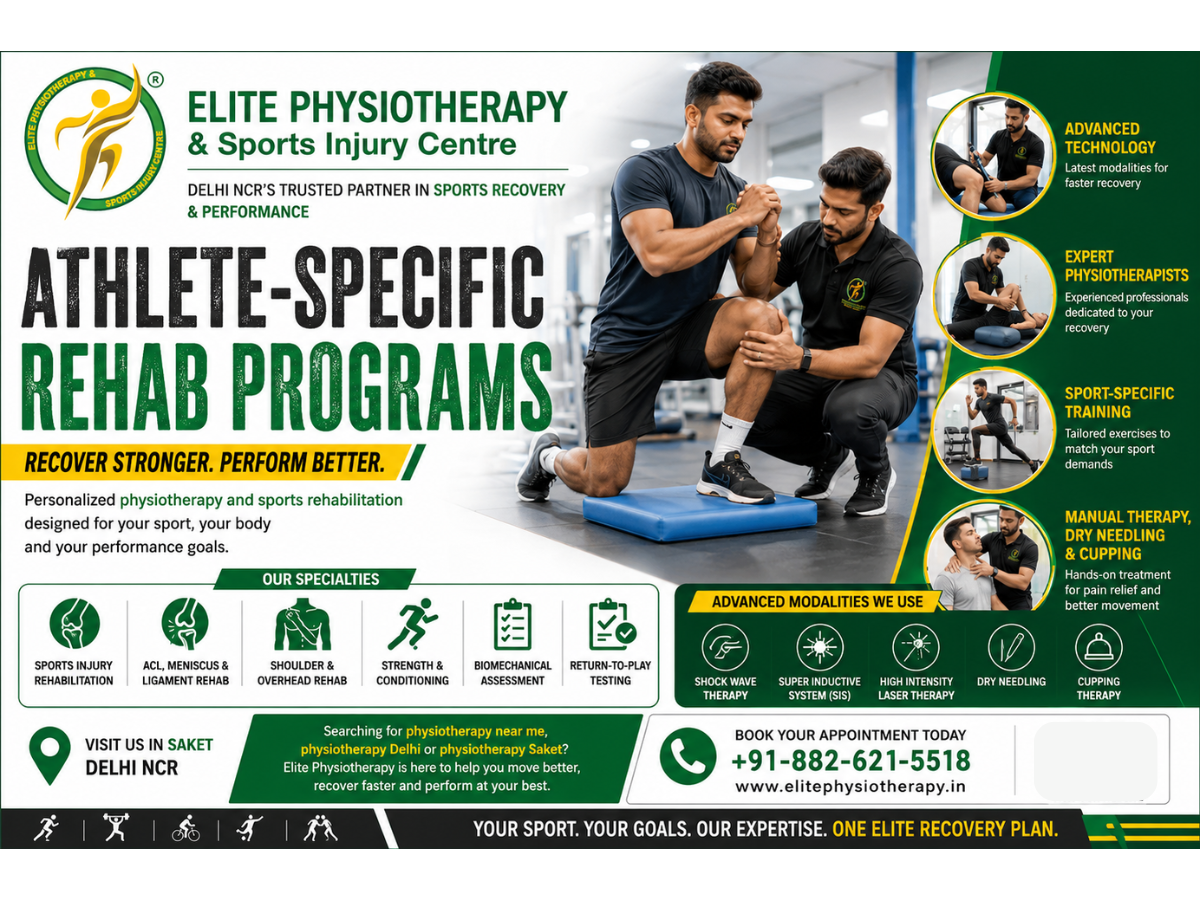
How Athlete-Specific Rehab Programs Improve Recovery and Performance
- We design Athlete-Specific Rehab Programs, movement requirements, performance level, past injuries, and return-to-play objectives.
- Our athlete-specific rehabilitation programs, in contrast to general rehabilitation regimens, concentrate on regaining strength, mobility, power, neuromuscular control, and confidence. Additionally, we integrate evidence-based sports rehabilitation strategies with cutting-edge physiotherapy treatments. This method enhances performance while assisting athletes in safely recovering.
- Our team at Elite Physiotherapy and Sports Injury Centre design rehabilitation plans based on your body mechanics and athletic needs, whether you are a professional athlete, recreational runner, cricket player, wrestler, football player, weightlifter, or fitness enthusiast.
- Elite Physiotherapy & Sports Injury Centre in Delhi NCR offers modern sports rehabilitation with individualized care if you're looking for physiotherapy near me, physiotherapy Delhi, or physiotherapy Saket.
What Is an Athlete-Specific Rehab Program?
- An athlete-specific rehabilitation program is a customized treatment plan created in accordance with:
- Type of sport
- Position played
- Injury severity
- Movement demands
- Training load
- Competition schedule
- Strength deficits
- Biomechanical limitations
- Performance goals
- A wrestler's shoulder rehabilitation program, for instance, is very different from a swimmer's or volleyball player's. In a same vein, football players' ACL recovery calls for different cutting and agility exercises than weightlifters.
- Before creating a rehabilitation plan, we at Elite Physiotherapy examine the entire kinetic chain. As a result, rather of being prescribed general workout regimens, players receive focused physiotherapy treatment.
Why Generic Rehabilitation Often Fails in Athletes
- Because rehabilitation simply treats pain, many athletes suffer from recurring injuries. Performance deficiencies, however, are still untreated.
- Typical causes include of:
- Poor movement mechanics
- Incomplete strength restoration
- Reduced proprioception
- Early return to sport
- Limited sport-specific conditioning
- Improper load progression
- Weak kinetic chain control
- Muscle imbalance
- Poor landing mechanics
- Inadequate core stability
- As a result, both rehabilitation and performance improvement are the main goals of athlete-specific rehab regimens.
- Common Sports Injuries Treated at Elite Physiotherapy
- Lower Limb Injuries
- ACL injuries
- Meniscus tears
- Ankle sprains
- Achilles tendinopathy
- Shin splints
- Patellofemoral pain syndrome
- Hamstring strain
- Quadriceps strain
- IT band syndrome
- Upper Limb Injuries
- Rotator cuff injuries
- Shoulder instability
- Labral injuries
- Tennis elbow
- Golfer’s elbow
- Wrist overload injuries
- Spine and Core Conditions
- Lumbar disc injuries
- Facet dysfunction
- SI joint dysfunction
- Cervical pain
- Postural overload syndromes
- Overuse Injuries
- Tendinopathies
- Stress reactions
- Muscle fatigue syndromes
- Load management injuries
How We Design Athlete-Specific Rehab Programs at Elite
Phase 1: Pain Reduction and Tissue Protection
- Initially, the focus remains on reducing pain and protecting healing tissues.
- Treatment may include:
- Activity modification
- Manual therapy
- Joint mobilization
- Soft tissue release
- Cryotherapy
- Taping techniques
- Isometric exercises
- Neuromuscular activation
- Additionally, we educate athletes about injury mechanisms and recovery expectations.
Phase 2: Restoring Mobility and Movement Quality
- After pain reduces, we improve movement quality.
- This phase includes:
- Dynamic mobility drills
- Muscle flexibility work
- Joint mobility exercises
- Corrective movement training
- Breathing mechanics
- Core activation
- Pelvic control exercises
- At Elite Physiotherapy, we identify faulty movement patterns early. Consequently, athletes regain efficient mechanics.
Phase 3: Strength Restoration
- Strength rehabilitation forms the foundation of sports recovery.
- Our physiotherapy team uses:
- Progressive resistance training
- Eccentric strengthening
- Isometric loading
- Plyometric preparation
- Functional strengthening
- Unilateral training
- Core strengthening
- Hip stability exercises
- Furthermore, we design sport-specific strengthening protocols. For example, wrestlers require rotational stability, while runners require elastic energy control.
Phase 4: Neuromuscular and Proprioceptive Training
- Athletes require precise body control during high-speed movements.
- Therefore, our athlete-specific rehab programs include:
- Balance training
- Reaction drills
- Perturbation training
- Agility exercises
- Landing retraining
- Direction-change drills
- Coordination exercises
- This phase improves movement efficiency and reduces reinjury risk.
Phase 5: Sport-Specific Rehabilitation
- At Elite Physiotherapy & Sports Injury Centre, rehabilitation becomes increasingly sport-specific.
- Examples include:
- Sprint mechanics for runners
- Grappling drills for wrestlers
- Jump training for basketball players
- Throwing progression for overhead athletes
- Cutting drills for football players
- Olympic lifting mechanics for weightlifters
- This stage bridges the gap between rehabilitation and performance.
Return-to-Play Testing at Elite Physiotherapy
- Many athletes return too early after injury. Consequently, reinjury rates increase.
- At Elite Physiotherapy, return-to-play decisions depend on objective criteria.
- We assess:
- Strength symmetry
- Hop performance
- Agility capacity
- Movement quality
- Psychological confidence
- Endurance
- Power output
- Sport-specific readiness
- This evidence-based approach improves long-term athletic performance.
Advanced Modalities Used at Elite Physiotherapy
- Shockwave Therapy
- Super Inductive System (SIS)
- High Intensity Laser Therapy (HILT)
- Dry Needling
- Cupping Therapy
Importance of Biomechanics in Sports Rehabilitation
- At Elite Physiotherapy, biomechanics remains central to rehabilitation.
- Poor biomechanics can overload joints and muscles. Therefore, we analyze:
- Running mechanics
- Squat patterns
- Jump landing
- Lifting technique
- Shoulder mechanics
- Hip control
- Correcting biomechanics improves efficiency and minimizes reinjury risk.
Why Athletes Choose Elite Physiotherapy & Sports Injury Centre
- Athletes across Delhi NCR trust Elite Physiotherapy because we provide:
- Personalized athlete-specific rehab programs
- Evidence-based physiotherapy
- Sports-specific rehabilitation
- Advanced rehabilitation technology
- Return-to-play testing
- Strength and conditioning integration
- Experienced sports physiotherapists
- Performance-focused rehabilitation
- Whether you need physiotherapy Delhi, physiotherapy Saket, or expert sports rehabilitation in Delhi NCR, our team delivers comprehensive care.
Final Thoughts
- There should never be a standard pattern for athlete rehabilitation. Every athlete has different recovery objectives, sport demands, and movement patterns.
- Our athlete-specific rehabilitation programs at Elite Physiotherapy & Sports Injury Centre incorporate evidence-based rehabilitation, performance training, advanced physiotherapy, and biomechanical correction.
- Pain alleviation is just one of our objectives. We assist athletes in getting back stronger, quicker, and more self-assured.
- Elite Physiotherapy is prepared to support your recuperation and optimal performance if you're searching for advanced sports rehabilitation or physiotherapy near me in Delhi NCR.